Behind the Numbers of Binghamton’s 2013-14 Season

I wrote about Binghamton’s season back in April and then graded the prospects a week ago, but I return to the topic because Manny has gifted us with analytics via Josh Weissbock for the AHL.  Weissbock’s methodology is not included in the blog (just a link to his Twitter), but by the power of Internet I went and found an article he wrote for nhlnumbers which gives us somewhere to start:

To create a proxy for possession in the AHL, I looked at all games that have been played so far this year, added up each teams Shots For and Shots Against and calculated their Shots For %. This means there are some obvious limitations. These numbers also include special teams (not just even strength) and don’t take account score effects. So this a very rough proxy for the possession numbers we usually use for the NHL.

There’s clearly more to it now, but it sheds some light on where Weissbock’s numbers come from (he did Tweet how he calculated TOI).  I’m not going to break down each player comparing my thoughts to Manny’s because the differences aren’t extreme enough for that.  Instead I’ll highlight differences and reinforcements that I consider significant.

Goaltenders

I thought Andrew Hammond was solid in net and the numbers agree, although Manny believes more is needed from him next season; conversely I thought Nathan Lawson was average that was far too kind to the UFA.

Blueliners

No surprises here at all; I didn’t think much of Mark Borowiecki‘s season, nor is it a surprise to know he faced the toughest opposition in the league–I still expected more from him.

Forwards

I didn’t think much of Darren Kramer, Wacey Hamilton, or Corey Cowick‘s seasons and their underlying numbers are awful.  The former two comes as no surprise to anyone, but I think the data here makes it clear that Cowick cannot effectively handle a checking role (he was also a drag for Derek Grant and David Dziurzynski).  Jean-Gabriel Pageau was a monster against the toughest opposition.  It’s worth listing Binghamton’s forwards by the level of competition they faced (the number in brackets is where they finished in points-per-game in scoring by forwards; I’ve bolded the top-scorers):
Jean-Gabriel Pageau (4)
David Dziurzynski (11)
Derek Grant (9)
Jim O’Brien (8)
Corey Cowick (12)
Mark Stone (2)
Cole Schneider (5)
Matt Puempel (7)
Darren Kramer (14)
Wacey Hamilton (13)
Stephane Da Costa (3)
Buddy Robinson (10)
Mike Hoffman (1)
Shane Prince (6)
It would have been nice to see where Andre Petersson fit here before he left, but while excluded from Manny’s list his name appears amongst the bubbles of QoT/QoC and he slots ahead of Schneider above.  It’s worth pointing out that I gave Puempel and Prince equal grades and it’s clear the former had a better season given his QoT; Grant warranted a bit more generosity as well.

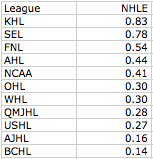
The last thing I want to address is the NHL Equivalency number included in the final chart.  These numbers are derived from a now gone-from-the-web Gabe Desjardins article, but Manny got his formula via Justin Azevedo:

chart

I have no doubt Desjardins put a lot of work into this, but as a cautionary tale for taking this chart as gospel, it predicts that Brandon Bochenski (KHL) is a 72-point producer at the NHL level (hell, Nigel Dawes is a 61-point player); or, for an AHL-example, Martin St. Louis should have been a 42-point NHL player.  I don’t think there’s a useful way to take statistics from one league and apply them to another, although it’s still fun to try.

This article is written by Peter Levi (@eyeonthesens)

European Free Agents of Interest

I’ve cast my eye on Europe the previous two years (2012 and 2013), and with the recent signing of DEL star David Wolf (Calgary) I thought I’d look again across the Atlantic and see what free agents might be worth pursuing.  The focus here isn’t aging veterans or former NHL players–I’m looking at lesser known, undrafted players who might make the jump.

Jan Kovar (LW/C), 24, 5’11 KHL Metellurg 54-23-45-68 (signed KHL; a player I highlighted in 2012)
The Czech player was second in league scoring, playing on a line with Sergei Mozyakin and Denis Zarpiov; he makes a lot of money in Russia and may not want to take the pay cut to get his shot in the NHL, but at some point he’ll pull a Roman Cervenka and take a year off to try it out

Sakari Salminen (RW/LW), 25, 5’11 KHL Torpedo 54-18-29-47 (signed KHL; player I identified in 2012)
Like most players who dominate in their domestic leagues, Salminen has made the transition to the KHL and enjoyed a great deal of success; leading Torpedo in scoring by nearly ten points (ahead of former NHLer Wojtek Wolski); I think there’s a good chance he’ll give the NHL a shot at some point

Dennis Rasmussen (C/LW), 23, 6’3, SHL Vaxjo 52-16-24-40 (signed SHL)
Enjoyed a career year leading Vaxjo in scoring; has good size which always makes GM’s happy; may not have an opt-out clause, but unless he goes for the money in the KHL he should land a deal with someone across the Atlantic [June 10th: Chicago signed him]

Michael Keranen (C/RW), 24, 6’1, Liiga Ilves 52-17-35-52 (signed, Liiga)
Nearly doubled his previous career high as he finished tied for the scoring lead in the Liiga; was nearly 20 points ahead of his nearest teammate–like Rasmussen above he’ll have to make the choice between the KHL and NHL, but undoubtedly he’s received calls from both [June 5th: Minnesota signed him]

Tommi Huhtala (LW), 26, 6’0, Liiga Blues 60-23-20-43 (signed KHL)
Locked into a KHL deal for the upcoming season; he lead the Blues in scoring while enjoying a career year; if he has a good season with Jokerit he might make the jump to the NHL, although at his age he may be beyond the point of wanting to play in the AHL

Julius Junttila (LW/RW), 22, 5’10, Liiga Karpat 56-19-15-34 (signed Liiga; a player I identified in 2012)
Set career highs with Karpat, where he finished fifth in team scoring; his numbers aren’t overwhelming, but he’s trending upwards and still very young

Borna Rendulic (RW), 22, 6’1, Liiga HPK 57-11-21-32 (FA)
Croatian national worked his way up through the Finnish junior system to establish himself as a Liiga-regular; he lead HPK in scoring

Ville Kolppanen (G), 21, 6’1, Liiga Ilves 2.18 .927
I believe he’s still eligible for the draft as an overage European, but I’ll include him here anyway; put up good numbers as Ilves’ starting goaltender

Players Signed from Previous Lists

Just a quick look back on those mentioned that appeared in previous versions of this list.  It’s worth noting the majority of players identified have not been signed.  There are far fewer European players who come over as compared to college, even though the dividends can be much higher (as you can see here).

Damien Brunner (RW) – signed with Detroit two years ago and after a strong rookie campaign struggled with New Jersey
Simon Moser (LW/RW) – signed an ELC with Nashville last season and spent most of the year in the AHL (48-8-18-26); he’s an RFA (I highlighted him in 2012)
Ronalds Kenins (LW) – signed by Vancouver last season to an ELC (I identified him in 2012), but was loaned back to Switzerland and enjoyed a career year (39-8-17-25); he should be in the AHL next season
Joel Vermin (C/W) – signed an ELC with Tampa last season (I highlighted him in 2013), but was loaned back to Switzerland where he struggled (49-6-12-18); his fate the following season is up in the air
David Wolf (LW) – signed by Calgary this week to an ELC (I identified him in 2012); DEL players tend not to translate well at the next level, although Marcel Muller was a decent AHL player

This article is written by Peter Levi (@eyeonthesens)

Thoughts on Senators Prospects (Part Two)

The second installment of my look at the Sens prospects (you can find Part One here).  After covering prospects in junior, college, and the ECHL, I’m taking a look at AHLers.  I have left out players who I don’t believe will return (like Wacey Hamilton), while players who are through their ELC’s who have established what they are (like Mark Borowiecki) are treated a bit further below (as is Cody Ceci, who spent most of his season in the NHL).  As always, for players without significant time in the NHL it’s worthwhile viewing the scouting reports when drafted (many of which can be found via the link above).

Cole Schneider (FA NCAA 2012; 69-20-34-54; previous season 60-17-18-35; splits 10-4-1-5/10-2-6-8/10-6-8-14/10-3-3-6/10-1-4-5/10-3-5-8/9-1-5-6)
An excellent sophomore campaign with only a few periods of inconsistency; so far Schneider has been an excellent free agent signing and all that remains to be tested is his capabilities at the next level–he can clearly dominate in the AHL.  Does he need to be a top-six player to pan out at the next level?  I think that remains to be seen–if he’s a possession guy then the goals aren’t the only way for him to step up.

Chris Wideman (4-100/09; 73-9-42-51; previous season 60-2-16-18; splits 10-1-7-8/10-1-3-4/10-1-7-8/10-2-10-12/10-1-4-5/10-0-3-3/13-2-8-10)
A fantastic sophomore season, slowing a little in the second half (32 points in the first 40, 19 in the next 33); undersized NCAA grad will always have to do more to get his shot, but another dominant AHL-season is going to force Ottawa’s hand.  It’s very rare for a small blueliner to play a depth role, so he has to push for at least a 4-5, second unit powerplay spot to have a realistic shot.

Matt Puempel (1-24/11; 74-30-18-48; splits 10-3-2-5/10-3-2-5/10-3-1-4/10-5-2-7/10-5-2-7/10-5-3-8/14-6-5-11)
First-rounder’s rookie season improved over the course of the season (went from 0.46 points-per-game in the first 30 to 0.77 the rest of the way); sniper projects as a top-six player who can eat up powerplay minutes, but whether he’ll achieve that potential is still up in the air (his ability at the AHL-level is not in question).

Shane Prince (2-61/11; 69-21-27-48; previous season 65-18-17-35; splits 10-2-2-4/10-3-5-8/10-2-5-7/10-6-4-10/10-3-2-5/10-3-3-6/9-2-5-7)
Improved over last season; his primary issue is inconsistency, but his tracking the right direction; I don’t know if Prince has the chops for the next level, but that possibility remains (perhaps as a pesky top-nine player).

Jean-Gabriel Pageau (4-96/11; 46-20-24-44; NHL 28-2-0-2; previous season 69-7-22-29; splits 10-5-9-14/10-2-4-6/10-2-8-10/16-11-3-14)
While his time in the NHL was a disappointment, he dominated in the AHL and his future remains bright; he’s not a lock for the NHL roster next season, but that league is in his future (even if he never produces enough to escape a bottom six role).

Mark Stone (6-178/10, 37-15-26-41; NHL 19-4-4-8; previous season 54-15-23-38; splits 10-4-4-8/10-6-6-12/10-3-9-12/7-2-7-9)
Injury-prone, but there’s no questioning Stone‘s hands or instincts; it remains to be seen if his feet are fast enough to be an NHL-regular, but he’ll get an opportunity to show that sooner than later.

Buddy Robinson (FA NCAA 2013, 69-15-16-31; splits 10-2-1-3/10-4-3-7/10-1-1-2/10-1-2-3/10-2-3-5/10-1-3-4/9-4-2-6)
The big winger gradually became more consistent over the course of his rookie season, which echoed Cole Schneider‘s last year; NHL-potential hasn’t been tested yet, but at the least he’s going to be a good AHLer.

Fredrik Claesson (5-126/11, 75-3-26-29; previous season 70-3-8-11; splits 10-0-0-0/10-0-5-5/10-1-6-7/10-1-8-9/10-0-1-1/10-1-1-2/15-0-5-5)
Steady Freddy enjoyed a fantastic sophomore season; defensively dependable, there’s no question he could at least fill-in at the NHL-level, so the question now is whether he can be a regular or not.

Corey Cowick (6-160/09, 72-12-13-25; previous season 72-16-19-35; splits 10-1-1-2/10-3-1-4/10-0-2-2/10-4-4-8/10-2-1-3/10-1-1-2/12-0-3-3)
After a successful season riding shotgun with Jean-Gabriel Pageau, everything came crashing to earth for Cowick who, other than a short stretch in December, put up awful numbers (even for a checker).  He’s clearly someone who needs to be insulated to perform at his best and that doesn’t bode well for an NHL future, even if he’s now fully established as an AHLer.

Derek Grant (4-119/08, 46-12-10-22; NHL 20-0-2-2; previous season 63-19-9-28; splits 10-3-3-6/10-3-1-4/10-0-2-2/16-6-4-10)
His numbers marginally improved over last season and he spent a good chunk of the early season in the NHL; projects as a PK forward and the upcoming season is going to be make-or-break for him (I don’t think he’ll be on the Sens roster, but he should dominate in the AHL no matter where he’s played).

Michael Sdao (7-191/09, 61-5-6-11; splits: 10-1-0-1/10-1-2-3/10-0-2-2/10-2-1-3/10-1-0-1/11-1-0-1)
Drafted as the best fighter of the 2009 class, his rookie season saw him eventually push Ben Blood out of the lineup, but not do enough to dress in the playoffs; he projects as a 5-6 guy.  His numbers are actually quite decent and he can do more with the puck than someone who is just a goon–the question remains if he can translate that to the next level and at this point it’s too early to tell.

Darren Kramer (6-156/11, 45-2-2-4; previous season AHL 21-1-0-1/ECHL 19-3-7-10; splits 10-1-1-2/10-1-0-1/10-0-1-1/15-0-0-0)
The best fighter in his draft class, he was a full-time roster player in his sophomore season, but dressed for only just over half the games–despite appearing in the playoffs, it’s clear his skill level isn’t high enough for him to fill anything other than the role of a fighter, something I don’t see him translating to the NHL.

Older/NHL Players

Cody Ceci (1-15/12; NHL 49-3-6-9; AHL 27-2-17-19)
First-rounder was locked into Ottawa’s lineup for the same kind of WTF reasoning that keeps Chris Phillips in the lineup; like most young defenseman there’s a lot growth yet to come and a full season in the AHL would likely help; an offense-first blueliner, the future should be bright for Ceci–the only question is when he’ll be ready for full-time NHL duty.

Mike Hoffman (5-130/09; AHL 51-30-37-67; NHL 25-3-3-6; previous season AHL 41-13-15-28)
He has nothing left to prove at the AHL level, so the question remains whether or not he can be a regular NHL player; I think he can–he has the speed and hands to be useful even if he can’t translate his scoring–the only question is whether he does this in Ottawa or not, and whether he’s someone who plays for parts of a few seasons and then disappears.

Stephane Da Costa (FA NCAA 2011; AHL 56-18-40-48; NHL 12-3-1-4; previous season AHL 57-13-25-38)
This was the first season where Da Costa looked like a (potentially) useful NHL player; I’m still not sure how well his skills translate, since I don’t think he’s particularly useful in a depth role and his production might not warrant anything else, but given that after last year I thought his peak was the AHL, he’s become a more interesting asset.

Mark Borowiecki (5-139/08; AHL 50-2-6-8; NHL 13-1-0-1; previous season 53-4-10-14)
Heart and soul player had a poor season–too many penalties, too many fights, sub par production, etc.  There’s no questioning his worth ethic, but the more I see of Borowiecki the more I’m convinced his peak is a 6-7 blueliner who is as good as he’s going to get right now.

David Dziurzynski (FA BCHL 2010; AHL 68-13-12-25; previous season AHL 54-4-16-20; NHL 12-2-0-2)
There’s nothing left for Dizzy to prove in the AHL–he’s a well-established checking forward whose numbers have been almost ruthlessly consistent (points-per-game per season: 0.26, 0.38, 0.37, and 0.36); is he good enough to perform the same role in the NHL?  I thought he looked out of place with Ottawa two season’s ago, but that’s not to say he couldn’t fit on a line in the right situation–although I’m dubious he’ll get that chance with the Sens.

This article is written by Peter Levi (@eyeonthesens)

Thoughts on Senators Prospects (Part One)

The signing of prospect Mikael Wikstrand on Thursday got me thinking about what we can expect from Ottawa’s many prospects.  Given the great multitude this will be done in two parts.  I’m leaving out players like RFA Ben Blood (he won’t be retained), Francois Brassard (the organisation has made it known they have no intention of signing him), or the injured Jarrod Maidens.  Acronym of note for players in pro: ppg = points-per-game.  Players who will be playing pro next season have been coloured green.

CHL Prospects

It’s worth noting here that production (unless it’s bad) doesn’t mean much at this level; Tyler Donati was an OHL star and couldn’t manage to become an AHL-regular, so keep that in mind.  Scouting reports are much better guides to these players and you can find most of them by draft year: 20102011, 2012, and 2013.

Curtis Lazar (1-17/13; WHL 58-41-35-76; previous season 72-38-23-61)
The scouting consensus was that the first-rounder was a solid, well-rounded second-line player and nothing from this season would suggest otherwise.  His numbers were up from his draft year and he performed very well at the WJC.  The organisation has talked about him making the jump to the NHL next season, but there’s no reason (beyond budget) to rush him into the lineup.

Vincent Dunn (5-138/13; QMJHL 50-31-20-51; AHL 1-0-0-0; previous season 53-25-27-52)
Super pest dropped a long way in the draft; his numbers were essentially unchanged from the previous season and all the scouting reports project him as a pesky bottom six forward–nothing from this year has changed that estimation.

Ben Harpur (4-108/13; OHL 67-3-13-16; previous season 67-3-12-15)
Drafted primarily because he was big; a stay-at-home blueliner,  his limitations with the puck are going to make the transition to pro very difficult (his numbers did not improve over his draft year); I don’t believe the organisation will sign him when they have to make that choice next year.

Chris Driedger (3-76/12; WHL 28-14-7 2.64 .918; ECHL 1-2 3.92 .893; AHL no result; previous season 36-14-4, 2.51 .915)
Won the goaltending sweepstakes within the organisation by beating out sixth-rounder Brassard; scouting reports are all over the place and contradictory, largely because Driedger was not the full-time ‘tender in his draft year; his numbers have improved in each of the two season since he was drafted and he’s slotted in to play backup in the AHL (a backup at the NHL-level is where he projects out).

NCAA/USPHL

College scoring is more predictive at the minor pro level than that of the CHL, but it’s still not the best guide.  The various US junior systems are as potentially misleading as those in CHL.

Tim Boyle (4-106/12; USPHL 37-5-16-21; previous season NCAA 15-0-2-2)
The Sens surprise pick of the 2012 draft, Boyle left the NCAA after a year at Union College to go back into the US junior system; his numbers were good, but not dominant (ala former Sens prospect Bryce Aneloski who did the same thing); there’s a lot of time left for him to develop so it’s too early to judge him, but there’s a lot for him to prove.

Ryan Dzingel (7-204/11; NCAA 37-22-24-46; AHL 9-2-5-7; previous season 40-16-22-38)
Left college early (after three seasons) to turn pro; another skilled player who fell in the draft (his second) because of his size and lack of physicality; after dominating at Ohio State he did not look out of place in his short debut with Binghamton; is he another Ryan Shannon, or is he something more than that?  It’s difficult to judge at this point.  The challenge for all top scorers when they turn pro is can they do anything else if their scoring doesn’t translate.

Max McCormick (6-171/11; NCAA 37-11-24-35; previous season 40-15-16-31)
Teammate of Dzingel and drafted in the same year; he has been very good at Ohio, albeit not quite as electric as the above; he”ll finish up his college career before turning pro; he’s a hard-working player who projects as a depth, energy player.

Garrett Thompson (FA 2013; NCAA 43-16-16-32; AHL 7-1-2-3; previous season NCAA 37-11-15-26)
Free agent signee from Ferris State I don’t know enough about to project–he was not on the radar when he was draft eligible and has been described as a meat and potatoes type of player, so projects as a depth forward.

Robert Baillargeon (5-136/12; NCAA 35-10-17-27; previous season USHL 55-18-23-41)
Lead Boston U in scoring in his rookie season, benefitting from a more settled season than his last in the USHL; his stock fell at the draft due to a lack of “toughness”, but all the things that actually matter (speed, skill with the puck) are present and were demonstrated this season.  I think to his the highest level he’ll have to become an Erik Condra; a depth player with good possession numbers.

Quentin Shore (6-168/13; NCAA 33-7-18-25; previous season 39-10-9-19)
A solid season at U Denver; drafted as a two-way player and something of a gamble, we’re still a few years away from judging him.

Chris Leblanc (6-161/13; NCAA 23-6-6-12; previous season EJHL 44-13-20-33)
A surprise draft pick enjoyed a solid rookie season with Merrimack; there were no scouting reports on him beyond the organisation describing him as a “big two-way player”; he’s a long way away, but projects as a depth player.

Europe

Much like the CHL above, production does not mean much except in absence here.

Mikael Wikstrand (7-196/12; SHL 19-4-7-11; Alls 27-4-16-20; previous season Alls 45-11-14-25)
Benefitted the previous season from playing with lockout players like Anze Kopitar, but this year he not only maintained but improved his production in the absence of NHL superstars.  Scouting reports when drafted all indicated he was a good, two-way player (his 3 points in his draft year seem the primary reason he nearly fell out of the draft), but his performance as a powerplay quarterback eluded everyone (including the Sens organisation).  He should do well in Binghamton this upcoming season, although the usual switch to smaller ice might lead to a slow start.  He was projected as a bottom-pairing NHL player, but if his offense translates he might also be a second unit PP guy.  Time will tell.

Tobias Lindberg (4-102/13; SuperElit 38-7-15-22; Alls 3-0-0-0; previous season SuperElit 43-9-13-22)
An off-the-wall pick last year, Lindberg‘s numbers improved only slightly from his draft year (ppg went from 0.51 to 0.57) and I think his future is heavily tied into how he does next season.  I have a suspicion he’ll wind up being Marcus Sorensen (4-106/10)–an energy player whose skills don’t quite translate outside of Europe.

Marcus Hogberg (3-78/13; Alls 5-8-0 2.93 .892; SHL 4-0-0 1.08 .960; previous season SuperElit 2.77 .906)
Scouts struggle to figure goaltenders out (have some fun and scan goaltending picks from any draft), so what little was said about Hogberg at the draft was all over the place; his numbers weren’t great this season for Mora in the Allsvenskan, but he was fantastic in the SHL and one wonders how much of his stats are dependent on the defense in front of him.  He’ll spend another year in Sweden, but I’d expect him to come to Binghamton in 15-16.

ECHL Prospects

Elmira just finished a disastrous season (24-40-8, third worst in the league), which is their last season in affiliation with Ottawa (no official replacement has been named for the Sens).  The Jackals produced the second fewest goals in the league and allowed the second most–it was an unmitigated disaster and that’s worth keeping in mind for the players below.

Troy Rutkowski (FA WHL 2013, ECHL 41-0-9-9 PPG 0.21; AHL 12-1-0-1; ECHL splits 10-0-3-3/10-0-2-2/10-0-1-1/11-0-3-3)
The disaster that is Troy Rutkowski makes it clear why Colorado walked away from him (5-137/10) last year.  Now, it’s possible that he could turn into a decent AHL player (and certainly he might have a future bouncing around Europe), but NHL-calibre players don’t struggle in the ECHL.  With plenty of opportunity in Elmira, the offense-minded blueliner was unable to translate his CHL success.  Yes, the Jackals had a terrible season and a bad team, but that didn’t prevent other prospects from performing adequately.  There was no sign of evolution of his play over the season (his production did not increase).  Ottawa is stuck with Rutkowski‘s contract for two more seasons and given the thinness of their blueline in Binghamton he’ll probably get one more try before they attempt to move him.

Jakub Culek (3-76/10; ECHL 49-8-22-30 PPG 0.61; AHL 7-0-0-0; ECHL splits 10-3-6-9/10-1-5-6/10-4-5-9/10-0-4-4/9-0-2-2)
Enjoyed a moderately successful rookie season in Elmira, although he faded badly down the stretch (18-0-4-4).  I don’t think there’s any NHL potential in him (when drafted he projected as a depth, checking forward), but he could become a solid bottom-six forward in the AHL.

Ludwig Karlsson (FA NCAA 2013; ECHL 39-11-13-24 PPG 0.61; AHL 8-0-0-0; ECHL splits 10-2-2-4/10-2-5-7/10-2-4-6/9-5-2-7)
Did not perform as expected (you don’t sign a college free agent to play in the ECHL), but at least in Elmira he was decent (other than the games immediately after his injury).  His season was derailed early and he got stuck behind a huge logjam at forward–next season will be make-or-break for the Swede.

This article is written by Peter Levi (@eyeonthesens)

Binghamton falls to Wilkes-Barre

Just like last year, the B-Sens playoffs ended with a whimper against the Penguins (losing the series 3-1, as the AHL has five-game series to open the playoffs for whatever reason).    Three of the games were one-goal decisions and there are a few things that stand out to me about the series (Jeff Ulmer has offered his thoughts as well).

1. Four of the five Penguins who dominated in the series were older players (30s), most with a ton of NHL experience: Tom Kostopoulos (630), Chuck Kobasew (601), and former B-Sen Andrew Ebbett (200); goaltender Peter Mannino is a six-year AHL vet.

2. Lack of secondary scoring: once Wilkes-Barre shut down Mark Stone and Stephane Da Costa, Binghamton was not able to generate enough offence.  With Mike Hoffman and Matt Puempel unable to participate, secondary scoring dried up from Cole Scheider, Shane Prince, and Jean-Gabriel Pageau (one wonders if the team might have benefitted from keeping Andre Petersson in that respect).

3. Defensive struggles: new additions Alex Grant and Patrick Mullen did not make the difference needed (the former in particular); I believe Chris Wideman played with an injury so his struggles didn’t bother me as much; Cody Ceci, just like in the NHL, needs to put more work in.

4. Penalties: while officiating is extremely erratic, the B-Sens followed their parent club in taking a ridiculous number of penalties–wearing down their PK players and their goaltender.  I believe the organisation does not do enough to punish players who continual take stupid penalties (case in point: Chris Neil).

5. Goaltending: Andrew Hammond could not win a game for his team this series, which was something they clearly needed.

In the end there was no single fatal flaw–a lot went wrong for Binghamton.  The result does not take away from what was a very successful season.  Ottawa has always treated its AHL-affiliates as a development project where winning is nice, but not something to do at all costs.  The older Wilkes-Barre lineup was much more suited to winning in the playoffs, as team’s that win championships in the AHL always have an abundance of older players leading the way.  Whether or not the experience of losing aids anyone’s development is unknown (I’ve never seen a study on it, so anything anyone says about it is purely speculative).  The same, oddly, goes for winning.  Players with Calder Cup rings do not receive any sort of definitive development boost either.

The team has lot’s of rosters decisions to make for next year, but will at least begin jettisoning some dead weight (Tyler Eckford, Ben Blood, Wacey Hamiltion, and Jim O’Brien at least).  There’s still a lack of depth on the blueline, although if they can bring Mikael Wikstrand over (which seems unlikely given his contract with Frolunda) that would help exponentially.

This article is written by Peter Levi (@eyeonthesens)

Binghamton Senators: Regular Season Review

Binghamton’s regular season has wrapped up and it’s time to take a quick look at the East Division champs and how the players on the roster performed.  The team finished 44-24-8 (virtually their exact record from last season), setting up a re-match with the Wilkes-Barre Penguins who upset them last year.  The B-Sens were the highest scoring team in the AHL, their 276 goals (+49 from last season) far above most team’s in the league and 18 more than their closest competitor (St. John’s); on the flip side they allowed the most goals in the Eastern Conference (232; up 44 from last season).  Below I’ve graded each player specifically for their play in the AHL (for last year’s examination go here); acronyms ppp=powerplay points, ppg=points-per-game; I put RFA’s in green and UFA’s in red.  Grade rationale is simple: A – above expectations, B – met expectations, C – didn’t grow, but didn’t decline, D – below expectations, F – awful.

Mike Hoffman RFA (5-130/09) 51-30-37-67 ppp 35 ppg 1.31 [NHL 25-3-3-6] Grade: A
Finally experienced the explosion in production that I expected last year and made a legitimate push to be considered an NHL player; he lead the team in points, goals, and powerplay points; he has pro speed and good hands, but the question remains is he Ryan Shannon or something more?
Stephane Da Costa RFA (NCAA FA/11) 56-18-40-58 ppp 27 ppg 1.04 [NHL 12-3-1-4] Grade: A
Also produced as I’d expected in the previous season and showed firmer glimmers of NHL potential (with solid underlying numbers–ala Hoffman, although Travis Yost seems to have backed off in relation to Da Costa in his year-end grades); doesn’t have the blazing speed of Hoffman, but good hands and offensive instincts–fitness has been a problem and the question remains how well his skills translate
Cole Schneider RFA (NCAA FA/12) 69-20-34-54 ppp 15 ppg 0.78 Grade A
The organisation doesn’t always hit homeruns with their FA college signings and while Cole’s translation at the next level remains unknown, he’s improved leaps and bounds over his rookie season; his hands stand out most (both shooting and passing)
Chris Wideman RFA (4-100/09) 73-9-42-51 ppp 30 ppg 0.70 Grade A
A fantastic sophomore season by the blueliner (leading the team in assists) whose size might be his chief impediment to getting a taste at the next level–smaller defenseman have to be quick and proactive
Matt Puempel (1-24/11) 74-30-18-48 ppp 18 ppg 0.65 Grade B
An excellent rookie season for the first-rounder, who on a team with less depth likely would have posted even better numbers; good speed and great hands
Shane Prince (2-61/11) 69-21-27-48 ppp 10 ppg 0.70 Grade B
A modest improvement over last year including struggles to start the season, but he did lead the team in even strength scoring despite rumours he demanded a trade; a smaller player he has more to prove, particularly given how many undersized forwards compete with him in the organisation
Jean-Gabriel Pageau (4-96/11) 46-20-24-44 ppp 12 ppg 0.96 [NHL 28-2-0-2] Grade A
Many expected him to spend the entire season in Ottawa (I was not among them) and while he wasn’t particularly good in the NHL he was excellent in Bingo; excellent speed and defensively responsible
Mark Stone (6-178/10) 37-15-26-41 ppp 18 ppg 1.11 [NHL 19-4-4-8] Grade A
Last season’s leading scoring, the injury-prone Stone put up good numbers again (with the same underlying NHL numbers of Hoffman and Da Costa above); he’s second on the roster in points-per-game; doesn’t have great footspeed, but a heady player with great hands
Alex Grant UFA (4-118/07 Pit) 71-9-28-37 ppg 0.52 Grade B
Acquired in a trade from Norfolk to solidify the blueline and he has proven a solid addition; savvy veteran has posted consistent numbers
Patrick Mullen UFA (NCAA FA/09 LA) 66-8-24-32 ppg 0.48 Grade C
Another deadline acquisition for defensive depth, this time from Utica; a decent all-around player
Buddy Robinson (NCAA FA/13) 69-15-16-31 ppp 0 ppg 0.45 Grade B
Like Schneider he’s another early NCAA departure with a lot of raw tools; an up and down rookie season, but solid overall as he trends upward; good speed for a big man along with soft hands
Jim O’Brien UFA (1-29/07) 51-11-18-29 ppp 4 ppg 0.57 Grade F
Pissed off the organisation enough to bury him in Bingo with a one-way contract; middling numbers given his past performance (I’d been told he’d been sent home, but now hear he’s practicing with the team and could play)
Fredrik Claesson (5-126/11) 75-3-26-29 ppp 0 ppg 0.39 Grade A
Excellent sophomore campaign from the defensive defenseman; continues to grow in leaps and bounds, keeping his game simple
David Dziurzynski RFA (BCHL FA/10) 68-13-12-25 ppp 0 ppg 0.37 Grade C
Seems to have plateaued and his future as a depth player in the NHL is very much in doubt
Corey Cowick RFA (6-160/09) 72-12-13-25 ppp 0 ppg 0.35 Grade C
Without riding shotgun with JJP his numbers plummeted and whatever hints of NHL-potential fell with them; seems to be missing some of the elements needed to become a depth NHL-forward
Derek Grant RFA (4-119/08) 46-12-10-22 ppp 3 ppg 0.48 [NHL 20-0-2-2] Grade C
His unexpected NHL call-up did not yield better AHL-returns; his numbers are only slightly better than last year; he apparently developed an attitude after his time in Ottawa; projects as a depth penalty killer and there’s still time for that to happen
Wacey Hamilton RFA (WHL FA/11) 63-4-16-20 ppp 0 ppg 0.32 Grade C
The org has missed badly in their free agent CHL-signings and I’m still scratching my head over what they thought they were getting in Hamilton
Cody Ceci (1-15/12) 27-2-17-19 ppp 6 ppg 0.70 [NHL 49-3-6-9] Grade B
A good albeit short rookie season for the first-rounder, whose time in the NHL was rocky; has all the offensive tools, but defensive play still needs work
Daniel New (NCAA FA/12 AHL) 31-1-12-13 ppp 4 ppg 0.42 [ECHL 22-2-9-11] Grade C
Any time an ECHL defenseman plays over 30 games and gets powerplay time you know you have a weak blueline
Michael Sdao RFA (7-191/09) 61-6-5-11 ppp 1 ppg 0.18 Grade C+
The best fighter in the 2009 draft, Sdao will look to continue to grow into a depth defenseman (unlike Blood below)
Mark Borowiecki (5-139/08) 50-2-6-8 ppp 0 ppg 0.16 [NHL 13-1-0-1] Grade C
A season marred by injury, poor production, and taking too many penalties; gritty blueliner is at his best a #6 in the NHL
Ryan Dzingel (7-204/11) 9-2-5-7 ppp 1 ppg 0.78 Grade incomplete
Did not look out of place as he left the NCAA; has great hands and head for the game
Darren Kramer (6-156/11) 45-2-2-4 ppp 0 ppg 0.09 Grade D
The toughest fighter in the 2011 draft, it looks doubtful he can do much more than that at the AHL-level
Tyler Eckford UFA (7-217/04 NJ) 32-0-4-4 ppp 0 ppg 0.12 Grade F
Awful last year, he was somehow even worse this season–a terrible signing (like O’Brien he’s apparently been sent home)
Garrett Thompson (NCAA FA/14) 7-1-2-3 ppp 0 ppg 0.43 Grade incomplete
NCAA free agent was solid in his brief debut
Danny Hobbs (NCAA FA/12 AHL) 13-1-2-3 ppp 0 ppg 0.23 [ECHL 52-17-18-35] Grade incomplete
ECHL call-up had 2 points in his first game and 1 in his next 12–enough said
Ben Blood RFA (4-120/07) 54-0-3-3 ppp 0 ppg 0.06 Grade F
I’m amazed he dressed for more than half the season; no offensive tools and despite his size isn’t particularly aggressive
Troy Rutkowski (WHL FA/13) 12-1-0-1 ppp 1 ppg 0.08 [ECHL 41-0-9-9] Grade F
Was awful in the ECHL as well and could well join the long line of bad CHL free agent signings for the organisation; a puck-mover at the junior level he was unable to bring that into the pro game
Vincent Dunn (5-138/13) 1-0-0-0 Grade incomplete
One game is just not a big enough sample size
Jakub Culek (3-76/10) 7-0-0-0 [ECHL 49-8-22-30] Grade F
Was solid in the ECHL, but I’m not sure there’s more to him
Ludwig Karlsson (NCAA FA/13) 8-0-0-0 [ECHL 39-11-13-24] Grade F
A lot more has to be expected from an NCAA free agent–he needs to be better

Andrew Hammond (NCAA FA/13) 25-19-3 2.81 .910 [NHL 1 game, no result] Grade B
A solid year for the rookie, who sported better numbers than Lawson; proved he has AHL-chops, but whether he can be more is an open question
Nathan Lawson UFA (NCAA FA/07 ECHL) 15-8-1 3.05 .908 [NHL 1 game no result] Grade C
Mr. Glass was often on the shelf, but solid when he appeared (he’s finished for the season due to injury)
Scott Greenham (NCAA FA/11 AHL) 4-0-1 2.57 .912 [ECHL 8-15-3 3.21 .904] Grade B
ECHL ‘tender looked good in limited duty–better than he did on an awful Elmira team
Chris Driedger (3-76/12) 4.58 .909 [ECHL 1-2-0 3.92 .893] Grade incomplete
You can’t judge from him playing part of one game

It was another successful season in the AHL as Binghamton has a good chance to go deep in the playoffs.  There are no future NHL stars playing here, but there are a number of NHL-caliber players and worthwhile call-ups which is a compliment to the now-departed Tim Murray, Luke Richardson, and the scouting staff.  The main issue for the organisation is their hit-and-miss veteran signings and their swings for the fences with CHL free agents.

This article is written by Peter Levi (@eyeonthesens)

NHL Draft Success (2005-08)

There have been a few articles reviewing draft accuracy over the years (like TSN’s Scott Cullen‘s awhile back) and as engaging as they are I’ve always had problems with the way they are constructed. Examinations of the draft that cover a long period of time fail to account for the changes in the league and the draft itself, so the comparisons just don’t work. When articles cover more recent drafts (Hockey Futures does them at five-year intervals) they are forced to make judgement calls on players whose futures are yet to be defined (for example, Colin Greening hadn’t started his pro career by that time; Carl Soderberg didn’t until he was 27). All this preamble is to make two key points: 1) the attitude and approach to the NHL draft changed seismically after the 2004-05 lockout (due to the cap), 2) the typical make-or-break moment for a draft pick varies considerably.  On top of that, the raw overview I’m about to give is simply a window into the study, since I can’t account for management changes or know how much money/emphasis is being allocated on scouting by each team, nor am I comparing the quality of those players beyond being useful at the NHL level.  What follows is a very broad examination of levels of success within the draft.  I’ve cut off at 2008 because even the ’09 draft class still hasn’t completed their cycle of development (even ’08 has a certain level of ambiguity).  All of this presupposes the importance of the draft, something that could not be assumed at certain points in NHL history.

My framework: what is a successful pick?  Any skater who has played 200+ NHL games (along with some judgement calls, particularly when it comes to goaltenders).  With that many games the player has managed at least two and a half seasons of NHL work and that’s a solid return on the investment.

2005 (here)

First Round
17 players have played 200+ games (I’m including Tuukka Rask), including 8 of the top-10 (Luc Bourdon tragically died and is the only exception).  Only 3 players never suited up in the NHL (Marek Zagrapan #13, Sasha Pokulok #14, and Alex Bourret #16); 6 other players (excluding Bourdon) played less than a full season, leaving 4 other players as middling returns with only Jack Skille (#7) likely to crest the 200 game barrier.
Second Round
8 players hit 200+ games (the best are James Neal #33 and Paul Statsny ##44), with 12 never suiting up and another 8 having yet to play a full season’s worth of games.  There are no players who seem likely to break that 200 barrier.
Third Round
4 players hit the mark (the best are Kris Letang #62 and Jonathan Quick #72); 12 never played, with another 10 not getting a full season’s worth.  Two players (Mark Fraser #84 and Ben Bishop #85) could break the 200 mark.
Fourth Round
6 players have reached the plateau (the best is Keith Yandle #105); 17 never played, with another 10 short a season; no one else will reach the barrier.
Fifth Round
4 players hit the mark (the best are Darren Helm #132 and Nathan Gerbe #142); 24 never played, with another 6 not reaching a full season; Ryan Reaves (#156) will make it 5 players next season.
Sixth Round
Only Matt D’Agostini qualifies, with Tim Kennedy having a slight chance to join him; 24 players never played with another 6 failing to get a full season.
Seventh Round
4 players reached the plateau (all serviceable players); 26 players never played, with another 4 not reaching a full season; Joe Vitale (#195) could hit 200 games.

Here’s the success by team (I’ve included those players destined to break the plateau):
4 – Columbus, Montreal
3 – Detroit, Dallas
2 – Pittsburgh, San Jose, Ottawa, Los Angeles, New York Rangers, Phoenix, Toronto, St. Louis, Nashville, Buffalo, Chicago
1 – Anaheim, Carolina, Minnesota, Edmonton, Philadelphia, Atlanta/Winnipeg, Colorado, Vancouver, Boston, New Jersey
0 – Washington, New York Islanders, Florida, Calgary, Tampa Bay

2006 (here)

First Round
19 players hit the plateau, including all of the top-ten picks; again 3 players did not suit up for an NHL game (Mark Mitera #19, David Fischer #20, and Dennis Persson #24), and 7 players did not play a full season; only Jonathan Bernier (#11) will achieve “success” status by my metric.
Second Round
9 players (I’m including Michal Neuvirth) hit the mark; 14 players never played, with another 6 never have played a full season’s worth of games.
Third Round
Only 3 players reached the plateau (Steve Mason #69, Brad Marchand #71, and Cal Clutterbuck #72); 16 never played, with another 5 not having hit a full season; it’s possible another player might hit the mark, but none are assured of it.
Fourth Round
Just 1 player (Matt Beleskey #112) meets the criteria, although I’ll include James Reimer (#99); 22 players never played, 6 others falling short of a season.
Fifth Round
No player has hit or will hit the 200 game-mark (or even 100); 23 never played.
Sixth Round
3 players hit the mark (Andrew MacDonald #160, Viktor Stalberg #161, and Mathieu Perreault #177); 23 prospects never played, with another 4 not getting a season’s worth of games.
Seventh Round
2 players qualify (Derek Dorsett #189 and Erik Condra #211); 24 players never played with another 4 not getting a season’s worth.

Here’s the success by team (I’ve included those players destined to break the plateau):
4 – Washington, Toronto
3 – Boston, Columbus
2 – St. Louis, New York Islanders, Minnesota, Ottawa, Los Angeles
1 – Pittsburgh, Chicago, Phoenix, Florida, Atlanta/Winnipeg, Vancouver, Colorado, Philadelphia, San Jose, Edmonton, Detroit, New York Rangers, Buffalo, Carolina, Anaheim
0 – Tampa Bay, Montreal, Calgary, New Jersey, Dallas, Nashville

2007 (here)
First Round
15 players hit the mark, including 8 of the top-ten; 5 picks never played a game (Alexei Cherepanov #17 died; Logan MacMillan #19, Angelo Esposito #20, Patrick White #25, and Nick Ross #30), with another 4 playing less than a full season; 4 players seem likely to reach the plateau (Tomas Hickey, Ian Cole, Riley Nash, and Brendan Smith).
Second Round
4 players have reached the plateau; 15 never played a game, with 9 more short a full-season.
Third Round
No player has reached 200 games yet, although 3 players have a good shot at it (Drayson Bowman #72, Yannick Weber #73, and Alex Killorn #77); 16 players never suited up, while 8 have yet to achieve a full-season.
Fourth Round
2 players qualify (Alec Martinez #95 and Matt Halischuk #117); 16 never played, with another 8 not achieving a full-season’s worth of games; Dwight King (#109) and Keith Aulie (#116) should join the other two after next season.
Fifth Round
1 player (Jamie Benn #159) reaches the mark; 23 have never played, while 5 have fewer than a season’s worth of games; Jake Muzzin (#141) seems likely to also hit 200 games.
Sixth Round
No one qualifies, although both Carl Hagelin (#168) and Nick Bonino (#173) will get there; 18 prospects never played, while 8 haven’t reached a season’s worth of games.
Seventh Round
2 players (Carl Gunnarsson #194 and Justin Braun #201) reached the mark; 25 have never played with another 2 not reaching a season’s worth of games.

Here’s the success by team (I’ve included those players destined to break the plateau):
4 – Los Angeles, Montreal
3 – San Jose, St. Louis
2 – Edmonton, Carolina, Colorado
1 – Chicago, Philadelphia, Phoenix, Washington, Columbus, Florida, Detroit, Nashville, Tampa Bay, Calgary, New Jersey, Dallas, Pittsburgh, New York Rangers, Toronto
0 – Ottawa, Boston, Anaheim, Vancouver, Buffalo, Atlanta/Winnipeg, New York Islanders, Minnesota

2008 (here)
First Round
16 players have reached 200 games, including 9 of the top-ten; four prospects never played (Kyle Beach #11, Chet Pickard ##18, Anton Gustafsson #21, and Daultan Leveille #29), with another 6 having less than a season’s worth of games; Jake Gardiner (#17) will join the 200 club next season.
Second Round
2 players (Derek Stepan #51 and Travis Hamonic #53) have reached the plateau, with Vyacheslav Voinov (#32), Roman Josi (#38), Justin Schultz (#43), and Marco Scandella (#55) locks to join them (Patrick Wiercioch #42 should as well); 8 players have never suited up, with another 13 short of a full-season.
Third Round
Again 2 players (Zack Smith #79 and I’m including Adam Henrique #82); 19 prospects never made it, with another 6 short of a full season.
Fourth Round
No one has reached 200 games, although Dale Weise (#111), T. J. Brodie (#114), and Gustav Nyquist (#121) should get there and I’d count Braden Holtby (#93); 16 players never suited up, with another 9 falling short of a full season’s worth of games.
Fifth Round
Only Matt Martin (#148) has hit the mark, although Andrei Loktionov (#123) and Matt Calvert (#127) should join him; 18 prospects never played, with another 8 short of a full-season.
Sixth Round
1 player qualifies (Jared Spurgeon #156), but Cam Atkinson (#157) and Tommy Wingels (#177) will join him next season; 20 players never suited up, while another 5 are short a full-season’s worth of games.
Seventh Round
Only Jason Demers (#186) hits the mark; 23 have never played with another 4 without a full-season; I’ll include Anders Lindback (#207) as well.

Here’s the success by team (I’ve included those players destined to break the plateau):
4 – New York Islanders
3 – Los Angeles, Nashville, Ottawa, New York Rangers
2 – Buffalo, Anaheim, Washington, Columbus, San Jose
1 – Tampa Bay, Atlanta/Winnipeg, St. Louis, Toronto, Phoenix, Vancouver, Philadelphia, Edmonton, Minnesota, New Jersey, Calgary, Detroit
0 – Chicago, Carolina, Boston, Florida, Colorado, Montreal, Dallas, Pittsburgh

Overview

Here’s the round-by-round success rate:
First: 63/120 (52.5%)
Second: 28/123 (22.7%)
Third: 14/120 (11.6%)
Fourth: 16/124 (12.9%)
Fifth: 10/127 (7.8%)
Sixth: 9/123 (7.3%)
Seventh: 11/128 (8.5%)

The scaling between rounds is not surprising.  Of the 39 top-ten picks (excluding Bourdon for obvious reasons), only 4 were misses, making them 89.7% reliable.  Excluding the top-ten picks, the first round is still significantly stronger than the second round (28/79, 35%, excluding Cherepanov for the same obvious reason).  The third and fourth, and then fifth-seventh rounds are roughly all on equal footing in terms of results.  Given the lack of decline after the second round there are clearly missing factors in the way NHL teams scout (otherwise the trend should go downward each round consistently), albeit the above data is a small sample (just four years).

Team Performance
Los Angeles 11
Columbus 10
Montreal, San Jose, Toronto, St. Louis 8
Ottawa, New York Rangers, Washington 7
Detroit, Nashville, New York Islanders 6
Phoenix, Buffalo, Edmonton 5
Dallas, Pittsburgh, Chicago, Anaheim, Carolina, Minnesota, Philadelphia, Colorado, Boston 4
Atlanta/Winnipeg, Vancouver, New Jersey 3
Florida, Calgary, Tampa Bay 2

It’s difficult to imagine any scouting staff could completely whiff on an entire year, but awful organisations of the time are on display among the bottom-feeders here.  It’s interesting that LA is in the midst of benefitting from excellent scouting right now, whereas Columbus is experiencing much more modest gains from their success (here’s where the difference between quality of players manifests itself most clearly).  It seems like a good year for scouts is 2 NHL players (more than that is excellent), while there should always be at least one found.

My hope is that others will dig a little deeper into the draft and glean a bit more the how and why behind the numbers–a few basic factors (poor coverage of Europe and the dismissal of smaller players) are clearly a factor (as explored here in a look at undrafted success stories).

This article is written by Peter Levi (@eyeonthesens)

Wrapping up Ottawa’s 2013-14 Season

It’s time to clean up the blood and entrails of the Sens 2013-14 season, the one Rob Vollman was convinced would result in a President’s Trophy for the Sens.  Looking back Daniel Alfredsson‘s decision to jump ship for Detroit has paid off, while the Sens inability to release dead weight like Chris Neil and Chris Phillips remains as inexplicable as management trading for Matt Kassian last year (hard to believe he played 33 games this year).

Ottawa finished 37-31-14, putting them fifth in their division, eleventh in the conference, and twenty-first in the league.  The Sens won’t benefit from a top-ten pick as they peddled it for Bobby Ryan over the summer and as the 2014 draft class is considered weak, I’m not sure how much they’ll profit from their other selections.  Assistant GM Tim Murray was allowed to jump ship to Buffalo mid-season, which was good for Tim, but a rather odd move for the organisation given how integral he was for their prospects and system.  This was a season that saw Mika Zibanejad demoted to Binghamton for no particular reason while penny-pinching ownership buried Jim O’Brien‘s one-way contract in the minors (if the guy is such a disturbance loan him to Europe or another AHL team–Binghamton was an odd choice).

Reports that Jason Spezza will be moved seem to have a solid basis and whatever the merits of that decision (assuming they find a dance partner), I can’t help but look at his price tag and wonder how much the motivation to move him is attached to it.  For me, a player with chronic back problems is always an incident away from being out of the lineup anyway, so why not make the transition to Kyle Turris fronting the team (there’s no possibility of the Sens getting a #1 center in return for their captain).  Can the Sens keep Ales Hemsky without Spezza?  Time will tell, albeit Hemsky may not want to stick around for the gong show that is Eugene Melnyk.

The logjam on the blueline going into next season should see some player movement (it still boggles my mind that the Sens bothered signing Joe Corvo over the summer).  A lot of fans have latched onto Mark Borowiecki‘s one-way contract as making him being a lock on the team, which I don’t buy (besides the aforementioned O’Brien they also buried Corvo‘s salary in the AHL).  Murray has to make a decision on Eric Gryba (RFA) and there’s no guarantee Cody Ceci is in the lineup, but whatever the roster is I don’t think they’ll move Patrick Wiercioch who was so poorly used this season.

Speaking of reports/rumours, Paul MacLean may be on the hot seat.  It’s an easy out for management to lay the blame for a disappointing season on the coaching staff, but there actually were a lot of perplexing decisions this year (using the Chris‘ on the powerplay; MacLean’s addiction to the Greening-Smith-Neil line; etc).  Did the Sens miss the playoffs because of MacLean?  I don’t think so–ultimately that responsibility is on the roster and (therefore) management, but perhaps it’s time for a fresh voice.

I’ve included stats below (keep in mind plus/minus is meaningless); it’s bemusing that Erik Karlsson can think of his year as subpar–sure he can be better, but a middling year from EK is better than virtually every other defenseman.  Milan Michalek coming off the books is good–Mr. Glass is a good player, but the years have not been kind to him.  Of the young forwards who spent time in the NHL (Mark Stone, Mike Hoffman, Stephane Da Costa, Jean-Gabriel Pageau, and Derek Grant) it looks like Stone is most likely to make the jump next season.  I think Ottawa keeps Hoffman (he’s an RFA), but I can’t figure out if he’s Ryan Shannon or something more.  There’s a lot of talk about Curtis Lazar making the jump directly to the NHL (he can’t play in the AHL), but with a young player I take a wait and see attitude.

A little more generally, this year we saw analytics triumphantly predict Toronto’s failure, allowing older hack journalists (Steve Simmons, Damien Cox, etc) to embarrass themselves the entire season by mocking them.  Corsi, Fenwick, and all the other tools are in place are allowing fans (if not management) to understand what a player like Erik Condra accomplishes, along with exploding various long-held myths (like hits having any importance at all).


1. Erik Karlsson (D) 82 20 54 74 36 -15 |
2. Jason Spezza (F) 75 23 43 66 46 -26 |
3. Kyle Turris (F) 82 26 31 57 39 22 |
4. Clarke MacArthur (F) 79 24 32 56 78 12 |
5. Bobby Ryan (F) 70 23 25 48 45 7 |
6. Milan Michálek (F) 82 17 22 39 41 -25 |
7. Mika Zibanejad (F) 69 16 17 33 18 -15 |
8. Marc Methot (D) 75 6 17 23 28 0 |
9. Patrick Wiercioch (D) 53 4 19 23 20 -1 |
10. Zack Smith (F) 82 13 9 22 111 -9 |
.    
11. Cory Conacher (F) 60 4 16 20 34 8 |
12. Colin Greening (F) 76 6 11 17 41 -15 |
13. Ales Hemsky (F) 20 4 13 17 4 -2 |
14. Erik Condra (F) 76 6 10 16 30 0 |
15. Jared Cowen (D) 68 6 9 15 45 0 |
16. Chris Phillips (D) 70 1 14 15 30 -12 |
17. Chris Neil (F) 76 8 6 14 211 -10 |
18. Eric Gryba (D) 57 2 9 11 64 9 |
19. Joe Corvo (D) 25 3 7 10 10 -7 |
20. Cody Ceci (D) 49 3 6 9 14 -5 |
21. Mark Stone (F) 19 4 4 8 4 5 |
.    
22. Mike Hoffman (F) 25 3 3 6 2 -2 |
23. Stéphane Da Costa (F) 12 3 1 4 2 2 |
24. Jean-Gabriel Pageau (F) 28 2 0 2 12 -5 |
25. Matt Kassian (F) 33 1 1 2 63 -1 |
26. Derek Grant (F) 20 0 2 2 4 -3 |
27. Mark Borowiecki (D) 13 1 0 1 48 -2 |
1. Andrew Hammond 1 0.00 1.000 |
2. Nathan Lawson 1 10.00 .800 |
3. Craig Anderson 53 3.00 .911 |
4. Robin Lehner 36 3.06 .913 |

This article is written by Peter Levi (@eyeonthesens)

Senators News: April 9th

Both Ottawa and the Leafs were officially eliminated last night, a fact Sens fans have accepted for a while, but Leafs fans are having difficult times coming to terms with.  It’s difficult to encapsulate how badly Ottawa’s management misjudged their roster this year and I’m sure even in a bad draft Bryan Murray wishes he had his pick back.  This doesn’t mean the Sens will be as bad next year, but it should temper expectations.

Manny looks at the reasons why the Sens failed to make the playoffs this year and points to the following: goaltending, possession, penalties, and player usage.  Three of those four are heavily influenced by coaching (Travis Yost also looks at shot blocking, which also falls under this umbrella), so Paul MacLean should be under the microscope.  Will he be fired?  Some are making the financial argument that they won’t want to pay MacLean not to coach (of course, if he’s hired elsewhere that obligation disappears), but a successful team is far more valuable to ownership and if they believe that can happen with another coach, a change will be made.

Elliotte Friedman explores the futures of Jason Spezza and Bobby Ryan with the Sens and Nichols (via the link) would rather both be moved than simply maintain the status quo.  Given the organisations odd obsession with veterans (Neil and Phillips), perhaps the status quo is exactly what we’ll get.  I really don’t know what to want from the situation, althoughSpezza is disposable given his chronic back problems.

The Sens are trying to trade the rights of Francois Brassard (6-166/12), although it’s hard to imagine what they would get back if they can find a dance partner (not much presumably).  Brassard is a victim of numbers, behind the just-signed Chris Driedger and 2013 draft pick Marcus Hogberg.

Peter Morrow looks at the Sens Swedish and NCAA prospects where he includes a little scouting information, but not where he got it from (it isn’t noted, so I’d take it with a grain of salt).

Speaking of prospects, here’s an update (signed players are in italics):

SHL
Mikael Wikstrand (Frolunda, D) 20-4-7-11

NCAA
Ryan Dzingel (Ohio, C) 37-22-24-46
Max McCormick (Ohio, LW) 37-11-24-35
Robert Baillargeon (BU, C) 35-10-17-27
Quentin Shore (Denver, C) 33-7-18-25
Chris Leblanc (Merrimack, RW) 23-6-6-12

CHL
Curtis Lazar (Edmonton, C) 58-41-35-76
Vincent Dunn (Gatineau, LW) 50-31-20-51
Ben Harpur (Guelph, D) 67-3-13-16
Jarrod Maidens (injured)
Chris Driedger (Calgary, G) 28-14-7 2.64 .918
Francois Brassard (Quebec, G) 28-12-9 2.95 .909

Allsvenskan
Marcus Hogberg (Mora, G) 5-8-0 2.93 .892

SuperElit
Tobias Lindberg (Djurgardens, RW) 21-6-5-11

USPHL
Tim Boyle (South Shore Kings, D) 35-4-15-19

I’ve never understood all the hate that Alexander Ovechkin gets from traditional media, so I was quite happy when he hit the 50-goal plateau last night (well ahead of Corey Perry which makes him a lock to receive the Rocket Richard trophy). Speaking of production, the NHL’s limp attempts to increase scoring continue to fail as only Sidney Crosby will finish the season with over 100-points.  Fans like points–if defensive hockey sold then the dead puck era would have resulted in remarkable growth.  I don’t expect this to change, but it’s worth noting.

This article is written by Peter Levi (@eyeonthesens)

Senators News: April 4th

As the Sens season winds down to its disappointing conclusion the organisation has signed a few players to ELC–one expected, one hoped for, and 0ne off the radar:

Goaltender Chris Driedger (3-76/12) has wrapped up his CHL career in Calgary and has signed an ATO to play for Elmira in the ECHL.  Driedger established a career high in save percentage (.918, slightly above the .915 from last year) and has a good chance to back up Andrew Hammond in Binghamton next season if (as I suspect) the oft-injured Nathan Lawson goes elsewhere.  For an extensive scouting report on the goaltender go here.

The hoped-for signee is Ryan Dzingel (7-204/11); the seventh round pick had another year of NCAA eligibility, but choose to turn pro with an ATO with Binghamton where he’s expected to play.  There was nothing left for Dzingel to prove at Ohio State as his numbers have improved in every respect each year (37-22-24-46 this year, leading his team in scoring).  Here‘s a scouting report on him.

The surprising player is collegiate free agent Garrett Thompson; the 24-year old Ferris State grad finished his senior year tied for the lead in scoring (43-16-16-32) and has signed an ATO in Binghamton and is expected to play.  Thompson was not ranked when he was draft eligible nor was he heavily recruited.  Described as a hard-working, meat and potatoes player he doesn’t look like an NHL-caliber player on the surface, but the team wouldn’t sign him to an ELC if they didn’t believe he had that potential, so we’ll have to see what happens.

The addition of two more forwards adds to the glut in Binghamton and we have to assume more roster moves are planned (beyond trading away Andre Petersson and the rights to Jeff Costello), even if purely through attrition (ie, letting contracts expire at season’s end).  The Sens also need to make decisions on Francois Brassard and Jarrod Maidens or lose their rights to them (both were 2012 draft picks)–I suspect neither will be signed (I consider signing Mikael Wikstrand a foregone conclusion).

As for the NHL team itself, rumours have surfaced that Paul MacLean’s head might be on the block.  MacLean’s player usage, assuming it’s completely his decision, is so perplexing even Travis Yost has no idea what he’s doing:

Chris Phillips, Chris Neil, Zack Smith — are regularly being sent over the boards, rewarded with ice-time when things maybe aren’t going in the team’s favor. Why? I have no discernible idea. I hear often how these guys give an “honest shift”, playing hard through and after the whistles. That’s fantastic. They’re killed in the areas where hockey matters, energy or not, and they’ve certainly contributed adversely to this team’s position in the standings more than a lot of the other guys. I have no idea why so much time this season has been spent sending messages and banishing productive players and rewarding guys who just get obliterated against the competition, but that’s more or less what’s occurred here.

He’s not the only one confused.  If MacLean stays presumably this puzzling player usage will continue, but if Bryan Murray shares his coaches philosophy I’m not sure a new voice will be any different.  Time will tell.

A little more Binghamton news: the always disappointing Ben Blood has been sent down to Elmira.  There’s no reason to expect Ottawa to retain his rights once the season (and his ELC) is over.

This article is written by Peter Levi (@eyeonthesens)