Dorion Loses Again, Pinto Saga Continues, Pre-Season Hype, Staios Arrives, Fizer Earns a Contract, and BSens Training Camp Opens

In just-Dorion-things: the team lost their most talented AHL-prospect in Lassi Thomson for nothing on waivers (a move that does nothing to help the cap situation). Thomson was the only meaningful remainder from the Matt Duchene trade, which made him the only meaningful return for Bowen Byram. There’s no guarantee the affable 23-year old Finn is going to become a good NHLer–maybe he’s another Christian Wolanin or Max Lajoie (both currently on two-ways in Vancouver and Toronto respectively), but at least the team got something back in those cases (current Vegas Knight Michael Amadio and the scrapheap/two-way Flame known as Clark Bishop). Among pro-blueline prospects, Thomson was the best puck mover in their system (cf), so it’s difficult to express how stupid this was on Dorion’s part. You have to wonder if the Toure signing was made in preparation for putting Thomson on waivers, given that they play the same side (cf), although there’s no comparing their talent (as I said in the link above, I suspect Toure‘s contract will be considered a problem within ~2 years). It’s a suitably botched ending to the last piece of the Duchene deal and a lovely accent on Dorion’s self-created problems.

Dorion has received no criticism from the local media for losing Thomson (Mendes included), but he is getting pushback on the fact that Shane Pinto remains unsigned (the Sens hilarious recent offer was revealed by Elliotte Friedman and that has finally forced some criticism). While the Mendes article is a mixed bag (Mathieu Joseph‘s contract is the problem), one interesting thing brought up is that there’s a limit to how much you can bury in the AHL (which is probably why so many teams magically get players on IR whenever inconvenienced by the cap): 1.15 million. I had thought Del Zotto‘s retirement freed up space, but no one has echoed that so apparently not. You also have to ask yourself what roster player makes that amount of money (or more) that you could bury–the answeris the aforementioned Joseph or Travis Hamonic, neither of whom is likely to get that treatment. It could also be a duo (neither Parker Kelly or Jacob Bernard-Docker are NHL players in my opinion), but is Dorion willing to do that? This is a mess of his own making, so we’ll see.

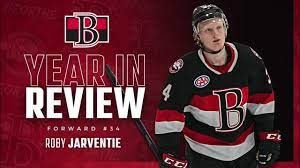
Pre-season mostly serves to eliminate players rather than reward them, but based on performance and media chatter (as in, the local media that largely serves as Dorion’s mouthpiece, but also including some others) through five of eight games has made a few judgements (excluding the established players). Who stood out? Roby Jarventie and Jiri Smejkal. The former is no surprise and I’ve been a fan of the talented Finn throughout. Smejkal, at his age, should be doing well in pre-season, although how much this really means remains an open question (I don’t think Jarventie is in the NHL barring a trade or injury, as Dorion has too many one-ways to make room for him and more developing wouldn’t hurt). On the opposite side, while he hasn’t been bad, no one is praising PTO Josh Bailey. Without roster moves there was no way for him to make the team anyway so I think his time with the team is simply as a showcase for the league.

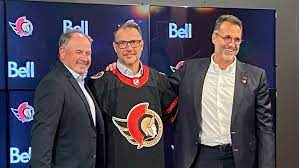
As long expected Steve Staios, who has deep ties to Andlauer, has been hired as team president. I see this as the grim reaper knocking on Pierre Dorion’s future. I don’t expect head office moves to be made soon, but a poor start or missing the playoffs will put a merciful end to the Dorion-era.

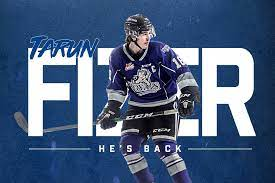
The Sens have signed Tarun Fizer to an AHL-contract, which is a credit to him and the most he could have hoped for from camp. There’s not a lot of room in Belleville (as we’ll get into in my BSens preview), but the talent on the roster has gaps so he has opportunities.

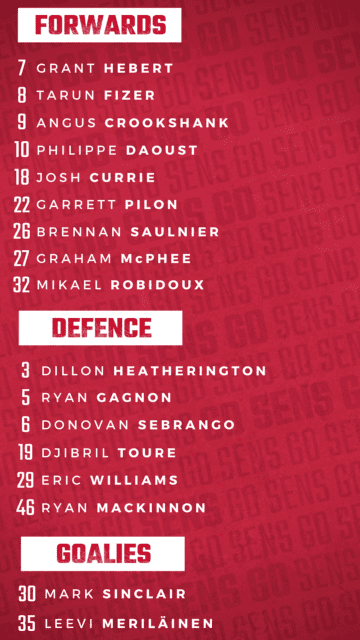
Speaking of the BSens, their camp has opened. Let’s briefly look at the roster, including the extra bodies floating around. ELCs assigned: Crookshank, Currie (vet), Daoust, Fizer (AHL-deal), McPhee (AHL-deal), Pilon (vet), Saulnier (AHL-deal); Heatherington (vet), MacKinnon (AHL-deal), Sebrango, Toure; Merilainen, Sinclair (AHL-deal). The invites:
Grant Hebert, CL, DOB 1997, 22-23 ECHL 37-8-18-26
The former NCAA center is looking for an ECHL deal if he doesn’t already have one
Mikael Robidoux, RW, DOB 1999, ECHL 42-9-7-16
QMJHLer is a fighter in the ECHL and that’s all he’ll be focused on
Ryan Gagnon, DR, DOB 1996, ECHL 72-4-5-9
Canadian University grad played with Hebert and can only play physical
Eric Williams, DR, DOB 1995, ECHL 16-2-2-4/AHL 9-0-0-0
Former NCAAer has become a fairly effective ECHL player who has had cups of coffee in the AHL (35 games)
These are all older warm bodies to fill out the lineup, as the BSens roster is overflowing with players (cf) and none of the above address a missing need (the primary need is skill, especially on the blueline).

This article was written by Peter Levi

The Alex DeBrincat Trade

When the Sens traded for DeBrincat last summer I immediately compared it to Dorion’s 2017 trade for Matt Duchene–a disastrous decision that contributed to needing a rebuild in 2018. The reaction from the fanbase in both instances was virtually identical, although I think the feelings about Duchene himself remained more positive when he was moved. Before we get into today’s trade with Detroit, let’s briefly remind ourselves how that prior move went for Dorion (for the deep dive read the article above):

2017
To Ottawa: Matt Duchene
To Nashville: Kyle Turris
To Colorado: Andrew Hammond, Shane Bowers, 1st-2019 (1-4 Bowen Byram), 2019-3rd (Matthew Stienburg)
2018
To Ottawa: Vitaly Abramov, Jonathan Davidsson, 1st-2019 (1-19 Lassi Thomson)
To Columbus: Matt Duchene, Julius Bergman

In retrospect Ottawa gave up Byram (and Stienburg) for less than two seasons of Duchene and prospect Thomson. I like Lassi, but I’d rather have Byram in my lineup. Let’s compare this to DeBrincat himself:

2022
To Ottawa: DeBrincat
To Chicago: 1st-2022 (1-7 Kevin Korchinski), 2nd-2022 (Paul Ludwinski), 3rd-2024
2023
To Ottawa: Dominik Kubalik, Donovan Sebrango, 1st-2024 (almost certain to be Boston’s), 4th-2024
To Detroit: DeBrincat

Because of the conditions attached to the 1st-round pick, it will likely be late (at best mid) and there’s no chance it’s in the top-10. Just like Duchene above, Dorion has converted a top-ten pick (the most successful part of the draft) into the crapshoot of later in the round for nothing (one meaningless season of DeBrincat). He lost a 2nd-round pick for nothing, and his 3rd has been turned into a 4th (almost certainly later than Ottawa’s own). There’s no question that in terms of future assets this is another enormous loss because everyone would rather have Bowen Byram and Kevin Korchinski on the Sens blueline rather than three meaningless seasons from Duchene and DeBrincat.

What about the tangible assets from the deal? What is being immediately injected into the Sens system?

Dominik Kubalik, LW, 6’2, DOB 95, 7-191/13 LA, 1yr/2.5
2021-22 Chi 78-15-17-32
2022-23 Det 81-20-25-45
He scored 30 goals in his rookie season with a talented Chicago team in 19-20, but his results the last two years are representative (receiving no boost from the NHL’s overall increase in scoring). If you were to slot his prior season in with Ottawa’s lineup he’s ahead of Shane Pinto and the idea has to be of him providing depth to the Sens otherwise anemic bottom-six (ahem, Mathieu Joseph). Kubalik was allowed to walk by the Blackhawks and Steve Yzerman has moved him after just one season–is that suggestive? Not necessarily, as Chicago was rebuilding and Detroit is retooling (and would rather have DeBrincat). He is, however, not locked in so the Sens can move him or walk away easily and it’s an excellent Cap hit for what he provides.

Donovan Sebrango, DL, 6’1, DOB 02, 3-63/20 Det, ELC/2yrs
2021-22 AHL 66-1-6-7
2022-23 AHL 39-4-3-7
This is an asset Yzerman wanted to be rid of (he spent about half of last season demoted to the ECHL–very much a Zach Senyshyn situation), so he’s part of the price the Sens have to pay to get rid of DeBrincat. He has two years left on his contract (including the upcoming one) and I suspect Dorion will look for a way to package him elsewhere before he finishes that out.

Let’s briefly assess and then summarize:
Positives: the DeBrincat situation has been resolved before the start of the season; Kubalik is a useful NHL player and arrives with a good contract; the Sens regained some of the draft equity they squandered; they have cap space to find a free agent and lock-up players like Pinto, Sanderson, etc
Negatives: Dorion (again!) overpaid for an asset he didn’t need so (again) failed to recoup the investment; just like with the Duchene trade above, there’s a good chance the entire fiasco ends with a modest asset like Lassi Thomson that is a pale shadow to what was given up in the first place; I don’t trust Dorion not to go overpay a free agent just to make a splash–I didn’t want five years for Korpisalo (or three years of Anton Forsberg for that matter) and I don’t want five years of an aging Tarasenko either (ask a stacked Rangers team how much he helped them). [The Detroit perspective doesn’t think much of the deal]

We can’t give the final assessment on the DeBrincat odyssey like we did with Duchene, but as it stands Dorion gave up: Kevin Korchinski (and Paul Ludwinski) for one season of DeBrincat in return for (possibly) one season of Kubalik and a late 1st-rounder. If that’s your return on investment, it’s time to get a new investor. Dorion rightfully received praise for some of the contracts he signed last summer (although lot’s not forget the hell he’s created for himself in that realm before, ala Colin White), but his ability to assess his team–where they are at, what they need–is hilariously and disastrously awful. Do we want to re-visit the Matt Murray trade? GMs are sometimes the victims of bad luck, but that’s not the case here. I’ve said it before and I’ll say it again: Dorion needs to go before he permanently damages the rebuild.

This article was written by Peter Levi

DeBrincat on the Move and Ottawa’s RFA Decisions

My belief, expressed back in April, that the local rumours about moving DeBrincat ultimately originated from within the org, seem justified as Pierre Dorion has finally made public his desire to move the player. This dovetails into what I said when he was acquired back in the summer, which was that there was a good chance the deal would ultimately fail. Dorion has already admitted he has no hope of getting back the value he gave up for the player (a top-ten pick, an early 2nd, and a 3rd next draft), hoping for something like a 2nd or 3rd round pick. So, as I’ve asked repeatedly since he was acquired, what was the point of trading for him? One year of DeBrincat for what (moving from 26th to 20th overall)? Dorion tends to get a free pass and this has been helped this time by drip feeding this eventuality for the last two months. As I said last summer, his acquisition echoes that of Matt Duchene and with similar results (I’m not sure how many people realize Dorion has surrendered the 4th and 7th overall picks for players who didn’t get the team into the playoffs and who spent less than two seasons with the org). This is one of the reasons why I don’t trust Dorion and I’m hopeful his days as GM are numbered.

Dorion also talked about how the team has dealt with their RFAs:
Qualified: Brannstrom, Pinto, Sokolov, Bernard-Docker, and Mandolese
Not qualified: Gauthier, Gambrell, Lodin, Ferguson, Larsson, and Aspirot

Those not qualified all had arbitration rights and in theory could be brought back as FAs (I don’t know that any are worth bringing back, but keep that in mind–if I was going to guess there’s a chance someone like Aspirot could return on an AHL-deal). Among those qualified, only Brannstrom has arbitration rights, but I’d expect him to be signed and/or moved long before that. The only surprise for me was retaining Mandolese (cf), although that may be as an extra piece to move or as depth going forward.

It’s funny, but not long after saying the Sens didn’t need to add anymore skill, Mendes says that the team needs one or two top-six forwards. I can’t even pretend to understand what’s changed for him between June 9th to June 26th, but it echoes a similar about face from Marc Method on Zub’s contract (that change took about four months).

This article was written by Peter Levi

Lucky Number Kleven

Yes, I remember the stupid advertisements for that movie, so now you can too. Headline aside, in the least surprisingly development of the season (cf), the Sens have signed Tyler Kleven (2-44/20) to an ELC. It’s a 3-year deal, which is plenty of time should he require seasoning in Belleville. For those who don’t recall, the Sens packaged two 2nd-round picks to Toronto (Roni Hirvonen (signed; Liiga 57-15-13-28) and Topi Niemela (signed; Liiga 58-8-10-18)) to acquire the pick they used for Kleven. Back in 2021, Corey Pronman (The Athletic) pegged him as a bottom-pairing defensemen, which hadn’t changed a year later. According to Dorion, he’ll play in a couple of NHL games. The signing isn’t about this season however, but next (I suspect in Belleville to start). The org likes to compare his hitting to Dion Phaneuf‘s, but hitting means less in the game than it has since (maybe) the Original Six, so I’m more interested in the other aspects of his game. As for his performance, remember that one good game doesn’t make him great and one bad game doesn’t make him awful–we’re looking for a body of work over time.

Another move the Sens made is bringing Leevi Merilainen over from Finland. Karpat’s season is over and the Sens goaltending situation is a mess, so the move makes sense. He’ll get some starts, as Mandolese‘s numbers have not been great in the AHL (.889), Sogaard and Ferguson are in Ottawa, Bibeau (.892) was awful returning from injury (5 goals and .861), and none of the other lower league goaltenders have performed well. Merilainen had one mediocre season in the OHL, but played well in Finland, so it will be interesting to see how he does with the BSens. I’m more excited for him than Kleven at this stage, largely because his potential impact is far greater (Pronman’s analysis, above, is cursory and based on his prior season–doesn’t make it wrong, but food for thought).

It’s funny how many goaltenders have to leave Ottawa to find their game. The 24-year old (soon to be 25) Filip Gustavsson is enjoying a career year in Minnesota. As a straight one-for-one trade it’s easy to compare his numbers with Cam Talbot:
Gustavsson – 33GP 18-9-5 2.04 .932
Talbot – 32GP 15-14-1 2.85 .904
He leads in every category, but context is important: Minnesota is a better team (41-22-9 vs 35-32-5) and a better defensive team (197GA vs 233GA). There is some sort of Pierre Dorion karmic cycle in effect where most of his pro deals crash and burn. The Wild will undoubtedly keep Gus (an RFA) while Talbot (35+ UFA) was always imagined to be one-and-done. The Sens (going back to Bryan Murray) have had insanely inconsistent approaches with goaltenders and generally picked poorly on when to be patient and when to give up (Ben Bishop, Brian Elliott, Robin Lehner, Chris Driedger, and even depth ‘tenders like Joey Daccord). [After I posted this, The Athletic rated him as the second-best off-season acquisition among goaltenders in the NHL.]

This article was written by Peter Levi

Sens News & Notes

The positivity continues as the Sens re-signed all but one of their pending RFA’s: diminutive Erik Brannstrom returns on a one-year deal (900k); Mathieu Joseph (see below) chimes in with 4-years at 2.95; and the electric Tim Stutzle signed an eight-year extension at 8.35. The only player currently left on the docket is Alex Formenton. The moves were well received (I don’t count Nichols worrying over Stutzle‘s defensive play, is that’s a by rote concern with offensive players), as the hype train continues. I’m apparently the only voice of caution at the moment, so is there a fly in the ointment with these signings? The one that occurs to me is the salary cap–not for this year, but for the 23-24 season.

The Sens have 61 million committed to 23-24 (minus Formenton). That’s 74% of the cap. If we imagine keeping Debrincat at roughly what he makes now (unlikely, but let’s be generous) and toss in Formenton (let’s ballpark 2.5), that’s 70 million committed (85%) when the team will need new contracts for Shane Pinto, possibly a goaltender, and half their blueline (Zub, Hamonic, Holden, and BrannstromLassi Thomson taking a spot doesn’t change much).

That’s very little cap space to work with, which likely means Dorion will be forced to move someone from the forward group. The Sens are disproportionately committed to their forwards, a gamble that did not produce playoff success last year (as Travis Yost notes, “No team with a below-average top four on defence reached the postseason [last year]“). Even if the Sens move Formenton without taking salary back, they’d still have just 15 million to work with (assuming Debrincat stays near his current salary). The Sens blueline has been awful (cf Nichols), so simply locking-up what’s in place will not suffice [after I posted this Ian Mendes echoed the point].

This scenario is one of the reasons why I brought up the potential cost of overpaying in the deals they’ve signed (I think both Giroux and Norris could have been signed for less). The odds are that at least one of the new deals will turn sour and the Sens will struggle to move the player (Zaitsev is still here, which is the perfect example of how hard it is to get rid of underperforming cap problems). I’ve seen no reflection of this issue either in the press or from fans–some of that is due to it being an issue for next season, but cap management is a key component for success, so it will be interesting to see when it does start getting debated (how the season starts will likely determine it).

Cap aside, I’m happy with the Stutzle deal–I’ve always been in favour of paying for skill and that’s what he brings. While we can’t know how he’ll project out (cf), there are no high end center prospects within the org and they are practically impossible to trade for, so it’s essential to keep him.

Nichols bent over backwards to praise the re-signing of Mathieu Joseph whose brief, meaningless late season numbers undoubtedly impressed Sens’ brass. The reason I’m dismissive of Nichols’ analysis is because he only looked at the numbers in Ottawa–Joseph has played 232 NHL games, so I’d rather see the whole picture for a breakdown. As for the deal itself, I don’t like its length, although Dorion avoided giving him Colin White money. While I don’t expect Joseph to perform like he did at the end of the season, if he truly underperforms (which I’m not saying he will, it’s just a potential) at least his salary is reasonable enough that he can be moved.

Erik Brannstrom is at a turning point in his career (Ary argues that’s not necessarily the case–link below–and while he’s right abstractly, I don’t think the org has patience for him). He’s only 23, but his numbers are underwhelming. When drafted he was compared to Victor Mete (ouch) and Timothy Liljegren (whose curve seems better). He’s undeniably fourth on the chart on the left side at the pro level (behind Chabot, Sanderson, and Holden), so outside of injury or someone playing their off side, it’s hard to know how much he’ll play. I think the Sens had to re-sign him (for depth reasons and to pump up his value), but I doubt much enthusiasm remains for him–I don’t think the coach is a fan.

I mentioned that we’d have to wait for sources outside of Ottawa to see words of caution about the Debrincat trade. That caution has arrived via an article by Sean McIndoe (which is ostensibly about Matthew Tkachuk), where he talks about how rarely trades like this (when the player is resigned long term) work out.

“…the dreaded Shiny New Toy. It’s a category of bad contract that I first proposed in a piece I wrote six years ago. … The scenario is in play when a team acquires a star player in a major trade, usually to great fanfare, and then has to immediately contend with an extension. … That puts the team in a bind. Sure, it’s great that they added a new player, but now they have to keep him. Their fans are excited. The GM is reading media coverage about what a great job he’s done. They may even be selling a few more season tickets. But all that positivity disappears if they let this new star walk away for nothing in a year or so.”

McIndoe then includes a long list of such failures (Seth Jones, Jeff Skinner, Erik Karlsson, Jacob Trouba, Jonathan Drouin, Justin Faulk, Ryan McDonough, Corey Schneider, 2012’s Jordan Staal, Ottawa’s own Bobby Ryan, and 2014’s Jason Spezza). The Sens have not yet signed Debrincat long term, but the expectation from both the fans and media seems to be that they will lock him up long term.

Travis Yost had an interesting look at goaltending performance. In it you can see some warning signs about Cam Talbot (using Goals Saved Above Expected, or GSAE); the newly acquired ‘tender hasn’t been above average in his last five seasons and below it twice. We know the Sens don’t believe in analytics, so this wouldn’t factor into their decision to trade for him, but it’s something to keep in mind for the upcoming season. This doesn’t concern me too much, since Talbot is here as a short-term back-up, but if there are injuries it’s worth keeping in mind. I don’t want the org to have to lean on Sogaard if things go wrong, as the Dane is very young and we’ve seen how pushing young goaltenders can turn out poorly (Lehner, Elliott, Hogberg, etc).

In a minor league deal the Sens added winger Jayce Hawryluk. This is his second tour of duty with the org, as he was a waiver pick-up in 2020. At that time the former 2nd-round pick put up solid season ending numbers (11-2-5-7) which was enough to convince Vancouver to sign him (he proceeded to bomb out completely). He spent this past season with Skelleftea in the SHL, where he was unimpressive (39-8-11-19, finishing 10th in scoring). While Hawryluk isn’t an NHL player, his AHL numbers are adequate (148-27-68-95 0.64). On the surface it’s an unimpressive addition to the BSens, but it’s not an obvious fail like some of last summer’s signings (cf).

This article was written by Peter Levi

Debrinked: Offering Perspective and Caution

The big news from the draft for the Sens was bundling picks for Chicago winger Alex DeBrincat— understandably the fanbase is skweeeing about it (here’s a typical example). I’m not here simply to offer a negative take, but I do think there’s important context and deeper analysis to perform (for instance, the aforementioned post includes this incorrect assumption: “It’s very unlikely any of the three picks they gave up will turn into anyone as good as [him]“). We’ll explore why that conviction is far from clear below.

The first thing that came to my mind when I heard about the trade was, assuming team finances are unchanged, that the 24-year old is a rental, albeit of the two-year variety. Debrincat is a fantastic comparison to another big move from the Pierre Dorion, namely trading for Matt Duchene in 2017 (Nichols almost hits upon this, but not quite). At the time, just like now, Dorion thought he was on the cusp of playoff success, so let’s go back to the halcyon days of 2017, look at that trade, and see how it compares.

This was a threeway trade between Ottawa, Nashville, and Colorado (which the Avalanche won going away); that aside, we’ll concern ourselves only with the elements that apply to Ottawa.
Sens gave up (1 player, 3 assets):
Kyle Turris (Nsh) – 172-29-67-96 (0.55) over three seasons, which was below his Ottawa average (0.67); the Sens wisely got out of the Turris-business before his play collapsed and they avoided paying him the absurd salary Nashville handed out–moving him at this time was a good idea
Andrew Hammond (Col) – The Sens ill-advisedly rewarded him with a one-way contract and dumping him became necessary (Anderson-Condon was the tandem that season); the Avalanche buried him in the minors and let him walk at the end of the season
Shane Bowers (Col) – A first-round pick (!) that I thought was terrible at the time and, as Colorado discovered, I was not wrong (his AHL numbers with them: 117-23-22-45 0.38); the Sens picking him was a waste (a Mann pick, incidentally), but knowing to get rid of him was the correct move
2019 1st-round pick (Bowen Byram, Col) – Dorion dumped the first-round pick thinking he was managing a playoff team–instead the Avalanche got a lottery pick the Sens needed; Byram has won a Cup already (his NHL numbers through parts of two seasons: 49-5-17-19 0.38)
2019 3rd-round pick (Matthew Stienburg, Col) – The third-rounder is still plying his trade in the NCAA and doing well, but whether he’ll pan out is up in the air (it’s statistically unlikely)
Sens acquired (1 player):
Matt Duchene – 118-50-57-107 (0.90) over parts of two seasons as the Sens bottomed out to become one of the worst teams in the NHL; he was flipped to Columbus (a trade we’ll get into below); Duchene played very well, producing above his career average (0.76), but that production was wasted because Dorion misunderstood how good his roster was

What you can say about this trade is that, in terms of the established assets, Dorion did well (moving on from Turris, Bowers, and Hammond, and getting in on Duchene at peak performance). What Dorion failed at was assessing his own team and thus surrendering an asset he’d dearly love to have back. Dorion also struggled when forced to move Duchene, so let’s briefly look at that.
Sens gave up (2 players):
Matt Duchene – Finished out the season with the Blue Jackets (23-4-8-12), but walked and signed with Nashville afterwards (so he was a pure rental)
Julius Bergman – Previously acquired in the Mike Hoffman deal, the Sens jettisoned him after just part of one-season in the AHL (he finished out the year and then went back to Europe)
Sens acquired (3 players):
Vitaly Abramov – The prospect received a lot of fanfare, but suited up for just 5 NHL games over three seasons before returning to Russia
Jonathan Davidsson – A signing Columbus clearly regretted, the Sens brought him over for one season where he accomplished nothing in the AHL (30-2-3-5) and returned to Europe
2019 1st-round pick (Lassi Thomson) – Is on the right trajectory, although it’s too early to say if he’ll become an important NHL regular or not

Dorion again made the correct decision to dump Duchene when he did (as well as moving an asset he didn’t want in Bergman), and Davidsson was simply part of the price to be paid for the trade, but the team failed hard in gauging Abramov’s potential. Given that Columbus retained none of the assets in what was a playoff-push trade, the Sens win the exchange if Thomson turns into even a marginal NHL-regular, however, big picture we’d all rather have Byram than Thomson, which means Dorion loses the entire Duchene cycle–not just because of the final assets, but because Duchene’s time with Ottawa was wasted. His performance, while good individually, did nothing for the team.

With that lengthy preamble aside, let’s see what Dorion has learned. The pint-sized Debrincat (368-160-147-307 0.83) was a 2nd-rounder in 2016 who has flourished with the largely non-competitive Hawks since he debuted. He’s young, hasn’t had notable injury concerns, is signed and an RFA for the following season–he’s expensive, but in theory there’s two seasons for the budget-conscious Sens to get out of him. What did they give up?
2022 1st-round pick (Kevin Korchinski)
2022 2nd-round pick (Paul Ludwinski)
2024 3rd-round pick

A top-ten pick is nothing to sneeze at and the 2nd is very early, meaning the odds of Ludwinski also turning out are (relatively) high–the 3rd-round pick is much more of a crapshoot. Let’s take a look at players picked in those positions over 2012-20 (those in italics either failed or were marginal players; those undetermined have their current league/circumstance noted):
7th overall: Matt Dumba, Darnell Nurse, Haydn Fleury, Ivan Provorov, Clayton Keller, Lias Andersson, Quinn Hughes, Dylan Cozens
39th overall: Lukas Sutter, Laurent Dauphin, Vitek Vanecek, A. J. Greer, Alex Debrincat, Jason Robertson, Olof Lindbom, Jackson LaCombe (NCAA)

I appreciate the irony of Debrincat being a 39th pick. That aside, 75% of the time the 7th-pick has become a significant asset; on the other side, two cases remain undecided (Vanecek and LaCombe), so of what’s left it’s 33% (which is still quite high). Let’s also keep in mind that the best later pick was made by Chicago, the team Dorion just traded with. In the long term, it’s unlikely the Sens win this trade (to do so Chicago needs to fail), so this trade isn’t for the long term.

With Debrincat, just like Duchene five years ago, this deal requires the Sens to win now. We understood that urgency when Melnyk was in charge, but he’s no longer with us, so where is the pressure coming from? My theory is Dorion knows he’s on very thin ice–this could be his last year as GM and, if that’s the case, he wants to go for broke. Are the 2022-23 Senators better than the 2017-18 Senators? It’s easy to say yes in hindsight, but the latter were coming off almost making the Stanley Cup finals, so I don’t think it’s that simple. Let’s briefly compare the two (I’m going to note the season they had prior and then the current season; bold is improved, italics is not):

Top-six forwards
Mark Stone (1.06/1.05)
Mike Hoffman (0.82/0.68)
Matt Duchene (0.53/0.72)
Ryan Dzingel (0.39/0.52)
Derick Brassard (0.48/0.65)
Bobby Ryan (0.40/0.53)
Top-four blueline
Erik Karlsson (0.92/0.87)
Thomas Chabot (junior/0.39)
Cody Ceci (0.21/0.23)
Dion Phaneuf (0.37/0.30)
Starting ‘tender
Craig Anderson (.923/.898)
Significant Roster Losses
Marc Methot

The Sens were slightly better offensively in the 17-18 season, but their goaltending collapsed and that had hidden deficiencies on defense. Dorion’s inability to read the tea leaves in terms of the blueline and goaltending sent the team crashing down into its lengthy rebuild.

Top-six forwards
Alex Debrincat (0.95)
Brady Tkachuk (0.84)
Tim Stutzle (0.73)
Josh Norris (0.83)
Drake Batherson (0.95)
Shane Pinto (injured)
Top-four blueline
Thomas Chabot (0.64)
Artyom Zub (0.27)
Jake Sanderson (NCAA)
Erik Brannstrom (0.26)-Lassi Thomson (AHL)
Starting ‘tender
Anders Forsberg (.917)
Significant Roster Losses
None

The Sens suffered a ton of key injuries this past season and are leaning heavily on younger players. There’s no depth to replace key losses, such that it’s impossible for success if there are any significant health issues (this also applies to individual regression or struggles). Goaltending, just like in 17-18, is a huge question mark, as Forsberg is a career backup and there’s only uncertainty behind him.

We also can’t help but repeat what Nichols and others have found by digging through the numbers: how much playing with Patrick Kane has helped boost Debrincat‘s numbers–and it does no good to say, well, if he’s not as advertised, the Sens aren’t committed, because they’ve already surrendered significant assets to get him that can’t be replaced. Debrincat must work out or this trade is a disaster.

Also, as others have pointed out, Debrincat helps the team in the way it needs least: on offense. While it’s safe to say the top-six without him is hardly dominant, scoring wasn’t the primary issue for the team this past season. Not only that, but by surrendering two top-40 picks, the Sens are delaying the addition of new top talent in net or on the blueline. Do I think Jake Sanderson will be a good NHL player? I do, but how long is he going to be playing with Chabot and Zub? It’s also unclear if the Sens have a proper #4 to complete the picture (along with zero capacity to make-up for injuries on the blueline). The net is a mess and clearly Dorion is praying for the continued evolution of Mads Sogaard, but he’s only 21 (shades of Murray waiting for Robin Lehner or Dorion relying on Marcus Hogberg). The echoes to 2017 and the Duchene trade are ringing louder and louder.

At the end of the day, I hope the Debrincat addition is all people hope it will be (I do love offense, lest we forget), but Pierre Dorion has a magical talent for losing trades, so I’m going to remain cautious until we’re well into the coming season.

This article was written by Peter Levi

Thoughts Post-Deadline and Post-Melnyk

I started writing this a week ago after the trade deadline, but the news of Eugene Melnyk’s unexpected passing has pushed me to complete it. My only interest in commenting on him here is wondering what this means for the future–will the family take over the team, or will the NHL manage as it seeks a new owner? I think even if the team remains in the family, Pierre Dorion’s days as GM are nearing an end–whatever one thinks of Dorion, a new person will want to inject ‘their guy’ in charge of the operation. Time will tell, but if I was going to guess Dorion will manage the draft and off-season, but 2022-23 will be his last as Ottawa’s GM.

Here are my scattered thoughts on the Sens with another season down the drain. Let’s state the obvious: this team was always going to sit near the bottom of the league (cf and cf). And now, trade deadline stuff:
—I’m happy the team got rid of Josh Brown. As per usual they overpaid for him in the first place and he failed to pan out, but at least they moved him.
—I’m also happy with moving Nick Paul, if for different reasons. He’s always been a nice enough support player, but the team needed him to do too much and, at 27, he is what he is (I’d rather have him off the books to make space for someone else).
—Is the ‘someone else’ Mathieu Joesph? I have my doubts, but it’s less of a risk and commitment (RFA) should they keep him (and at least they got a pick with him, even if it will be a 4th in 2024).
—Getting rid of Zach Sanford also made sense–an unimpressive veteran they weren’t going to keep.
—I don’t think much of Zach Senyshyn or Michael McNiven, but there’s no commitment to either and I assume they will be out the door at the end of the season.
—The big move is overpaying for Travis Hamonic. This is a classic Pierre Dorion trade–pick up a declining, gritty veteran that no one else wants. What I think this means is they’ve realized they have to move or buy out Nikita Zaitsev and I suspect that’s truly who Hamonic is replacing. In that sense, he is both cheaper and an improvement, but whether Melnyk’s successor will eat the former’s salary remains to be seen. I think the Pierre’s are also realizing Jacob Bernard-Docker won’t be ready next year and that Lassi Thomson (if he’s ready) will have to be protected stepping in.
—What does re-signing Anton Forsberg mean (and three years)? Either that they are giving up on Matt Murray (a very expensive idea, but sensible), or more likely Filip Gustavsson. Gus, who has slipped back to his expected erratic performance, I think has been put on the funeral pyre for the more reliable Mads Sogaard and the team will simply wait out Murray‘s contract for him.

To move beyond the trade deadline, the continued inability to assess talent remains front and center. Let’s note that Victor Mete hasn’t performed as advertised and Michael Del Zotto is a problem they seem unable to figure out. Adding marginal players like Gaudette and Gambrel, scrambling to get rid of Colin White (someone I predicted would cause them issues years ago), being unable to move Chris Tierney–it’s the flailing of a man in Pierre Dorion who thinks he knows what he’s doing, but spends most of his time trying to put out the fires he started. Who could have guessed these moves wouldn’t turn out? As it happens, virtually everyone. Speaking of Dorion….

Let’s quickly review his asset management post-2021 draft. We’ll start with draft pick management:
Picks-in:
2022 3rd Vancouver (Dadonov trade, subsequently moved back to Vancouver in the Hamonic trade)
2022 5th Boston (Josh Brown trade)
2022 5th Winnipeg (Zack Sanford trade)
2024 4th Tampa (Nick Paul trade)
Picks-out:
2022 3rd Vancouver (Hamonic trade)
2022 4th Ottawa (Logan Brown trade)
2022 7th San Jose (Gambrell trade)

The net result is the Sens gave up higher assets than they received (3rd, 4th, and a 7th vs a future 4th and two 5ths).

Bodies in/out:
In:
Nick Holden (Vegas)
Zack Sanford (St. Louis–subsequently traded to Winnipeg)
Adam Gaudette (Chicago–waivers)
Dylan Gambrell (San Jose)
Travis Hamonic (Vancouver)
Mathieu Joseph (Tampa)
Out:
Evgeni Dadonov (Vegas)
Logan Brown (St. Louis)
Kole Sherwood (Nashville)
Nick Paul (Tampa)
Josh Brown (Boston)
Zack Sanford (Winnipeg)

The Sanford rental is a failure and the Sens ultimately turned Logan Brown into a 5th-round pick (not good asset management for your former first-rounder). Josh Brown and Kole Sherwood were problems they imposed on themselves, although collectively getting a 5th for them is probably the best one could do. What really stands out is how marginal all the assets involved here are–with the exception of the outgoing Dadonov, these are all bottom-nine forwards and depth defensemen (although admittedly the Pierre’s likely believe Hamonic is a top-four).

There’s nothing in terms of players or picks that are going to solve Ottawa’s problems going forward, meaning an entire season’s worth of work hasn’t changed the Sens dependence on the draft. Instead, all of these moves are fires Dorion is trying to put out–Dadonov’s salary, Logan Brown wants out, Sherwood didn’t pan out, Paul can’t be resigned, Josh Brown didn’t pan out, and Sanford won’t resign. There’s nothing here that’s a straight hockey trade to improve the team. None of this is a surprise to those of us who have followed Dorion over the years, but maybe (just maybe) the fanbase has finally caught on.

I have thoughts on how Belleville has performed as well as the various prospects in the system, but I’d rather get this out now and wait for the AHL season to end before doing that. Any thoughts, corrections, and comments are welcome.

This article was written by Peter Levi

Rudolfs Balcers and Josh Norris Profiles

Analysis

It’s a crazy time of year to write about the Sens (there’s so much material so I’m very behind on my MCU stuff). Beyond what follows I have a much delayed post about the Sens ECHL affiliate in Brampton (now no longer shared with Montreal), an article looking at Dorion’s trade history, and another post filled with general bits of news mostly about the rebuild (additional material from my initial post about the subject). This, however, is a look at the org’s newest prospects.

Ary posted a breakdown of newly acquired Rudolfs Balcers and Josh Norris (my own Coles Notes version was out a week ago). Ary’s article is an excellent read, although he admits he’s leaned towards the positive with Norris because he didn’t want the player facing fan wrath and he’s certainly received more negative press than Balcers (for pretty obvious reasons)–Varada has mentioned toxic fans, but we clearly go to different places for Sens opinions as most of what I see/hear are org apologists (I’ve seen nothing toxic, frankly). What new information has Ary brought to light in his article and how has it impacted my opinion?

Rudolfs Balcers

In my original article I simply summarized the scouting material on-hand (prior to the draft and afterwards); Ary quotes some of that, including one opinion from a scout I hadn’t seen before. Beyond that he provides some statistical data (beyond just the obvious numbers). He spends a lot of time on Emmanuel Perry’s NHLe numbers and given that I have little familiarity with that I can’t make much comment on it (other than saying translating minor league or junior production to pro is extremely difficult).

The aforementioned scouting report (written in June, 2016, the year after he was drafted) praises a few things: speed, shot, elusiveness; suggesting his primary need is strength. I didn’t specifically quote the Hockey Prospects appraisal from 2015, so let’s see how it compares:

In both competitions [IIHF U18 and U20] he was able to display his talent, and against his peers in Switzerland he was still dangerous offensively while facing the top nations in the World. Rudolfs is an impressive skater, possesses deceptive speed and he is able to hit another gear apparently without further effort. His skills and skating allow him to get into good shooting positions and his wrist shot is legit. However, too often he doesn’t look determined enough to take his chances as soon as they come up. He looks weak physically and not overly competitive, getting softer as the game gets tougher, even if in April he did show some improvement in that area. He is a prospect that will need a long development path, but given his talent level he might be worth the wait.

It’s clear the only exposure HP had to him were the three international tournaments referenced above (no one is paying scouts to watch games in Norway), but the talent profile is exactly the same. His unusual route to the draft, btw, echoes Alexandre Texier’s from 2017 (playing in the French men’s league but noticed via international tournaments).

What about opinions post-2016? Blogger favourite Corey Pronman wrote about Balcers as part of his San Jose prospect profile on August 15th (prior to the trade) and said the following:

Balcers had a great first pro season, as the best player for the Barracuda, and had a decent World Championships with Latvia. Balcers is a skilled forward, but what stands out the most to me is his hockey sense. He has great vision and overall offensive instincts. He can play at a pro pace and show the intellect to make plays at both ends of the rink. He’s not a big forward and only an average skater, but he makes defensive plays due to his work ethic and hockey IQ. I have some skepticism on his overall upside when I pick apart his skill set, but he keeps producing at a high level.

Pronman then revisited the profile in the wake of the trade:

All he’s done is produce, though, at various levels and events. … Scouts love his skill and IQ, and while they acknowledge he’s not a very fast skater for his size, I’ve heard the term “darting” and “shifty” used more than once in describing how he gets around the ice. I think he plays and he could play soon in the NHL. He’s got talent and is versatile. His biggest backers in the scouting community think he can be a top-six forward. I’m more of the top-nine area right now with the caveat that he’s had some impressive moments in the past year that have made me reconsider. I’d just like to see a tad more speed in his game to get him to that range.

Clearly (like most scouts) Pronman’s only exposure to him in his draft year and the subsequent season was via international tournaments. Once Balcers made the jump to the CHL it became much easier for scouts to see him. One of the things that’s changed is the opinion about his speed: it’s gone from blazing to just average–with agility emphasized. The love of his shot continues unabated. The comment about his work ethic is new and refutes HP’s 2015 opinion (or, to be generous, illustrates a change).

I don’t think Pronman is wrong about his speed and that is of some concern. As long as he has the hands as advertised and is elusive, however, his NHL-potential remains. Pronman plays it safe projecting him as a top-nine forward, but certainly the top-six remains a possibility.

Josh Norris

I’m not that keen on Norris, as was undoubtedly clear in my summary about him, so what new insights do we have via Ary? Let’s first go to a comparison Ary doesn’t make that occurred to me after posting my initial thoughts: he and Johnny Gruden‘s remarkably similar numbers at the same stage of their development:

Norris (16-17): USDP 61-27-34-61/USNTDP 25-12-14-26
Gruden (17-18): USDP 61-28-32-60/USNTDP 25-15-19-34

I projected Gruden to be a marginal pro, but like Norris there are positive underlying numbers despite the underwhelming projections (the underpinning for Norris is the theory of reliance–betweenness–attempting (via numbers) to ascertain how dependent players are on their teammates (the metric being used seems a little simplistic to me, but it is interesting). There is, of course, a much higher ceiling provided for the first-round pick, so why is that? Reading the scouting reports I think its easy to figure out:

Steve Kourniasos (via Ary):

plays physical, is matched up against top players … plays a heavy game and uses his size and determination to win puck battles … Playing in traffic isn’t a problem for Norris … A talented, mature leader with an NHL-ready build

RLR:

Big center is a rugged banger who can do a little of everything … Goes hard to the net both with and without the puck. … Strong physical force who is also good on faceoffs and responsible defensively – strong on the backcheck and kills penalties. High character, you win with guys like him

International Scouting Service (ISS):

Very competitive, he is willing to play in traffic and to battle for possession … [Bryan Smolinksi] uses [his] body well with a little nastiness

Future Considerations:

He is strong on puck and works like a mule … tough to deal with along the boards and effective in the cycle game. … has the ability to throw a hit to create turnovers … his two-way game at a premium position should make him a nice compliment to a team’s bottom-six.

Hockey Prospects:

shows good compete and grit to his game when needed … plays physical … [NHL scout] I like that he makes himself a bit of a pain in the ass to play against
sometimes.

And what about Pronman in the here & now?

[First link] has good athletic traits

[Second link] [how] great an athlete he is and how coaches trust him in all the tough situations

The theme is: he plays a hard, safe game. This is pure adrenaline for the org who, especially since Trent Mann took over their amateur scouting, is the poster child for safe picks (indeed, an anonymous NHL scout quoted by HP literally calls Norris ‘a safe pick’ and Dorion himself has just mentioned a preference for safe picks). Norris has, in short, the sort of ‘truculence’ Brian Burke used to yammer about. This isn’t to say he’s a one-dimensional prospect, as Ary thoroughly explores his offensive skills, but concerns remain:

HP:

There is a lot to like in his game yet not a pure goal scorer with immense creativity and high-end skill [NHL scout] his big issue is consistency

FC

He has a good shot but has to do a better job of finding an open lane before attempting a shot, as it gets blocked a lot leading to the puck clearing the zone … He doesn’t have high-end offensive potential

ISS

3rd line center with offensive upside … [Dennis MacInnis] Not a lot of flash to his game

RLR

Doesn’t have the slick moves and puckhandling wiggle to beat defenders off the rush

Pronman

First link: has skill, but I wouldn’t call it high-end. There are stretches where he can fade into the background offensively … doesn’t have a ton of pace to his game

Second link: they [scouts who like Norris] also acknowledge his skills aren’t standout and he needs work. .. The more pessimistic scouts just don’t buy him having enough offense and projects out as a third-liner — tops. I tend to fall in the latter camp

Summarizing: he may lack talent–there are concerns that he doesn’t have the puck skills to provide more than third-line output, and you don’t need to trade (or draft) for that (especially when you have arguably a more talented player with the same profile in Colin White). Its clear one of the major motivations for San Jose in taking him so early (I had him ranked 43rd for the draft) was because of how good he was at the combine. This is a terrible way to assess a player and clearly San Jose had no problem jettisoning him as part of the deal–the Sharks have been very adept at finding third-line talent for free in Europe for years (Joonas Donskoi, Melker Karlsson, Marcus Sorensen, etc), so it’s not a talent threshold of concern.

The Revised Prospect List

With all that information available, where do I two slot into the Sens prospect pool? Balcers slides in after Chlapik at #4 in the middle-six category (while he had a better rookie season the latter has better draft pedigree), while Norris gets the #9 slot behind Alex Formenton in the top-nine category. The forward top-ten would be:
1. Logan Brown
2. Brady Tkachuk
3. Filip Chlapik
4. Rudolfs Balcers
5. Drake Batherson
6. Gabriel Gagne
7. Colin White
8. Alex Formenton
9. Josh Norris
10. Andrew Sturtz

This article is written by Peter Levi (@eyeonthesens)

The Rebuild

Image result for bring the hammer down

This is a long post folks, so strap in and enjoy.

I’ve been beating the drum for 2011 rebuild comparisons for quite some time (not because I predicted a rebuild, but because of the rhetoric I was hearing on TSN 1200); in that spirit the mighty Nichols has begun the colonoscopy of that comparison in his usual bold letters. The focus of his latest piece is much broader than that (I was looking at the prospects themselves–specifically the hype generated about them), but he rightly takes to task the ridiculous idea Gord Wilson was floating that the current prospect pool is comparable to that of the 1990s. Nichols succinctly dissects how quickly Melnyk and Bryan Murray gave up on a full rebuild to chase the dream of a Cup (or, more accurately, playoff gates for the cash-strapped owner). He hits the nail on the head when he says:

there is always going to be this nagging suspicion that the Senators will change course as quickly as it did following the Duchene trade and perhaps most importantly, there is also the question of why fans should trust the owner and front office that put this organization in this position to begin with.

Unfortunately, the path to contention isn’t simply a matter of which team accrues the most talent at the top of the draft. Organizations like Buffalo and Edmonton are illustrative of the problems that can be created by poor asset management. Teams can’t simply rely on early first round picks, there needs to be an emphasis on analytics, scouting, recognizing the signs of when it’s time to sell high on players (or walk away) and cap management. 

Preach brother, preach. I’m not sure if it’s ironic or sad that both Edmonton and Buffalo are/have been headed by former members of the Senators org (Peter Chiarelli, who left during the Muckler regime, and Tim Murray).

fail

Speaking of the rebuild process, I’ve mentioned I don’t believe the plan to rebuild goes back to February, but Dorion is sticking to the narrative, repeating that timeframe and saying the only indecision was which piece to move–deciding on Karlsson after contract negotiations weren’t progressing as hoped. Like Nichols, I don’t buy this story at all–the offer made to EK wasn’t at market value and as the Don himself reports:

He [Karlsson] believed, or was led to believe, that Eugene Melnyk was close to selling the team. He was told that his good friend, Daniel Alfredsson, would become the Senators’ president. And he was banking on being presented a contract offer to keep him in Ottawa colours for at least another eight years, followed by one more that would make him a Senator for life.

Nichols points out the org is attempting to place the blame on Karlsson rather than themselves (just as the org did with Daniel Alfredsson). I think Nichols is absolutely right that the intent in hiding the rebuilding plan was to protect the flagging season ticket base, since on the trade front being open about it would make much more sense.

Why do I believe the rebuild hadn’t been decided in February? The most obvious reason: you don’t trade for Matt Duchene in November and just give up on everything three months later (Dorion’s ego is much too big for that kind of cold rationalism). Beyond that, if that decision had been made then we would have seen more trades characteristic of that process–not just big names, but bit parts that have some appeal to contenders that are of no use to a rebuilding team. We already know how the org behaves in a rebuild because we saw it in 2011–moving out favourites like Chris KellyMike Fisher, etc–trading away popular character pieces. That’s not what Dorion did–he moved a couple of fat contracts (Phaneuf and Brassard) and spare parts. The moves were applying a new coat of paint rather than stripping down the engine for a rebuild. The other indicator that the decision hadn’t been made was that they made no moves either leading up to the draft or at the draft itself (save the Hoffman deal, which was forced by the public relations disaster). Given that, if I’m right, why are we getting a rebuild now?

The Melnykian dictum since his SEC issues forced him out of Biovail (2007) has been make the playoffs–fulfill that short-term need and don’t worry about the future. Eugene needs the money from playoff gates to prop up his other activities (Travis Yost doesn’t get enough credit for bringing his financial struggles into the public eye). This is part of the reason why the 2011 rebuild quickly turned into a soft reboot and that we’ve heard that sentiment any time the Sens have had a subpar season up until now (chatter about how quickly a team can turn things around–Todd White was spouting that off today, for instance). What’s changed?

Melnyk can’t afford the lineup he has that’s meant to generate playoff gates. The weight of the internal budget means that the org’s string of short-term fixes (Bobby Ryan in 2013, Derick Brassard in 2016, Duchene in November, etc) aren’t feasible anymore. They also can’t rely on a hometown discount or try and deflate Karlsson‘s price with surrogates in the media whining about his ‘deficiencies’–two Norris trophies and a broad consensus that he’s a generational talent meant he was about to get paid.

The above theory could still fit the February timeline, so what’s my objection to it? I think Melnyk (and probably Dorion) couldn’t accept that the team that nearly made it to the Cup final just a year ago wouldn’t make another deep run. While the rationalists among us understood how fluky that feat was, the org itself was happily drinking its own Koolaid. All that talk we heard in February about them trying to attach Ryan to a Karlsson trade wasn’t just hot air–it was a transparent attempt to free up the money required to re-sign the other stars who could drag Dorion’s collection of detritus (Tom Pyatt et al) back into the playoffs. The org was desperate to maintain the model of mediocrity they’ve repeated ever since they lost the 2007 Cup final. To be blunt, I think Dorion is lying about when the decision to trade EK was made–if he could have moved him in February along with Ryan he would have.

So what happened? The deadline proved no one would swallow the poison pill of Ryan‘s contract, but this wasn’t enough for a philosophical change. It took the Hoffman situation, with the usual unimpressive return, followed by an inability at the draft to get what they wanted for Karlsson. They were left looking down the barrel of a terrible roster with no easy/quick fix.

Dorion and Melnyk were in a no-win situation of their own devising. EK would be moved for a bag of magic beans (how do you let yourself get fleeced by the same guy twice?)–that was apparent long before the trade was made–leaving the org with very few tangible assets. One of the worst teams in the league was going to be much, much worse–there was no high end free agent to sign (internal budget), no first round pick (recklessly traded away), and the prospect cupboard lacked the star power to garner a good return (no Jonathan Dahlen or Shane Bowers or Jakob Silverberg etc). In essence the team painted itself into a corner such that they had no choice but to rebuild.

To summarize: the decision to move Karlsson was made no later than February, but the decision to rebuild didn’t firm up until after the draft in June. All their decisions make sense within that framework.

The Rebuild Comparison (2011 and 2018)

Image result for comparison 2011 2018

I’m going to be fairly reductive in this rather than comprehensive because I’m making a pretty basic point. To narrow it down I want to focus on the prospects at the time, following the criteria I outlined in my prospect rankings a couple of weeks ago (excluding players with 50+ NHL games, 4+ AHL seasons, and those on AHL-contracts). I think it would be fairly simple to point out the established pieces in place in 2011 (established NHLers) were a better group than those who exist now (EK, Alfie, and Spezza vs Stone/Duchene), but for a rebuild I think that’s less relevant which is why I’m looking at the prospects.

2011 Prospect Pool

2011 Draft  (all who have or will play 200+ games are highlighted; this still with the org are in blue)
Mika Zibanejad
Stefan Noesen
Matt Puempel
Shane Prince
Jean-Gabriel Pageau
Fredrik Claesson
Darren Kramer
Max McCormick
Jordan Fransoo
Ryan Dzingel

Others
Top-tier: Mark StoneJared Cowen, Jakob Silverberg, Robin LehnerMike HoffmanPatrick Wiercioch, Andre Petersson, Derek Grant, Jim O’Brien, Stephane Da Costa, Bobby Butler, David Rundblad, Nikita Filatov
Also-ran: Jakub Culek, Marcus Sorensen, Bryce Aneloski, Chris Wideman, Jeff Costello, Corey Cowick, Brad Peltz, Mike Sdao, Mark Borowiecki, Emil Sandin, Louie Caporusso, Ben Blood, Eric Gryba, Kaspars Daugavins, Erik Condra, Cody Bass, Colin Greening, Craig Schira, Pat Cannone, David Dziurzynski

The two-part division may seem arbitrary, but it’s based on thoughts at the time and a synergy of the conventional opinion (you can check out Corey PronmanHockey Futures (John Henkelman), McKeen’sThe Hockey News and Hockey Prospectus‘ lists from back in the day)–briefly:

CP
1. Rundblad
2. Zibanejad
3. Filatov
4. Da Costa
5. Cowen
6. Silfverberg
7. Wiercioch
Lehner (fourth-best goaltending prospect in the league)

THN
1. David Rundblad
2. Mika Zibanejad
3. Nikita Filatov
4. Jared Cowen
5. Robin Lehner
6. Jakob Silfverberg
7. Patrick Wiercioch
8. Stefan Noesen
9. Colin Greening
10. Matt Puempel

HF
1. David Rundblad
2. Jared Cowen
3. Mika Zibanejad
4. Robin Lehner
5. Jakob Silfverberg
6. Matt Puempel
7. Nikita Filatov
8. Bobby Butler
9. Patrick Wiercioch
10. Colin Greening

Hockey Prospectus
1) David Rundblad
2) Mika Zibanejad
3) Nikita Filatov
4) Stephane Da Costa
5) Jared Cowen
6) Jakob Silfverberg
7) Patrick Wiercioch
8) Derek Grant
9) Matt Puempel
10) Robin Lehner

We have the benefit of hindsight and can say players like Rundblad and Filatov were overvalued, but my point isn’t who did or didn’t turn out but the caliber of prospects the org had (as in their value as assets around the league). Guys like Rundblad and Cowen were thought of as top defensemen; Lehner was an elite goaltending prospect (he’d just won the Calder Cup as a teenager); players like ZibanejadSilfverberg, and Da Costa were projected as top-six forwards or better. When I went through the 2018 prospects there was no elite goaltender, no first-line forwards, and no top-pairing defensemen. Zero. That doesn’t mean no one will become that kind of player, but it does mean the prospect pool of today doesn’t measure up to the last rebuild (which itself doesn’t hold a candle to the early days of Ottawa in the 1990s, as Nichols goes over in his post).

My point isn’t to demean current prospects–there are a lot of players to like–but they are all complimentary players–guys who round out top-flight talent which the team largely lacks. My intention, frankly, is perspective. The absurd hype I’m hearing needs context–fans need to be realistic about what they have and where the org currently stands. Losing out on that first overall pick (likely this year) means there’s no elite relief in sight until the 2020 draft rolls around. That means it’s time to buckle up and prepare for the long haul of losing.

Public Relations

One of the funnier/sadder things about the org is how out of touch they are with the fanbase. There are a small number of hardcore folks who buy-in with the team no matter what, but by and large Melnyk and Dorion habitually put their foot in their mouths when attempting to discern the mood of the public.

Ruszkowski’s comments only serve to alienate [upset fans] and reinforce the idea that the front office is comprised of like-minded individuals who serve their boss for better or worse. (Mostly worse.)

I absolutely agree with this and it’s interesting to me that comments like this are so rarely heard anywhere else. It’s been clear for quite some time that the org is a poster child for confirmation bias and I have no idea what (if anything) can shake them from it. Dorion’s response to unhappy fans is to talk about parking improvements and concession prices, which is so tone deaf I’m at a loss to make a coherent response to it–how could either matter if those fans simply don’t show up? The org is in no position to turn its nose up at any part of the fanbase and advertising defense-first hockey doesn’t lend itself to an entertaining product. Melnyk has long assumed eroding attendance was due to performance, not him, and I doubt he’d allow any subordinate to suggest otherwise.

Summary and What to Do

I’m making four basic points:
1) The organization is being disingenuous (or, at worst, lying) about how we arrived at the rebuild
2) The org has demonstrated neither the patience, will, or understanding to conduct a proper rebuild
3) The org is clueless about its own fanbase
4) We begin the rebuild in much worse shape than the aborted 2011 rebuild

None of this comes as a surprise other than the decision to rebuild itself. I wasn’t sure Melnyk would ever allow it given his financial difficulties, but there really isn’t a choice now that they’ve traded away their only superstar.

So what, as fans, are we to do? My approach won’t change. I’m still a Sens fan, but I gave up on this incarnation of the org quite some time ago, which is one of the reasons most of my coverage is on prospects and the AHL team–I can enjoy them regardless of the Luddites in charge. In that respect I’m quite keen on Belleville’s upcoming season (depending, a little, on how many prospects are rammed into the NHL lineup). In respect to the NHL side of things: until there is change at the top it’s just not realistic to expect the nonsense to stop. Removing Pierre Dorion wouldn’t change things because Melnyk would simply hire someone just like him. Melnyk has to go before the Ottawa Senators can truly evolve and compete.

This article is written by Peter Levi (@eyeonthesens)

Thoughts on the Karlsson Trade

Image result for chris evans laughing

So the trade we’ve long expected and dreaded has arrived and just like when the Sharks fleeced the Sens in the Mike Hoffman trade they’ve done it again. Doug Wilson doesn’t laugh very much, but adding Erik Karlsson must have put a smile on his face. We’d all accepted that the Sens were going to lose the trade–you can’t get proper return for a generational player–but the question remained if they were going to get burned as badly as Bryan Murray did in the Jason Spezza trade (for whom the Sens got nothing in return). I don’t think Dorion’s deal is as bad as that, but it’s not a good deal either (as The Athletic has just gone over in interviews with scouts/execs).

What did the Sens get for their best player (and Francis Perron)? Four bodies and some picks. No elite players–none with high upside–but two seemingly decent NHLers and a couple of okay prospects.

While the analytic breakdowns for both Chris Tierney (82-17-23-40) and Dylan DeMelo (63-0-20-20) haven’t come out yet (I figure Nichols or Yost will do it), we can take a quick look at them: Tierney has played 284 NHL games while the latter has logged 133–both have decent numbers for depth players and are young enough that there might be some upside, but they were easy for the Sharks to give up (for perspective: the former was behind Boedker in points-per-game, so not part of the top-six; the latter was fourth in blueline ppg’s).

So that’s two competent if unexciting NHLers, but what about the prospects? Again the Sharks did not give up the guys at the top of their prospect list. Instead we got the kind of prospects the Sens have in abundance–middle of the road players without elite potential:

Rudolfs Balcers 21 LW (5-142/15; 19-20) AHL 67-23-25-48 (0.71)
The Latvian was drafted out of a Norwegian league so only Hockey Prospects profiled him (no one ranked him)–HP liked his skill set but thought he was too soft and not competitive enough (a pretty generic criticism in scouting circles–Pronman shared this view until his numbers just didn’t go away). Kuddos to the Sharks for finding the guy as, if nothing else, he can play at the AHL level (leading the hapless Barracudas in scoring in his rookie season–none of his teammates were even close to his production).
No one made projections for Balcers when he was drafted, but he’s produced offensively in every league he’s played in and his tally would have lead the BSens last year–if nothing else he will help Belleville’s anemic offense and there’s always the hope those puck skills can translate at the next level. [In the aftermath of the trade Pronman projected him as a top-nine forward.]

Josh Norris 19 CL (1-19/17) NCAA 37-8-15-23 (0.62)
Every scouting resource I saw projected him as a third-line checking center with good character and offensive limitations (a taller Colin White, at least by description). Why San Jose used a first-round pick for that, I have no idea, but losing him doesn’t cost them anything. There should be no rush by the Sens to get him out of the NCAA environment.

The picks: the Sens will get a late 2019 or 2020 first-rounder (almost certainly the latter because the former is conditionally owed to the Sabers if the Sharks make the playoffs), a late 2019 second-rounder [this is actually the better of San Jose or Florida’s picks, so might be decent], and there are two conditional picks (which even if triggered will be late in whatever round they’re in). While it’s possible to turn the two guaranteed picks into good NHLers, the Sens have not had great luck with their top-picks, so while the picks are better than nothing there’s no chance of a Karlsson replacement (or near-replacement) from them.

In the end the trade comes across as a salary dump–a victim of the internal, Melnykian budget, and it’s a move that the Sens are going to have a very difficult time recovering from for years ahead. In the short term the move might actually help the BSens as the two players who came back means one less prospect will be shoved into the NHL lineup and Balcers adds a genuine offensive threat. Glass half full, right?

This article is written by Peter Levi (@eyeonthesens)

  • Calendar

    • January 2026
      M T W T F S S
       1234
      567891011
      12131415161718
      19202122232425
      262728293031  
  • Search