Sens Make the Playoffs: Reflecting on Trades and Roster Decisions

Before we dig in, a quick observation: despite the quality coverage of hockey on Youtube, the Sens (as in all other formats), are poorly represented. On the written side, fan site The Silver Seven‘s content garners virtually no engagement and is presumably nearing the end (The Athletic‘s Julian McKenzie is somehow even worse). Back to the matter at hand, let’s congratulate the org for finally achieving their goal of making the playoffs. I had a lot of questions about their decisions in the off-season (passim), but despite those concerns they made the dance for the first time since the 2017 miracle run.

So how was it achieved? Through internal development or savvy moves? Examining the latter determines the former, so let’s take a look at the changes between seasons. We need to keep in mind scoring decreased this year and is in danger of sliding back to the unwatchable doldrums that have characterized the Bettman era (cf). We can only judge these trades/signings by how they have gone so far, so in the future judgements could change.

Trades/Roster Moves

Linus Ullmark/Joonas Korpisalo+Mark Kastelic (Bos)
Ullmark .910 (-.005) resigned 8.25/4 yrs
Korpisalo/Kastelic .893 (+.003); Bos 61-5-9-14 (0.23, +.07) resigned 1.566/3 yrs

This was a substantial improvement in net and, despite four bad periods to start the playoffs, Ullmark has been as advertised. If he continues to perform then this is a steal for the Sens, as Korpisalo made it obvious in Boston that he’s never going to recapture the form he had for half a season in Columbus. This is a clear win thus far.

Jensen/Chychrun (Wsh)
Jensen 71-3-18-21 (0.29, +0.11)
Chychrun 74-20-27-47 (0.63, +0.13) resigned 9.0/4 yrs

Jensen is an underwhelming return for Chychrun, who was excellent in Washingon this year. The Sens picked the older Chabot over him and oddly both injury-prone players were healthy this year. Ottawa can’t win the trade, but even in terms of what they were trying to do, I think they fumbled the asset. Jensen is a useful depth piece for a Cup-contending team, which Ottawa is not and won’t be in the upcoming season. In essence, is Chabot a more useful part of a Cup chase than Chychrun? I doubt it. This is a loss.

David Perron
43-9-7-16 (0.37, -0.25)

He was abysmal during the regular season, but better in the playoffs. Does Ottawa need a player like this when the goal is just to make the playoffs? I don’t think so. Perron, just like Jensen above, is an addition for a realistic Cup run. Another loss, granting that if we see a good season from him next year and the Sens take another step, that can turn around.

Mathieu Joseph (Stl)
Stl 60-4-10-14 (0.23, -0.25)

He had a terrible season in St. Louis, which is what I was expecting, so moving on from his awful contract was needed. Amusingly, many fans who liked the Perron addition disliked the Joseph deletion–you couldn’t have both with the season’s Cap ceiling. Win.

Erik Brannstrom
Van 28-3-5-8 (0.28, +0.02) signed in Europe

He was traded twice this season and spent time in the minors. At this stage of his career it seems like the first-rounder doesn’t have enough talent to be a full-time NHLer and I suspect he’ll jump to the KHL or NLA to make a fortune. Win. [Since writing this he signed a deal in the NLA.]

Michael Amadio
72-11-16-27 (0.38, even)

I remain mystified by the addition. An unremarkable player who doesn’t hurt you, but doesn’t move the needle (he was largely invisible in the Toronto series). Overpaid for what he does, but with the cap going up it’s not a disaster. Loss.

Adam Gaudette
81-19-7-26 (0.32, AHL; vs last NHL season, +0.08)

Gaudette had his best season since he was 22 and playing in Vancouver (for Travis Green). Apparently Green can get the most out of him and he even showed that in the playoffs. He should be cheap and easy to resign if he wants to stay. Win.

Nick Cousins
50-6-9-15 (0.30, +0.08)

This signing puzzled me. I didn’t hate the addition, but players like Cousins are a dime a dozen and he brings nothing to the table that you couldn’t get from anyone else (including prospects). A wasted roster spot. Loss.

Parker Kelly (Col)
Col 80-8-11-19 (0.24, +0.01)

Is what he is, which is to say a marginal player who could easily find himself in the AHL or Europe because of his offensive limitations. The Sens did well to move on from him. Win.

Xavier Bourgault+Jake Chiasson+4th/Roby Jarventie (Edm)
Bourgault 61-12-14-26 (0.43, +0.07)
Jarventie 2-0-2-2 (1.00, +0.09)

Jarventie was hurt again this year, so one could say the Sens acquired an asset for damaged goods. That said, Bourgault was unimpressive and isn’t worth hanging onto (he had long and frequent droughts, with his only sustained performance coming near the end of the season, 9-4-3-7). In terms of talent there’s no question Edmonton won this deal (Jarventie has NHL-level offensive abilities), but talent isn’t useful if the player can’t play. However, given Bourgault’s performance, they got nothing in return (Chiasson was an expected disaster). Yes, the Sens were going to have to take a risk here, but they could have done better. Loss.

Jan Jenik/Igor Sokolov (Utah)
Jenik 52-12-17-27 (0.56, -0.09)
Sokolov 72-22-22-44 (0.61, -0.03)

Both teams have to be disappointed by this trade, as neither player was able to take a step forward. For the loveable Sokolov, this is probably the end of his NHL journey. His skating and production just aren’t good enough, but he can make good money in Europe. As for Jenik, he’s going to have to find a way to be a useful depth forward or else he’ll suffer the same fate. Let’s also point out that Jenik is the final, sad piece remaining from the Mark Stone trade–yikes! Wash.

6th/Kevin Mandolese (Col)
.903 (+.002)

Maintained roughly the same level of play in Colorado’s system, but there was no breakout and the Sens needed to move on from him. Win.

Fabian Zetterlund+Tristen Robins+4th/Zack Ostapchuk+Noah Gregor+2nd
Zetterlund/Robins 20-2-3-5 (0.20, -0.36)/AHL 15-1-5-6 (0.40, -0.04)
Ostapchuk/Gregor 13-0-0-0 (0.00, -0.09)/12-0-1-1 (0.08, -0.07)

Neither Ostapchuk or Gregor could produce as fourth-liners (if they can produce at all), so moving them for an asset makes sense. Zetterlund was not very good when he arrived, but he was buried in the lineup and struggled to find his place. If the Sens can do something with him (either via trade or usage), this is a good move. Robins is an unremarkable prospect and the Sens should let him walk. I’m not thrilled about the 2nd-round pick that’s included in the trade, so if that isn’t recouped and Zetterlund flames out or doesn’t get a good return, this is a loss. However, for now, Wash.

Dylan Cozens+Dennis Gilbert+2nd/Josh Norris+Bernard Jacob-Docker
Cozens/Gilbert 21-5-11-16 (0.76, +0.25)/4-0-1-1 (0.25, +0.05)
Norris/JBD 3-1-1-2 (0.66, +0.04)/15-1-3-4 (0.26)

I’ve never liked JBD and the oft-injured Norris needed to go (someone whose abilities have been increasingly hampered by injuries). Cozens is overpaid for what he does and Gilbert was just a throw-in for cap reasons (I see no reason to retain him), but as long as Cozens can maintain second-line production levels it’s a good deal (although I wonder if this means Pinto is on his way out). Win.

Internal Development vs Savvy Moves

Of the roster additions that joined the Sens, the most impactful was Ullmark. Stable goaltending, which the Sens haven’t had since the 2016-17 season, made all the difference. Their goalscoring slightly declined (I think simply in measure with that across the league), but cutting the goals against by almost 50 was fantastic. The Sens gave away Filip Gustavsson in 2022 and Joey Daccord in 2021, so perhaps they could have internally accomplished this earlier, but nevertheless, that huge hole has been filled. Internally Sanderson saw an appreciable bump in production, but otherwise the roster more or less performed as expected. So my answer to the question is a mix, as one key move and an expected internal development pushed the team into playoff territory. That said, the team is by no means guaranteed to make the playoffs again next year.

Belleville
The BSens finished the season 34-27-11, which is slightly better than last (31-31-10; a modest 3 extra wins and 7 points). The team struggled to score (206, which is 27 less than last season), although they did cut down goals against (35 from the prior season, keeping in mind scoring throughout the league dropped). Unlike last season, the BSens did not qualify for the playoffs.
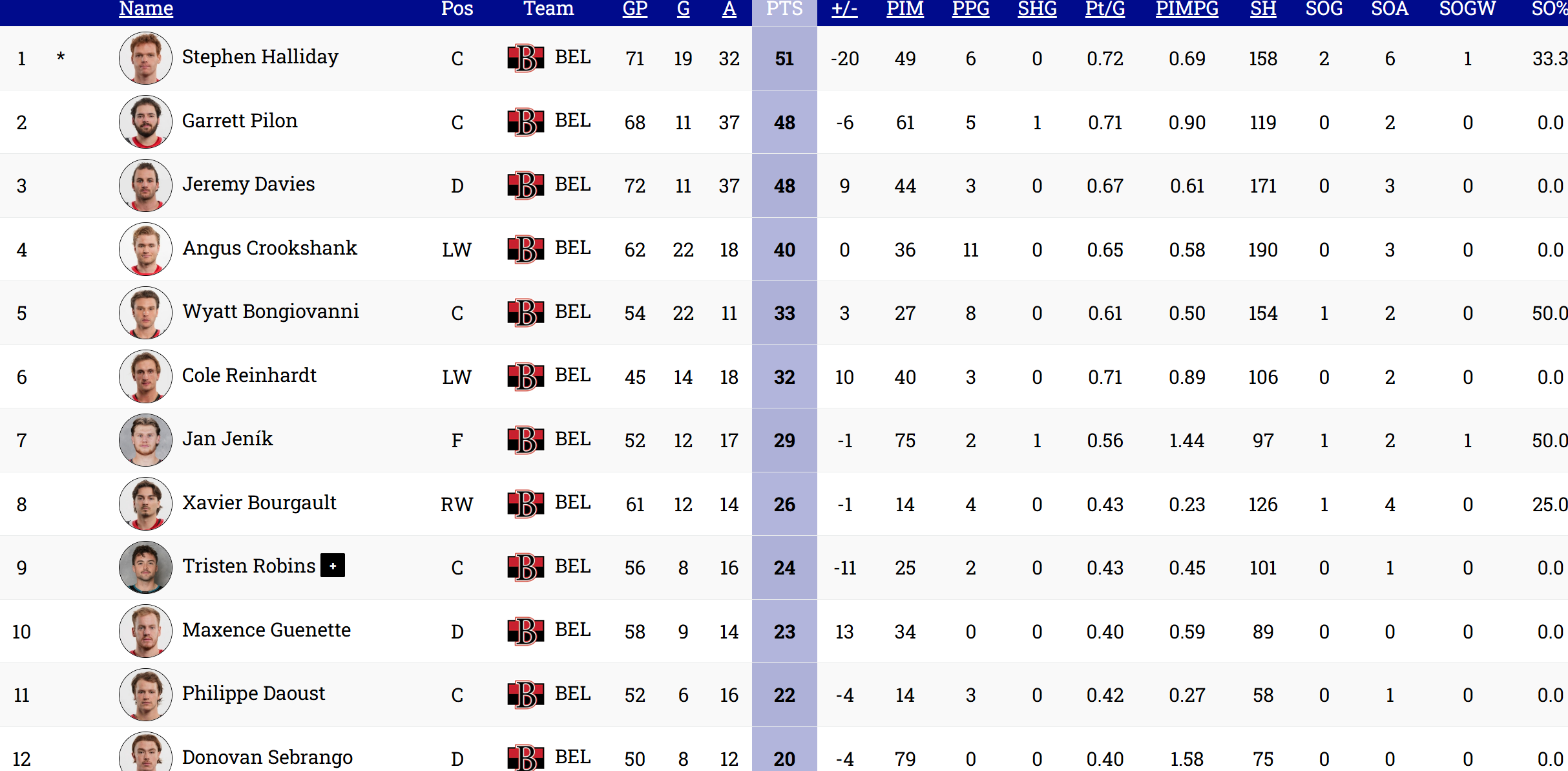
Halliday had an excellent rookie season, despite being hobbled by ECHL linemates to start the season (8-0-2-2; Rees/Boucher). His totals might not have been as halcyon as hoped, but are enough to confirm there is NHL potential, even if his defensive play needs work. He should dominate next season.

For Crookshank, this is the season where I’ve finally given up on his NHL potential. His footspeed is a huge impediment to his style of play (a bottom-six agitator/energy guy), and he’s not quite productive enough to overcome that. He’s excellent at this level, but not suited to the top line.

Reinhardt had a Jack Rodewald-style spike in production, which is not indicative of where his true potential is (ending the season 11-1-3-4). If (if) he has NHL-potential, it’s as a defensively sound depth player with good speed (a bit like a Peter Schaefer). That’s fantastic, but very much remains an if at this stage.

This was a down year for Guenette, which suggests there’s no NHL-potential and he’s simply a useful AHL defender (much like Max Lajoie, who left the org five years ago). Daoust, who was finally healthy, had a decent rookie season, but did nothing to show what the Sens expected when he was drafted (more time is needed, if he’s retained; he had an awful month-long stretch in Jan-Feb, 10-0-0-0).

Sebrango got hot early, but then went back to his typical play for the rest of the season (ending 14-2-2-4). I don’t see NHL-potential in him, although he has shown he can be a solid player at the AHL-level (something that was in doubt when acquired as part of the DeBrincat trade).
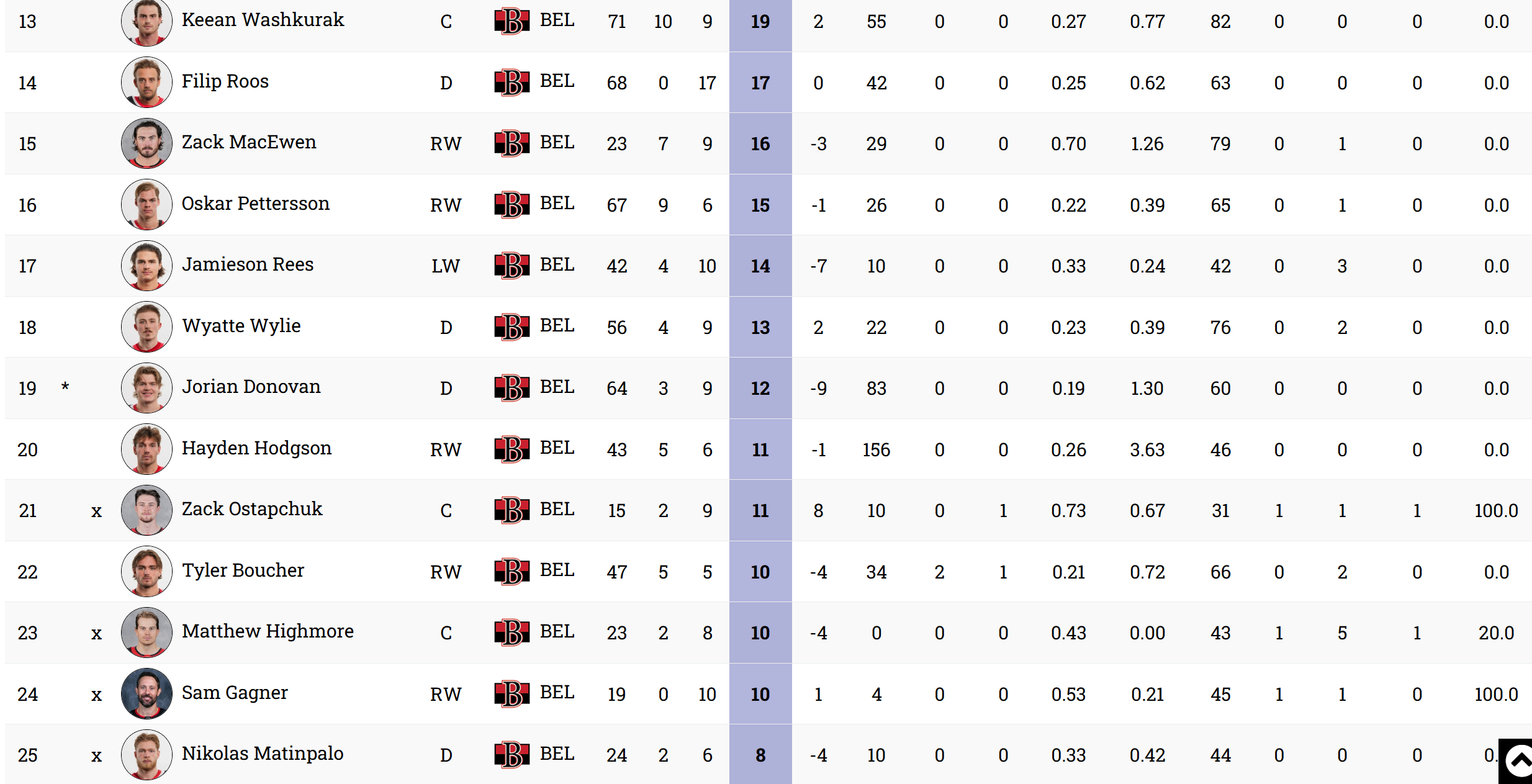

Both Rees and Boucher confirmed that they are marginal players (the former seems more like an ECHLer and the latter may be as well). Donovan had a very rough introduction to the league (20-0-0-0), but did improve as it went on. Toure‘s time in the ECHL helped and his transition was smoother because of it, but it’s not clear either defender has NHL-potential.
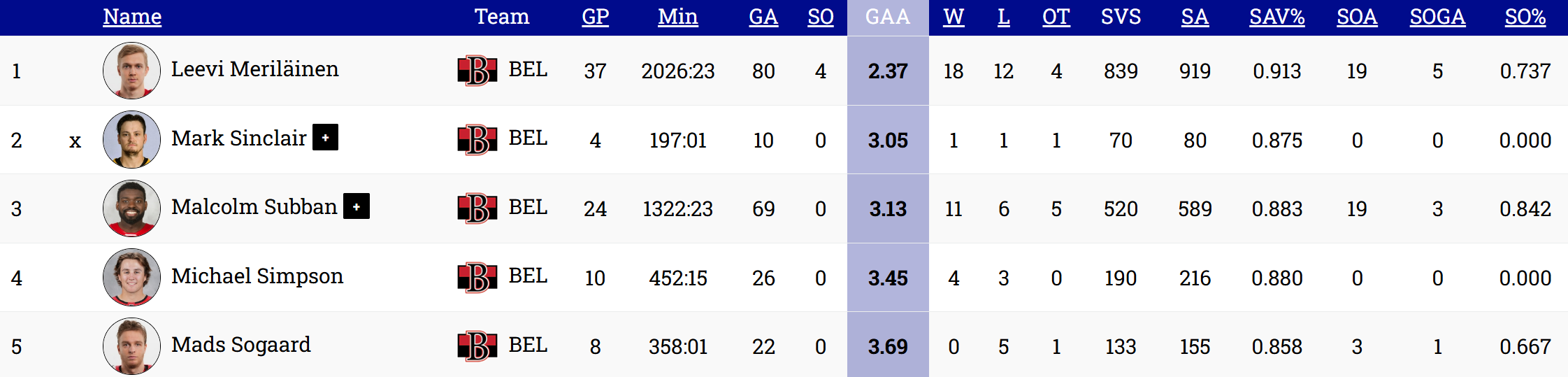
What a disaster this season was for Sogaard, who was hurt (again!) and awful in both the NHL and AHL (career worst numbers). Merilainen was the bright spot, but with no quality goaltender behind him he was overplayed. The Subban story is nice, but he can’t carry the load at this level anymore. The Sens suffered by taking a risk on their third minor league ‘tender as Simpson was not ready (such that we saw the return of Sinclair, who had that role the prior two seasons, but he couldn’t provide relief either). I don’t think goaltending is the only reason the BSens didn’t make the playoffs, but it didn’t help.

Overall, looking at the roster the BSens entered the season with, only Reinhardt and Bongiovanni (along with the aforementioned Halliday) stood out. The addition of Jeremy Davies helped a lackluster d-corps, but the roster was littered with useless additions (Roos), failed reclamation projects (Rees), and prospects with little apparent talent (Boucher, Pettersson). There’s a lot of work needed for both the prospect pool and in Belleville generally.

NHL Playoffs

I was happy to see some playoff hockey in Ottawa and other than the first game it was an entertaining series. It had no echo of the old rivalry with Toronto, as the modern Leafs are an inoffensive team you can’t hate for their style of play. The broadcasting was tolerable, although Craig Simpson remains one of the worst play-by-play analysts I’ve ever heard (my kingdom for Ray Ferraro!). I wasn’t expecting the Sens to win, but they would have been a more entertaining challenge for Florida (they would have lost too, particularly if there was an ‘accidental’ injury to Ullmark).

Playoff viewership numbers for the NHL continue to go down (albeit the article linked simply invents reasons for it, rather than digging into the data). This is no surprise, as I’ve been covering this in hockey and sports in general for years (and years, and years, and most recently). No one cares about Florida (or any of the sunbelt teams) and that will never change–hockey is too expensive and requires too much real estate to saturate communities already invested in other sports. When anyone can play basketball or baseball or soccer at virtually no cost (and the bar of entry for football isn’t high), there’s no room for hockey outside regional areas (mostly in the north). The league dodged a bullet by Dallas losing, as no one would watch Florida-Dallas. The smart thing for Bettman to do is relent and allow a Canadian team to win (the logic against it has always been: Canadians watch anyway and their market is saturated, so encourage/support the American base by having those franchises win). Giving the league’s only superstar (McDavid) a Cup makes sense (a bit like Ovechkin’s in 2018) before we go back to seeing unwatchable, marginal teams win in meaningless markets.

This article was written by Peter Levi

Sens Off-Season Continues to go off the Rails

Fans in Ottawa live in a myopic bubble where everything is positive until you can’t ignore reality anymore. Thankfully, outside this space you can get a reality check and we have one from The Athletic‘s Dom Luszczyszyn: “Everything else [besides the Ullmark trade] the Senators have done has only hurt their playoff chances. The Jakob Chychrun trade was a disaster. Not qualifying Erik Brannstrom probably wasn’t wise. And signing Michael Amadio at the expense of Mathieu Joseph didn’t make a whole lot of sense given the latter is probably cheaper and better.” He gives the Perron deal a pass (which I don’t) and this was written before the deals discussed below. The Chychrun trade in particular is one of those that, in future, will be in the hall of fame of the org’s bad deals.

What’s irritating about all this as a fan is that this counternarrative is ignored locally. Why the silence? Clicks? Access? The latter appears to be the case for Nicholls, as he’s landed work at The Hockey News, but the days of he, Ary, and others actively challenging the org seems passe except after the fact.

Speaking of dumb moves, they continue. The Sens jettisoned one of their only remaining talented prospects by sending Roby Jarventie to Edmonton for spare parts (and to be clear: most prospects don’t pan out, but in terms of talent this trade is a joke). Let’s look at what came back.

Xavier Bourgault, 10/02, 6’0, CR/RW, 1-21/21 Edm
23-24 55-8-12-20 0.36
23-22 62-13-21-34 0.55
Career 117-21-33-54 0.46

The former first-round pick is on the decline, having shown nothing in his first two seasons as a pro (Jarventie‘s career AHL numbers aren’t massively higher, 0.63, but if you eliminate his rookie season, he’s 0.81, close to double Bourgault). There’s not much room on the BSens roster for the new addition, so the point in acquiring him seems to be getting rid of Jarventie. The justification for the trade is that Jarventie is injured too much (I guess Chabot and Tyler Boucher are also on their way out) and “Bourgault is a fairly one-dimensional, offensive player, and he wasn’t being put in a position to succeed with the Condors, and he wasn’t the only one. There is a lot more talent with Bourgault than was shown over his last two seasons. His final season in the Quebec Maritime Junior Hockey League was his best and he posted 75 points in 43 games.” We’re basing everything on part of a season in the Q? Why? There’s no sign of this in the AHL and unlike Jarventie his performance is dropping. There’s no reason to imagine a turnaround.

Jake Chaisson, 05/03, 6’2, RW, 4-116/21 Edm
23-24 ECHL 68-9-11-20 0.29
22-23 WHL 70-20-38-58 0.83

This part of the deal reminds me a great deal of the org acquiring Graham McPhee (an Oiler castoff with no apparent talent). His ECHL numbers are abysmal, so I don’t expect him in Belleville unless there are injury problems. Undoubtedly he was someone the Oilers wanted to get rid of and Staios can’t turn down a bad player when offered one.

In a more minor deal, the Sens sent qualified third-stringer RFA Kevin Mandolese to Colorado along with a 7th round pick for a 6th. That’s not much value for the asset, but at least it’s something back as opposed nothing. With Sogaard re-signed it means he and Merilainen will carry the load for Belleville (which is fine).

The BSens signed blueliner Wyatte Wylie to an AHL-contract. Let’s take a look:

Wyatte Wylie, 11/99, 6’0, DR, 5-127/18 Phi
23-24 45-2-11-13 0.29
22-23 45-3-7-10 0.22
21-22 65-5-13-18 0.0.28
Career 176-11-37-48 0.27

An offensively gifted player when drafted from the WHL, he’s had an unremarkable career in the Philadelphia and LA systems. The BSens, with the loss of Thomson to the SEL, are short on the right side, so he arrives to help shore that up. He’s essentially a more talented version of part-time blueliner Ryan MacKinnon, who has departed to play in the Slovakian league.

The team also signed Keean Washkurak:

Keean Washkurakm, 08/01, 5’10, CL, 5-155/19 Stl
23-24 63-4-6-10 0.16
22-23 45-10-3-13 0.29
Career 175-27-19-46 0.26

The undersized forward has had an unremarkable career in the AHL after a similarly unremarkable career in the OHL. Clearly signed for depth, I’m not sure what he’s supposed to bring to the table besides a pulse.

I got what might be an indirect shoutout from NKB (as the org is still on the Titanic post-Dorion).

This article was written by Peter Levi

The Staios Nightmare Unfolds

Having spent time so much time covering Pierre Dorion, I know what incompetence feels like and this off-season feels very familiar. We had hints of this at the trade deadline with the awful Tarasenko trade (along with the inability to move either Joseph or Brannstrom), but that was just an appetizer. Every GM across the league should be picking up the phone to call Ottawa (as St. Louis did, getting Mathieu Joseph not just for nothing, but with a 3rd-round pick thrown in). I’m going to go through the latest roster moves and we can share the pain together. To save those of you who just want to skim for what I liked or disliked, I’ve colour-coded that with green for good, red for bad, and no highlight when I think it’s mixed.

Chychrun for Jensen/3rd-rounder (2026)
It’s difficult to imagine a worse trade. To quote The Athletic: “There’s no way to say right now just what the market on Chychrun was, but it’s fair to call it a highly underwhelming return.“. The Sens gave up on a signed, 26-year old dynamic blueliner who is finally healthy, affordable, and wanted to be in Ottawa, for a declining 33-year old blueliner coming off his worst year via analytics. I’m sure he’s good in the corners and I know he plays the right side, but he’s old, overpaid, and won’t be here long. Org defenders have come out with the refrain: “Chychrun was a sunk cost, so there is no use complaining about that anymore.” This is ridiculous (as one can see from The Athletic‘s reaction–and frankly everyone’s from outside the local market). Acquiring Chychrun is one of the few good trades from the Dorion regime and Staios’ failure to handle an asset (again!) simply illustrates he’s struggles as a general manager. It even fails in comparison to Dorion’s terrible DeBrincat trade, because he at least Dorian got a 1st-round pick. One can imagine Staios in the same scenario impatiently trading straight-up for Kubalik and a 4th-rounder.

What’s clear from the above and what follows is that Andlauer has given Staios a free reign and has no idea how to handle hockey assets. There’s positives in that he won’t interfere, but if he doesn’t have a meaningful understanding of hockey, a terrible manager can linger like Jarmo Kekalainen for years.

FA signing David Perron
He’s 35, so he can’t be bought out; he’s coming off his worst year via analytics ever (link above); and he’s signed with term for 4 million. I was trying to figure out the internal logic for this one and I think the org has done it projecting to the 25-26 season, after Giroux walks, is traded, or retires. Perron becomes a less expensive veteran in the lineup and clearly the org wants an older player in their top-six. Of course, Perron isn’t remotely as good a player as Giroux is. My problem, putting the questionable logic aside, is his cap hit, trajectory, and the inability to do anything with him if he completely falls off.

Re-signing Shane Pinto
There was never a question that he’d be re-signed, just for what and how long. The cap hit is fine (3.75) and while the term is short (two years), given all contracts coming off the books it’s possible for the team to keep him (at that point the state of Josh Norris should be clear–the worst case scenario for the Sens is Norris gets healthy but is a shadow of his former self).

Nothing for Mathieu Joseph and a 3rd-rounder (2025)
It’s amazing how easily Staios throws up his hands and gives up on players. Not only did he give Joseph away (having replaced him with someone only marginally cheaper in Amadio), he had to include a pick as well. I’m sure ‘sunk costs’ will explain this one locally too, but there’s no excuse for this. I’ve been eager for Joseph to go for a long time (based on the absurd contract Dorion gave him), but to get nothing in a market when talented players can be acquired for Nick Jensen is inexcusable.

Nothing letting Erik Brannstrom walk
I know, I know, ‘sunk cost’ mumble mumble couldn’t find a trade partner. Yet another complete fail without getting anything for an asset. What’s funny is that with both this and Chychrun‘s departure, the Sens are now lacking talent and skill on their blueline. Chabot is unlikely to ever play much more than half a season, Hamonic isn’t an NHL player any longer, and JBD has his own issues. The decision seems to be gambling on Kleven and simply hoping the puck magically moves from the blueline to the forwards.

FA signing Michael Amadio
He was with the org before, but this deal seems almost as bad as the Mathieu Joseph contract. Signed for 3-years, he’s a guy who will get the team 25-30 points a year…hopefully. He’s only achieved that on a very talented Vegas team, being much worse otherwise (0.37 with Vegas, 0.22 elsewhere). If there was less term (or cash) I could give it a pass, but the potential down sides are very unappealing.

FA signing Noah Gregor
The team let Parker Kelly walk (something I approve of) and replaced him with Gregor. The org’s rationale is that he’s quicker, while I’d say he’s marginally better offensively (0.26 per game vs 0.20; it’s almost eerie how similar they are as players). It feels like re-arranging the deck chairs on the Titanic.

FA signing Hayden Hodgson (2-way)
A pointless goon signing (especially with McEwen on the roster–someone I fully expect to play in the minors where he’s also a productive forward). He’s slightly more talented than Imama (0.34 vs 0.23), so that’s the silver lining, but he’s an unnecessary addition.

FA signing Filip Roos (2-way)
The big Swede hasn’t show much as an AHLer (0.28) and I have no idea where you play him (even with Kleven in the NHL there’s still five d-men on the left side). I find the choice baffling, but at least it’s not a veteran slot.

FA signing Jeremy Davies (2-way)
This makes a bit more sense to me, as the veteran is a puck mover at the AHL-level (0.49). The BSens haven’t brought in a player like him in quite some time (the last time they did it successfully was in 2012-13, with Andre Benoit, but the last time they tried was Michael Kostka in 2015-16), leaning on prospects to do that from the blueline, so I like the idea behind the move.

FA signing Adam Gaudette (2-way)
We’ve seen this movie before, but at least he’s not been signed for the NHL roster. He’s a very productive AHL-scorer and a welcome addition.

Retained AHL vet Garrett Pilon
While his regular season was just average, he was good in the playoffs. I don’t mind the two-year contract, as there’s not much coming through the Sens pipeline now.

The Sens have a few more RFA situations to sort out, but none are of immediate NHL-impact nor do I think any of them will be difficult to sort out. I’m not clear on why they qualified Kevin Mandolese again, but he is insurance at the AHL-level.

There’s not much cap room left, but if Norris is unavailable to start the season (which is my assumption), the team will need two players on two-way contracts to fill out spots on the third and fourth line (there are plenty of options for both). I’m also assuming Kleven is in the mix for the defensemen, so on paper the lineup is set. Is it a good lineup? That’s a different question and I’ll leave that for a separate discussion.

As a post-note, I missed Kyle Betts being re-signed to an AHL-deal with Belleville back in March. It’s a move I’m fine with. Betts won’t blow anyone away with his skill, but he can plug-and-play as a fourth-liner, which is a useful thing for the BSens to have.

The BSens also retained Bell as their head coach while replacing both his assistants with Stefan Legein (from the WHL), and Andrew Campbell (from the OHL). Gone are assistants Chris Dennis and Nathan McIver (I have no idea if the change is a conscious one from the org or if both simply moved on).

This article was written by Peter Levi
The Ullmark Trade, Re-Signings, and the Draft

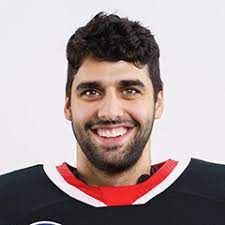
While I was not happy with Steve Staios at the trade deadline (cf), he did manage to undo one of the bigger Pierre Dorion flubs by dumping Joonas Korpisalo on the Bruins in return for one year of Linus Ullmark. The Sens were also able to get rid of a worthless one-way contract in Mark Kastelic, but had to give up a first-round pick in 2024, which the Bruins used to select 6’6 center Dean Letourneau. It’s a much better hockey trade for Boston (who already tried and failed to move Ullmark at the deadline), but this wipes the slate clean for Staios by getting him out from under the Korpisalo (and Kastelic). This frees his hands when it comes to goaltending, as both Ullmark and Forsberg have just one year left on their deals, while the Kastelic move creates opportunity for players like Crookshank, Jarventie, Halliday, etc. [After writing the bulk of this I learned that the Sens are not qualifying Erik Brannstrom, which is a suitably botched ending to the Mark Stone trade–yet another reason why Staios failed the trade deadline]

Linus Ullmark, DOB 93, 6’4, 6-163/12 Buf; 1yr remaining
2022-23 .915 2.58
2021-22 .938 1.89

Ullmark has never been a #1 goaltender before, at best being the 1A for Boston in 21-22. He’s been awful in the playoffs (including in the AHL), but the Sens won’t be a playoff team, so that’s not relevant. He’s played on bad teams before in Buffalo and put up better numbers than Korpisalo, Forsberg, Matt Murray, etc, in that situation, so he’s an improvement. To me the ideal circumstance is to move him at the deadline for other assets. The only hesitation here is that he’s never handled a starter’s workload in the NHL and it’s unclear how he’ll respond to that.

Besides the big trade, Staios has also been busy re-signing various players (mostly RFA’s) to two-way deals (you can see how their seasons went here). In order:
Angus Crookshank (50-24-22-46) – a one-year deal; this should be the transition deal where he graduates to the NHL team or is moved elsewhere; I like him quite a bit, with the potential issue for him being speed
Cole Reinhardt (56-8-15-23) – one-year; statistically on a down year, but he’s not in the org to produce; definitely a make or break season as I think he has to define a niche and excel in it (PK/energy role suits him best)
Maxence Guenette (58-7-27-34) – one-year; while he established himself as the top offensive blueliner in Belleville, he also trailed off as the season wore on; he’ll need to show more consistency next season
Nikolas Matinpalo (67-4-10-14) – one-year; the undrafted Finn is good defensively, so I think continuing that trend while being more physical and adding a more offense is what I’d look for
Jamieson Rees (51-0-8-8) – one-year; an absolute disaster for both Carolina and Ottawa, the Sens are banking on him rebounding somewhere close to the form he had in 21-22 (otherwise he’s a complete bust)
Wyatt Bongiovanni (48-16-9-25) – one-year; unlike Rees above, he did respond to the move to Ottawa and has been rewarded; he needs to produce, so that’s what to look for
Matthew Highmore (43-9-22-31) – one-year; the only UFA on this list, I suspect the team likes his versability, where he can function in the NHL while also doing his duty in the minors
Michael Simpson (OHL .905 2.61; AHL-deal) – one-year; undersized (6’1) undrafted OHLer signed to serve in the ECHL

One thing I didn’t discuss was the AHL playoffs for Belleville. To briefly recap: the Sens won their opening round 2-1 than lost 2-3 in the next. Halliday was the highlight among prospects (leading the team in scoring), with a trio of veterans doing most of the rest of the work. Generally the prospects wilted in the playoffs, with Sogaard erratic between the pipes.

For those who have read my coverage for a long time you know I like taking risks on skill and goaltending–the two rarest things in the NHL. The Sens have long preferred to take risks on grinders, tough guys, and defensive stalwarts. This approach echoes most of what Ottawa’s commentators ask for. This approach has caused the prospect pool to dry up we can see that the scouting team under Steve Staios still operates under that principal. Neither Scott Wheeler nor Corey Pronman‘s liked their draft.

In reflecting on these picks, it’s worth noting that despite incessantly picking from the US systems, the Sens have a terrible track record with those picks. Gonig over the trends from 2008 to 2021 (the Dorion era forward; success is equal to 400 NHL games or where we can presume it; for some younger players it’s TBD; I put first-round picks in green since that’s as close to idiot-proof as you can get):
US systems (24): Dzingel, (Daccord), Tkachuk, Pinto, Sanderson
WHL/BCHL (18): Smith, Grant, Stone, Lazar, (Greig)
Sweden (16): Karlsson, Silfverberg, Lehner, Zibanejad
OHL/CCHL/etc (14): Borowiecki, Noesen, Ceci, (Formenton)
QMJHL (11): Hoffman, Pageau, Chabot, Batherson
Finland (4): none
Germany (1): Stutzle
Out of 88 total picks, 27% are from the US systems, much more than the 20% from Western Canada in second (the combined CHL is much more, of course, 49%, but that’s to be expected). Despite that US preponderance, those selections aren’t ahead in terms of success, sitting tied with the West, Sweden, and QMJHL (and just ahead of the OHL). To me that suggests the org needs to reevaluate its US scouting.

1-7 Carter Yakemchuk, RD, 6’3, WHL, 66-30-41-71
Lead the blueline in scoring and was second on the team overall; this is the one pick the aforementioned analysts actually liked, although it’s higher than the consensus listings. The criticisms of him (and why he wasn’t a top-five consideration) is based on his defending and mental mistakes. Defense is easily taught, but mental errors are harder to fix.

2-39 Gabriel Eliasson, LD, 6’7, Swe-J20, 36-1-5-6
Will be going to the NCAA from Sweden; amongst the worst producers on his team; the negative sentiments from scouts about him are overwhelming; the Sens are hoping his unique size and onery temperament will be enough to carry him through–it’s unlikely, but the org likes taking these kinds of risks based on size (Djibril Toure, Ben Roger, Chandler Romero, Filip Nordberg, Theo Wallberg, etc); like the pick above, he went ahead of projections. From Pronman: “He is a player some evaluators love because of how hard he plays, but there is some real doubt he can make even basic plays versus pros.” Wheeler: “I didn’t rank him on my board after watching him get in his own way more than any defenseman I’ve scouted in 11 years of doing this. He is the most undisciplined player I’ve ever watched and has shown no ability to play with any restraint

4-104 Lucas Ellinas, LW/CL, 6’2, OHL, 67-16-17-33
Plays with fellow Sens’ pick Andonovski; he was 7th in scoring; scouts liked his shot and work ethic; it’s worth noting he’s already had shoulder problems and there are mixed feelings about his skating (Pronman thinks it’s not good, Wheeler says he has good speed).

4-112 Javon Moore, LW, 6’4, USHS, 28-26-27-53
The pick acquired from Detroit in the DeBrincat trade; was third on his high school team in scoring. Pronman: “I didn’t think he dominated high school opponents like his talent dictated he should, whether it was due to so-so hockey sense or too much perimeter play.

4-117 Blake Montgomery, LW, 6’4, USHL, 58-22-21-43
The pick acquired from Tampa in the Paul trade; third in scoring on the team, but first in points-per-game; picked slightly ahead of projections. Pronman: “he’s a great athlete who has some physicality and OK skill that will make him appealing to NHL teams.

5-136 Eerik Wallenius, DL, 6’4, Finn-U20, 14-3-5-8
Bounced between leagues (as is normal for younger players in Europe), but in limited action was the most successful offensive blueliner. Pronman: “His mobility isn’t great … and I don’t see the top-level puck play to compensate for that.

(Ottawa’s 3rd-round pick was lost to Chicago in the DeBrincat trade; the 6th-round was lost to Carolina in the inexplicable Rees trade; the 7th-round pick went to Toronto in the Murray trade.)

There’s a pretty obvious theme in the players above and that’s size. Nearly all the players were taken ahead of projections and are projects (many of which verge between bust and depth). This tendency goes back to Troy Mann and thus far none of the ‘truculent’ players have panned out. The successes Mann had were risks on skilled players (Batherson, Pinto, etc). How many Tyler Boucher‘s can you draft before the lesson sinks in? Apparently there is no limit. (Tangentially I have to comment on lazy writing from The Silver Seven on the later prospects–using the Google machine won’t hurt you Beata!)

The odds of Yakemchuk working out are good, because top-ten picks usually do (Boucher is an exception), but we’ll have to see with the rest of the crew, none of whom are coming soon. On the surface this isn’t a great draft, but I want to see some results before I take a strong stance on it.

This article was written by Peter Levi

Belleville’s 2023-24 Regular Season

With the BSens in the midst of the playoffs, let’s take a look at the season that was. The team finished 38-28-6, with 209 GF and 211 GA. This is a 7-win, 10-point improvement over the season before, with the team scoring 24 less goals and allowing 47 less. The year closely mimics 21-22 (both in terms of winning percentage and the low goals for/against), where the BSens qualified for the playoffs and then were swept 2-0 by Rochester.

Belleville’s top scorer (Pilon) was 66th in the AHL, but if you go by points-per-game and cut players who played less than 20, things improve a little as Crookshank was 33rd. Sogaard finished tied for 10th in the AHL for save percentage and GAA. Let’s look at the basic stats before a further breakdown (rookies are in italics; ECHL fill-ins who played significant time are in blue; any significant change in performance is noted in green (positive) or red (negative)).

Stats

Forwards
Angus Crookshank 50-24-22-46 0.92 (+0.26) NHL 13-2-1-3
Roby Jarventie 22-9-11-20 0.91 (+0.16) NHL 7-0-1-1
Garrett Pilon 62-18-29-47 0.76 (+0.16 AHL career average)
Matthew Highmore 43-9-22-31 0.72 NHL 7-0-2-2
Wyatt Bongiovanni (t-Win)14-8-2-10 0.71
Rourke Chartier 19-7-6-13 0.68 NHL 37-2-1-3
Egor Sokolov 71-21-25-46 0.65 (-0.19)
Stephen Halliday (NCAA) 10-0-5-5 0.50
Josh Currie 62-12-17-29 0.47 (-0.19 AHL career average)
Jiri Smejkal 47-9-13-22 0.47 20-1-1-2
Matthew Boucher 17-2-6-8 0.47 (+0.15)
Zack Ostapchuk 69-17-11-28 0.41 NHL 7-0-0-0
Cole Reinhardt 56-8-15-23 0.41 (-0.11)
Jamieson Rees (t-Car) 14-0-4-4 0.29
Oskar Pettersson (SEL) 29-3-4-7 0.24
Tyler Boucher 21-2-3-5 0.24
Bokondji Imama 53-3-7-10 0.19 NHL 6-0-0-0
Brennan Saulnier 36-3-4-7 0.19 (-0.31)
Graham McPhee 33-4-2-6 0.18 (+0.11)
Tarun Fizer 30-2-3-5 0.17
Kyle Betts 56-5-4-9 0.16 (+0.08)
Jarid Lukosevicius 19-2-1-3 0.16 (-0.09)
(Philippe Daoust only played 4 games before injury ended his seasonagain!)

Defense
Maxence Guenette 58-7-27-34 0.59 NHL 7-0-0-0
Jacob Larsson 61-7-26-33 0.54 (+0.23)
Tyler Kleven 53-5-16-21 0.40 NHL 9-0-1-1
Lassi Thomson 67-6-15-21 0.31 (-0.28)
Nikolas Matinpalo 67-4-10-14 0.21 NHL 4-0-0-0
Donovan Sebrango 35-0-7-7 0.20
Dillon Heatherington 60-3-7-10 0.17 (-0.08)
Ryan MacKinnon 29-0-3-3 0.10

Goalies
Mads Sogaard 18-9-3 2.45 .916 (+0.23) NHL 6-1-3-0 .859 4.05
Leevi Merilainen 10-9-1 2.87 .906 (Liiga)
Kevin Mandolese 10-9-2 3.07 .901 (+0.11)

Powerplay Production
Sokolov 10-10-20
Crookshank 6-9-15
Guenette 3-12-15
Larsson 1-14-15
Pilon 6-7-13
Highmore 2-10-12
Currie 3-6-9
Ostapchuk 7-1-8
Jarventie 2-4-6
Thomson 0-6-6
Smejkal 3-1-4

The injury woes for the org are hitting the point where you wonder if there’s a problem with how they’ve been managed. Jarventie and Daoust suffered significant injuries again, not to mention Tyler Boucher (although his problems pre-existed).

The collective veteran shrapnel Pierre Dorion signed in the off-season had mixed results, but overall it’s a pass–no homeruns, but no utter failures either. Jason York’s favourite player (possibly one of the greatest to ever play in any league), Chartier, had average numbers when with the BSens (and abysmal ones in the NHL).

Crookshank‘s strong year echoes his debut (20-21) so I see it largely as a sign of his full recovery over the injury that cost him the 21-22 season. The strangest year is from Larsson, who with first PP time hit career numbers after nearly 400-games as a pro. It’s an anomaly and not something to get too excited over. As for the European free agent experiments, Smejkal‘s offensive numbers are slightly disappointing and I suspect not good to be retained (he’s a UFA). As for Matinpalo, he wasn’t brought in to score, and I think he did what was expected of him. I don’t know if he’ll be retained (he’s an RFA), but I see no harm in doing so. Coach Bell was not a fan of Thomson, who was on the second PP unit most of the season (he’s been scratched twice in the playoffs as well), which is a significant reason for why his numbers are down. I have to assume the disconnect with his coach is his defensively play (something I haven’t noticed, but I haven’t watched all 72-games).

Of the prospects signed the one to make an impact is Stephen Halliday, who is the only significant offensive depth pick the Sens have made in years and he’s continued to perform well in the playoffs. It’s early to judge, but at least at the AHL-level he’s a steal (and a slap in the face to Troy Mann’s stated philosophy of no longer drafting for skill in later rounds).

As for the goaltending, with better defense in front all the goaltenders’ numbers improved. Mandolese, however, remained incredibly erratic. Merilainen was also erratic, but as a rookie that’s less of an issue. Sogaard had issues early in the season, but slowly settled down (I have yet to see the kind of consistent play needed for the NHL, however).

Overall I’d call the season average. My expectations for Bell were low and it’s not clear he made any significant impact on younger players, all of whom performed about as expected. Older prospects generally did worse (Sokolov, Thomson, Reinhardt), so where Bell shined was with veterans (as much as he did shine). Defensively the team was better, but I think that’s unrelated to Bell and more about not suffering through the parade of goaltenders due to injury from last year. I think for the season to truly be a success they need to win another playoff round, otherwise it is, as I said, average. If the org keeps Bell going forward I can live with it, but I think there are better voices out there to help prospects.

This article was written by Peter Levi

Sens Acquire Two Minor Leaguers and Sign Halliday

Under the radar Sens GM Staios made a couple of minor league deals about a week ago (March 15th), acquiring failed Winnipeg asset Wyatt Bongiovanni for nothing (future considerations) and sending their 6th round pick for failed Carolina asset Jamieson Rees. The former deal I greet with a shrug of the shoulders–it costs nothing and the BSens are short on useful forwards, so why not try? I’m less enamored with the second deal, since dumping picks for questionable assets is a poor use of draft capital. Let’s look at both players.

Wyatt Bongiovanni, DOB 99, CL, 6’0, undrafted
2021-22 NCAA 42-16-18-34 0.81 (2nd)
2022-23 AHL 56-13-5-18 0.32 (11th)
2022-24 AHL 34-8-7-15 0.44 (10th)

A relatively unremarkable USHL player who moved on to Quinnipiac where he was much better; he finished his final NCAA season second in scoring to the undrafted, undersized defenseman Zach Metsa (who is having a decent season with Rochester as a rookie). Was he unproductive on the Moose or was he not given the opportunity? Given that the Jets gave him away I’m leaning towards the former.

Jamieson Rees, DOB 01, CL, 5’10, 2-44/19
2021-22 61-7-17-24 0.39 (8th)
2022-23 65-14-28-42 0.64 (3rd)
2023-24 37-0-4-4 0.11 (sub-12th)

The OHL grad’s career has derailed after a solid third AHL-season last year. He’s never been dominant in the minors and I don’t see the NHL upside, so I’m lost on why the Sens want to take a flier on him (as in, what’s the hope for him with the org?). Barring a late season surge this looks like a fail off the hop. For those with good memories (or a nose for trivia), Rees has an Ottawa connection, as the pick used to draft him was part of the Erik Karlsson deal, subsequently traded away to draft Mads Sogaard (cf).

We had one other transaction that I’ve expected for some time: signing Stephen Halliday to his ELC (cf for projection thoughts).

Stephen Halliday, DOB 02, CL, 6’3, 4-104/22
2021-22 62-35-60-95 (1st)
2022-23 40-9-32-41 (1st)
2023-24 38-10-26-36 (1st)

For once the Sens drafted for talent in the later rounds and he’s proceeded to lead his team in production every season. The BSens are desperate for scoring (something neither of the two players above can solve) and the org in general needs a talent-injection. Here’s hoping he can provide that (certainly his size gives him the option of being more than just a scorer as well). If his description sounds a little bit like failed picks Todd Burgess (4-103/16) and Jakov Novak (7-188/18) it’s worth noting that Halliday was much more productive than both as a college player. He was, incidentally, playing with Sens prospect Theo Wallberg who has turned poor USHL production into solid NCAA production as a rookie, which is encouraging.

This article was written by Peter Levi
Staios/Andlauer: Too Patient?

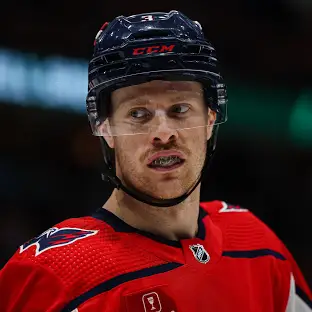
One of the mantras we hear from the Sens’ new ownership and GM (directly and through the media) is patience. They want to assess things. Abstractly this is a good thing–you don’t want to rush decisions. However, it’s beginning to feel like this might be beyond patience and simply reflect indecisiveness. Let’s look at some examples.

Pierre Dorion
Everyone knew he needed to go–from his disastrous trades and signings, to his mixed draft record, to his absurd comments in the media about expectations (Cup challengers in 2018 to the rebuild being over every year from 2019 onwards). Instead of firing him, Andlauer did nothing until the NHL nuked him from orbit.

D. J. Smith
I have no idea if Smith could find success in another situation, but nothing about his prior performance suggested he could take the Sens roster and lead it anywhere. Rather than making a change, he was allowed to coach the team to a limp 11-15-0 record with no signs of improvement before getting replaced by the long retired Jacques Martin.

Goaltending
It didn’t take a crystal ball to guess that the Korpisalo-Forsberg tandem was going to struggle–I called it out when it happened. I’m not sure I expected them to be this bad, but Korpisalo‘s play with a better defensive team in front of him is close to his career worst season in Columbus (2021-22). Forsberg, on the other hand, is having his career worst performance. Ottawa has talent in the minors, but Sogaard is not ready for prime time (he’s only 23), despite a career year in Belleville (the BSens have overplayed him). What should have happened ASAP was moving one of the vets (Forsberg because his contract is easier to move) and gamble on someone else while waiting until the off-season to buyout Korpisalo. Instead, the two have been left to rot and lose what little value they have.

The Roster
I have more sympathy here because Dorion created cap problems going into the season. That said, when the writing was on the wall in December a lot of moves could have been made (Kubalik‘s value has only gone down as the season has gone on, for example). There’s also been a logjam of veterans in the AHL all year long that has been ignored–it’s not fair to the vets or the players looking for ice time.

I have to think the incessant Chychrun rumours are coming from the team (not just because Ian Mendes won’t stop talking about it, but because we’re seeing the speculation outside the market as well). No one seems to want to make the comparison between he and Chabot for the future (I took a brief look in September, with Chabot picking up yet one more injury since then while Chychrun has been healthy for the first time in years). The only reason to trade Chychrun over Chabot is salary, but I’d much rather move an injury-prone, 8.0 cap hit. Maybe Staios is playing 4D-chess, but there’s no evidence for that thus far.

It doesn’t help that the local media is channeling their inner Don Cherry and demanding more toughness on the team (MacEwen‘s demotion and Kastelic‘s horrendous season having no impact on them). It boggles the mind that in 2024 there are still people who think ‘good in the corners’ (without tangible outcomes being attached to the term) are being seriously bandied about.

This article was written by Peter Levi
Another Lost Season, but Hope for the Future

The Sens have not hit the halfway point of the season, but 38-games in (squeaking past the worst team in the league this afternoon), with no significant help coming on the goaltending front (the LTIR they get from Forsberg just makes room for Pinto), Ottawa is going to miss the playoffs again and I think it’s a fitting final note to the Pierre Dorion regime (the same that had been prematurely declaring the end of the rebuild since 2019). I’d argue Dorion was damaging the organization back from when he simply managed the draft and some blame has to be given to Bryan Murry and Eugene Melnyk for buying into his bullshit. You reap what you sow and Dorion had no idea how to build a winning team despite seeing examples year after year after year (as I went over exhaustively in the link above).

Unfortunately for new GM Steve Staios (how many former NHL players are GMs now? Verbeek, Sweeney, Adams, Conroy, Kekalainen, Nill, Yzerman, Blake, Guerin, Fitzgerald, Drury, Briere, Grier, Francis, and MacLellan–16 if my counting is correct), he has a team that’s too good to rebuild (with a fanbase exasperated by the Dorion rebuild), but not good enough to compete. He has assets he can play with, but not a lot given the teams problems.

I went through the problems about a month ago, so a quick recap:
Goaltending: Korpisalo and Forsberg have been about equally bad, but we’ve had ex-Sens goaltenders post up fantastic numbers behind good defensive clubs (Filip Gustavsson and Cam Talbot). Clearly, it’s not just the goaltending (and shoutout to Joey Daccord, yet another discarded Sens ‘tender who has found success)–how goaltending coach Zak Bierk still has a job is mystery–you can see the erratic results in the minors as well.
Depth: at forward and on defense is not good enough. There’s a long list of players who should not be in the lineup and there’s very little in the system that’s NHL ready to plug those holes.

What can they do? Move bodies. A lot of bodies. Here’s who I would move and why (cap number included), keeping in mind that realistically the Sens (even if they wanted to) could not trade that many players before the deadline so I’ve highlighted them in probability (green absolutely will go, orange is 50-50, and red is my wishful thinking):

Tarasenko (5.0) – he’s on everyone’s list because of his expiring contract, although that will reduce what you can get for him (the Sens will have to take a player back for cap reasons)
Joseph (2.95/26) – Ian Mendes has bought into the hype again (what’s the definition of insanity?), but you sell high and he can’t get higher than now (the Sens problem is his contract–term/cost)
Kubalik (2.5) – he’s 28, on an affordable expiring deal, and you have a prospect who can fill his roll in Jarventie (if not this season, perhaps next), so get something for him
Brannstrom (2.0) – nothing against him, but there’s no space for his role on the team assuming we’re keeping both Chabot and Chychrun (which I would); his age (24) and decent season should increase what you can get for him
Hamonic (1.1/25) – the wheels have fallen off (just like they did in Vancouver); he really shouldn’t have been retained [After I posted this The Athletic listed him as the biggest underperformer on the team, cf, along with Kubalik above]
Kastelic (0.835/25) – there are plenty of suckers for truculence in the league–he’s averaging less TOI than Smejkal when he’s in the lineup–time to go!)
MacEwen (0.775/26) – no one plays less than he does–if you don’t trade him you’ll have to buy him out (which I would do if no one will take him); alternatively you permanently bury him in Belleville
Kelly (0.7625) – he’s on the verge of a career year (over 82 games a whole 15-points) and he’s cheap, but he’s not so good in his role that you can’t replace him with a player with more upside

You’ll note one name I constantly deride is not on this list: JBD. Why? It may be a fluke, but he hasn’t been the trainwreck that he was in the AHL (perhaps the better structure in the NHL makes it easier for him). He’s so cheap (0.805) that he’s harmless to keep if you are shifting out a large number of players (as I’m suggesting). So for now I am holding back on my policy of firing Bernard-Docker straight into orbit.

There are two other players to discuss: Giroux, not because the team wouldn’t want him, but if he wants out. As a player-directed event, we can’t know if that’s an issue, so we’ll leave it be. The other is Zub, largely because of the cap hit and term–I think he’s overpaid (4.6), but it’s not egregious and Sens get cap relief next season, so I doubt he moves.

What about the pipeline Staios is inheriting? How are things in Belleville? On an individual basis it’s a mixed bag. There are some odd things happening (no idea what coach Bell is thinking replacing Lassi Thomson on the PP with Jacob Larsson, who has the offensive instincts of a dead whale). Among the prospects Crookshank and Jarventie are the only ones who have been consistent (although the latter is currently hurt); Sokolov is slowly getting over the worst start of his career; Guenette had a fantastic start but has hit a wall (five game pointless streak and 4 over his last 12); Thomson‘s numbers have cratered (at least in part due to the PP change); T. Boucher and Ostapchuk are finding their feet, and so on. Kleven is the one guy, along with the aforementioned at the top, who might be able to make the transition, but I’d leave him in Belleville for as long as you can to get him the reps as a pro. He’s not a dominant AHLer (yet at least), so he’s going to be a depth player in the NHL if he comes up.

As for the older prospects Dorion gambled on, Smejkal has a lot of components you like, but he’s slow, doesn’t use his size, and doesn’t generate enough offense to make the leap (at 27, he has to be ready now). For the younger Matinpalo (25), defensively he’s got the tools and like all Finnish players the physical side isn’t an issue. The concern for him was production and keeping in mind he isn’t on the PP I’m not convinced there’s enough there. I think he was intimidated during his NHL audition so fans did not get a chance to see him play his game (which is quite good defensively). In a dead season after some moves, I’d be content to see if he can handle being a 6 on the blueline, but whether he has a long term future or not remains in doubt. None of the other assorted veteran players taken off the scrapheap have stood out (Highmore and Currie are underperforming, while Pilon has been average, and there’s still no reason for Imama to be there at all).

What about prospects not currently in the org? Let’s start with those signed:
Toure, 20, RD (OHL 25-6-6-12) – undrafted; an improvement over last year (as you’d expect from an older player), but unclear how well his talent will translate
Hamara (3-87/22), 19, LD (OHL 33-1-11-12) – improvement over last year, but like Toure, I don’t know how well it translates and since he’s not a big guy you want to see numbers
Donovan (5-136/22), 19, LD (OHL 36-9-21-30) – about the same pace as last year, but it’s good to see him maintain high numbers
Pettersson (3-72/22), 19, RW (SHL 22-0-1-1) – roughly the same production in the men’s league as last year, which is a bit disappointing (but not yet a big deal yet)
The bottom three all played in the WJC (absent Russia, making it feel like the 84′ Olympics–does it really matter?), but only Hamara had good results there. It also feels odd that all three OHLers have been traded, but trivial matters aside, nothing that’s happened staples any of these guys as significant NHLers in the near future (if at all).

How about the unsigned?
Halliday (4-104/22), 21, CL (NCAA 21-6-15-21) – similar to last year
Wallberg (6-168/22), 20, DL (NCAA 21-1-12-13) – these are good numbers given his unremarkable USHL season prior
Nordberg (2-64/22), 19, LD (USHL 24-1-10-11) – so-so numbers in a fairly weak junior league
O’Neill (5-143/22), 19, RW (NCAA 14-2-2-4) – coming off pretty terrible USHL numbers last year, this isn’t too bad
Reidler (5-151/22), 19, GL (USHL .902) – he’s played well
Dyck (7-206/22), 19, CL (NCAA 18-0-7-7) – switched schools and the results have improved
Nikitin (7-207/23), 19, GL (BCHL .847) – getting caved-in by tier-2 (which is still a big step-up from the Kazakh league)
Van Tassell (7-215/23), 19, CR (NCAA 12-0-1-1) – unimpressive numbers from an unimpressive USHLer
Stanley (4-108/23), 18, RD (NCAA 14-1-2-3) – fine for a rookie blueliner
Andonovski (5-140/23), 18, LD (OHL 41-3-17-20) – solid improvement over his prior season
Beckner (7-204/23), 18, CL (USHL 29-8-14-22) – similar to his BCHL production

What’s clear here is that, other than Halliday, there’s nothing coming soon and that it’s unlikely what’s coming is anything other than potential depth. There’s always a chance for a surprise, but none of the numbers suggest it.

As for picks, Dorion has peddled away a great many of them. This is what the Sens have the next year (with me assuming they will get Boston’s first-rounder instead of Detroit’s while keeping their own this year and probably next):
2024: 1st (2; Bos); 2nd, 4th (3; Det/TB), 5th, 6th
2025: 1st, 2nd, 3rd, 4th, 5th, 6th, 7th
2026: 3rd, 5th, 6th 7th
This means the Sens have to be in contention by 2026 because of all the capital jettisoned. Staios has to hit homeruns in this (2024) draft, since there’s nothing else on the board prepared for him. The team also has to go back to drafting for talent rather than focusing on grit. Can he do that with Dorion’s scouting team? I have no idea.

Where does this leave the Sens? They have excellent pieces: arguably a top-four (when healthy) and four top forwards in their prime (along with Giroux)–arguably six if Pinto/Greig continue developing, but we have to be careful with assumptions like that. The strange thing for Staios is that it’s what’s surrounding the talent that’s been neglected. He needs to shore up the bottom-six and bottom-pairing and restock the pool. That doesn’t mean drafting for a fourth-line center, that means drafting talented players who can be put in that role for while pressuring the person above them. That’s success–a team with talent throughout. The good thing about that is none of this requires blockbuster trades. It needs good drafting and smart moves and Staios can do both then the team isn’t far from turning this around–just not in time for this season.

This article was written by Peter Levi
BSens Through 22 Games

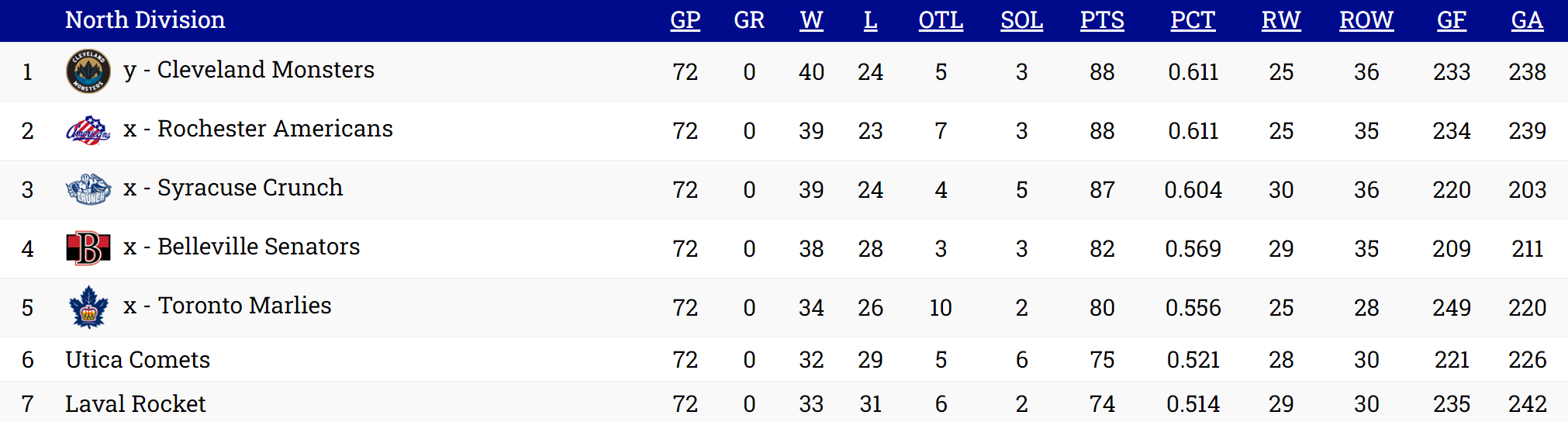
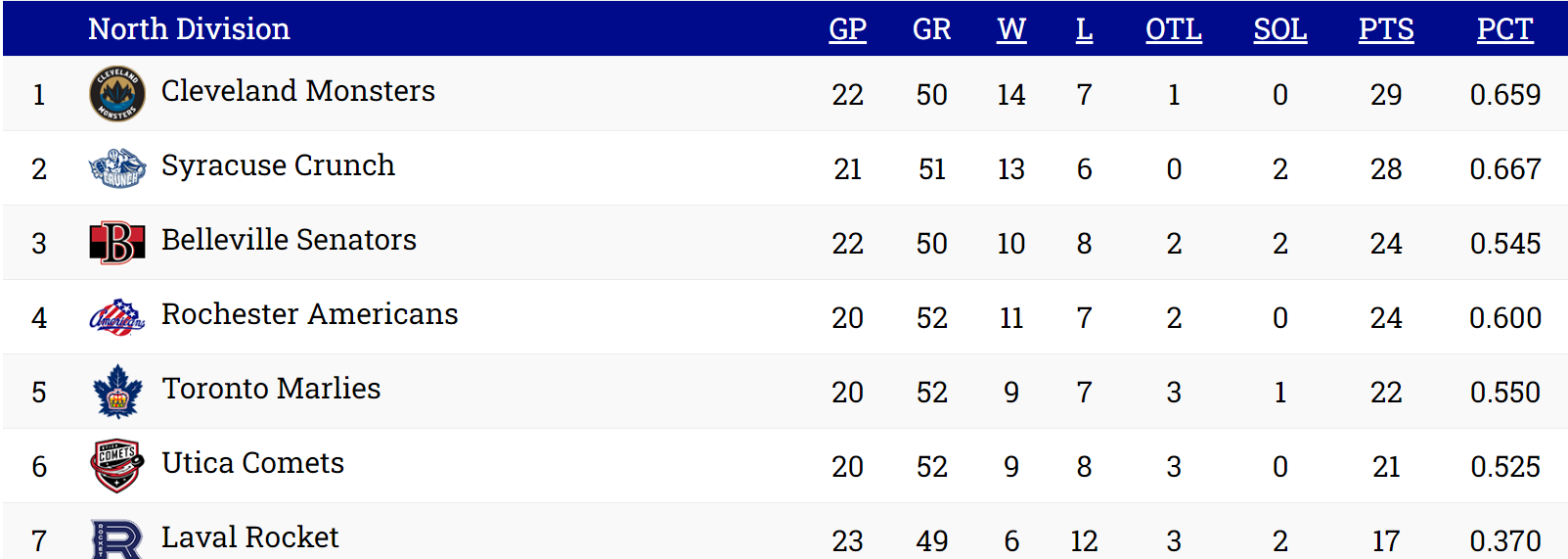
How time flies as the BSens are now at the 22-game mark (here are my comments on the first 10; the schedule made another 10-game segment awkward to do). We’ll start with a snapshot of the standings:

While the BSens winning percentage has barely moved, they’ve technically moved up the standings slightly (although their position via winning percentage is unchanged). The most recent segment: 5-4-3; going 4-2-0 in the division; PP 14.6% (-2.4%); PK 78.7% (-1.8%); GF 39 (+12); GA 42 (+12)–because this covers two extra games we’d expect more goals for/against, but in terms of per-game the team has gone from 2.7 to 3.25 and 3.0 to 3.5 (so both have increased unrelated to the extra games).

Game by Game
2-1 Cleveland (injured: Fizer, T. Boucher, Daoust, Saulnier; Sebrango)
4-6 Laval (injured: Fizer, T. Boucher, Daoust, Saulnier; Sebrango; in Ottawa: Sogaard, Larsson)
2-3 Manitoba (injured: Fizer, T. Boucher, Daoust, Saulnier; Sebrango)
1-8 Lehigh (injured: Fizer, T. Boucher, Daoust, Saulnier; Sebrango)
3-4 (OT) Hartford (Kleven, Larsson returned; Supryka released from PTO; PTO Orrin Centazzo; injured: Fizer, T. Boucher, Daoust, Saulnier, McPhee, Reinhardt; Sebrango)
2-4 Bridgeport (injured: Fizer, T. Boucher, Daoust, Saulnier, McPhee, Reinhardt; Sebrango)
6-3 Utica (Jarventie, Sogaard returned; Merilainen to ECHL; injured: Fizer, T. Boucher, Daoust, Saulnier, McPhee, Reinhardt; Sebrango)
2-3 Rochester (no changes)
4-2 Rochester (no changes)
5-2 Laval (Highmore, Reinhardt, Fizer back; Sogaard injured; Centazzo released; Sebrango loaned to ECHL)
5-2 Grand Rapids (Smejkal to Ottawa; Merilainen recalled)
3-4 (OT) Grand Rapids (Sogaard back from injury)

Individual Performances
I’ve marked those significantly above/below their career averages (cf, where appropriate); @=veteran, *=rookie, #AHL-contract, %=PTO, italics=drafted player. The NHL tallies are year-to-date rather than segment-related.

Forwards
Crookshank 12-7-6-13 (22-9-10-19)
@Pilon 12-5-6-11 (20-8-8-16)
%M. Boucher 12-2-7-9 (14-2-7-9)
Jarventie 6-3-4-7 (12-4-6-10) NHL: 7-0-1-1 TOI 7:31
*Smejkal 10-2-4-6 (17-3-6-9) NHL: 2-0-0-0 TOI 6:51
Sokolov 12-4-2-6 (22-6-6-12)
@Imama 10-1-4-5 (17-1-5-6)
Reinhardt 6-0-3-3 (16-2-6-8)
%Lukosevicius 11-2-1-3 (12-2-1-3)
@Currie 11-1-2-3 (18-2-4-6)
%Betts 11-0-3-3 (12-0-3-3)
*Ostapchuk 12-3-0-3 (22-5-2-7)
@Highmore 3-0-1-1 (12-2-6-8) NHL: 6-0-1-1 TOI 7:59
*#Fizer 3-0-1-1 (11-0-1-1)
%Centazzo 4-1-0-1 [no longer on the roster]
#McPhee 5-1-0-1 (12-2-0-2)
(@MacEwen 4-2-0-2) NHL: 10-0-1-1 TOI 4:45
(#Saulnier 9-1-1-2)
(Daoust 4-0-2-2)

The biggest surprise are Sokolov‘s struggles. I think he’ll snap out of it as he’s well below his career average (0.79 coming into the season, he’s at just 0.54 right now). The other notable is veteran signee Currie, whose struggles are to the point where I have to assume the team wants to move him (there were signs of a decline when he was in KHL). On the positive side, Crookshank is starting to look like the form he had when he broke into the league and M. Boucher is enjoying the most success he’s had at this level as a pro (although that’s probably not sustainable). One trivial note I want to make is that Betts has tripled his prior production last season with the BSens (however anemic that still remains).

Defense
Guenette 12-2-7-9 (22-3-14-17)
Thomson 12-2-3-5 (22-3-5-8)
*Matinpalo 12-1-2-3 (17-2-2-4) NHL 4-0-0-0 TOI 7:00
@Heatherington 12-1-2-3 (21-2-2-4)
*Kleven 6-1-1-2 (10-1-3-4) NHL 5-0-1-1 11:01
@Larsson 9-0-2-2 (18-2-2-4)
#MacKinnon 9-0-2-2 (15-0-3-3)
JBD 2-0-0-0 NHL 18-1-3-4 TOI 16:50
%Supryka 3-0-0-0 (7-0-0-0) [no longer on the roster]
Sebrango [ECHL 4-1-1-2]

Guenette has managed to maintain his hot pace and is the primary offensive driver from the blueline. Thomson is gradually moving back to his usual pace production (0.30->0.41, with 0.59 being the norm), but other than perhaps Kleven the team (as predicted) struggles to generate offense from the back end. It also looks like it will be safe to remove JBD from this list next time as he seems locked in Ottawa.

Goaltenders
Sogaard 1-0-2 (5-3-2 .922 2.51)
*Merilainen 2-3-0 [ECHL 1-1-0] (3-3-1 .901 3.41)
Mandolese 2-1-1 [ECHL 0-1-0] (2-2-1 .889 3.80)
#Sinclair [ECHL 3-4-0]

I mentioned prior to the season that Mandolese is consistently inconsistent and this persists. Merilainen experienced his first bumps as an AHL-pro, but that shouldn’t cause concern and in the ECHL he’s been by far the best goaltender. Sogaard has remained excellent and seems to be back on form after an inconsistent 2022-23.

Powerplay Production (6 goals)
Sokolov 3-1-4 (5-3-8)
Crookshank 1-2-3 (1-4-5)
Guenette 0-3-3 (1-7-8)
Jarventie 0-2-2 (1-2-3)
Smejkal 1-0-0 (2-1-3)
Ostapchuk 1-0-1
Reinhardt 0-1-1 (1-1-2)
Matinpalo 0-1-1 (1-1-2)
(Highmore 1-3-4)
(Thomson 0-2-2)
(Currie 0-1-1)
(Pilon 0-1-1)

The BSens are still figuring out their powerplay as only Guenette and Sokolov are producing consistently. Special teams in general have been poor and I feel like are among the indicators of coaching impact, but there’s still time for things to solidify and improve.

This article was written by Peter Levi
Ottawa Senators Season Wrap-up

The biggest point of discussion right now is not the team but the GM. One of the more hilarious defenses I’ve heard of Dorion is: 1) all his errors are Melnyk’s fault, or 2) all GMs make mistakes (Zibanejad for Brassard could happen to anyone). Ian Mendes points out Dorion is on the threshold of breaking a historical precedent of being the longest employed GM who consistently missed the playoffs (if he finishes next season he will break Carolina’s Bill Peters record of 328 games). Ian has pushed this point by saying if the team isn’t going to make the playoffs, Dorion should step aside (going through the GM’s rather hilarious pronouncements over the years about his goals and the state of rebuild–comments he’s conveniently forgotten). This willingness to push the org is one of the things I like about Mendes and perhaps the reason he’s at The Athletic and no longer hosting TSN 1200 anymore. The Mendes career arc reminded me of the contrast with Travis Yost, who made his name doing journalism about the team on Hockeybuzz, but now restricts himself to analytics on TSN.

As Mendes mentioned, coming into this season, just like last season (2021-22) and going back to 2019-20, Ottawa was supposed to make a serious push for the playoffs. How different has this season been? Let’s look at the raw numbers:

2021-22 33-42-7 224 (26th) 264 (22nd) PP 19.3 (20th) PK 80.3 (13th)
2022-23 39-35-8 259 (18th) 270 (20th) PP 23.5 (8th) PK 80.1(14th)

Finishing with 86 points (13 more than last year), the team was 11th in the east and 21st overall (moving up 5 spots in the standings). The major difference (6 more wins) was due to an increase in offense (35 more goals), as the team gave up slightly more goals (+6), and their PK was essentially unchanged (-0.2%).

Before we have fun and look at offense, let’s look at the part of the game ex-players and coaches spend 99% of their time talking about: defense. Clearly the coach has limited impact, so let’s focus on personnel. What’s changed between seasons?

2021-22
Thomas Chabot, DL, 1-18/15, 59-7-31-38 0.62 (0.60) 27th among d-men
Michael Del Zotto, DL, FA, 26-3-10-13 0.50 (0.36) -> AHL
Travis Hamonic, DR, T-Van (3-80/22, Elias Pettersson), 43-4-6-10 0.23 (0.26)
Artyom Zub, DR, FA, 81-6-16-22 0.27 (0.28)
Nick Holden, DL, T-VGK (Dadonov trade), 76-5-14-19 0.25 (0.28)
Erik Brannstrom, DL, T-VGK (Stone trade), 53-0-14-14 0.26 (0.27)
Nikita Zaitsev, DR, T-Tor (Ceci trade), 62-2-9-11 0.17 (0.26)
Victor Mete, DL, Waivers, 37-0-7-7 0.18 (0.21) -> 9th D in Toronto
2022-23
Thomas Chabot, DL, 1-18/15, 68-11-30-41 0.60 (0.62) tied for 31st among d-men
Jake Sanderson, DL, 1-5/20, 77-4-28-32 0.42 (NCAA) 3rd rookie d-men
Jakob Chychrun, DL, T-Ari (1st 2023, Wsh 2nd 2024, 2nd 2026), 12-2-3-5 0.42 (0.44)
Travis Hamonic, DR, T-Van (3-80/22, Elias Pettersson), 75-6-15-21 0.28 (0.23)
Nick Holden, DL, T-VGK (Dadonov trade), 65-2-14-16 0.25 (0.25)
Erik Brannstrom, DL, T-VGK (Stone trade), 74-2-16-18 0.24 (0.26)
Artyom Zub, DR, FA, 53-3-7-10 0.19 (0.27)
Nikita Zaitsev, DR, T-Tor (Ceci trade)/T-Chi (2nd 2023, 4th 2026 in return for nothing), 28-0-5-5 0.18 (0.17)

The major change year-to-year was the addition of Sanderson, an obvious upgrade, but that only impacted offensive numbers (Chychrun didn’t play enough this season for his effect to be felt). If the top-four can stay healthy, I think the Sens have a competitive group, although the quality of the depth behind them remains untested. How will the roster change? I thought Holden would be allowed to walk (and he was); I think the team will trade Brannstrom (who is ill-suited to the 5-6 spot) with either a sign-and-trade or a direct move. If that’s correct, that means Kleven and JBD move onto the roster (I think Thomson is better than JDB, whose limitations with the puck are exceptional, but I’m not making the decisions–Dorion may give JBD the classic first year two-way, second year one-way to keep his cap number down). I’m unsure about Hamonic–I’d let him walk, but I feel like Dorion will keep him if it’s on a team-friendly deal (he apparently talked to him about a one-year deal).

It’s worth addressing the offensive side of this group. Chabot has settled into a predictable range of production which, while good, is at the bottom end of top blueline producers. Adding Sanderon and Chychrun shifts the group out of the utterly anemic, but it’s unclear if there’s an elite puck mover (Sanderson could get there, perhaps, although that’s not how he was projected when drafted–granted, having read more Corey Pronman than any healthy person should, it’s a default reflex from him to criticize offensive ability); at 25 you’d think Chychrun‘s production won’t change much, but people like Jason York and Denis Potvin think it takes a long time for a blueliner to hit their stride, so increases are possible. A team can win without an elite offensive defensemen, but it’s rare to win to a Cup without one (Carolina in 2006 is what immediately springs to mind).

Let’s move to goaltending (the position Bob Essensa seems to understand so well):

2021-22
Anton Forsberg, GL, Waivers-WPG, .917 (.909)
Matt Murray, GL, T-Tor (3rd 2023 and 7th 2024 for nothing in return), .906 (.911) -> continued decline in Toronto (.903)
Filip Gustavsson, GL, T-Min (Talbot trade), .892 (.905) -> Career year (.931)
2022-23
Cam Talbot, GL, T-Min (Gustavsson trade), .898 (.911)
Anton Forsberg, GL, Waivers-WPG, .902 (.917)
Mads Sogaard, GL, 2-37/19, .889 (.889)

Numbers went down, with Talbot reverting to his late Edmonton form (as the analytics community warned he could), and Forsberg dropping towards his career average. In short, the goaltending was not very good. I expect Talbot to be let go (now confirmed, although Dorion tried to re-sign him in January), but will the team go with Forsberg/Sogaard? I’m not sure, particularly given the cap situation (see below). I’m doubtful of the pair, although you have to wonder how much of the performance in Ottawa rests on the shoulders of goaltending coach Zac Bierk. More broadly, goalies don’t tend to hit their stride until 25-26 and Sogaard turns 23 in December. My preference would see Sogaard play in Belleville next year and have the Sens sign someone else to play with Forsberg. Ottawa has a long track record of rushing goalie prospects (Robin Lehner, Brian Elliott, and Filip Gustavsson come to mind), so it will be interesting to see what they do.

Defensive Forwards
The other factor is the assemblage of ‘defensive forwards’ taking up space at the bottom of the roster (a tendency Dorion has had in the AHL as well): Joseph, Kelly, Kastelic, Watson, Gambrell, and the added P. Brown. This group changed absolutely nothing. The org should let Watson, Brown, and Gambrell walk, but D. J. Smith seems to love Gambrell and Dorion loves Watson, so it’s unclear if they will. Keep in mind on good teams there’s a scoring threat throughout the lineup, something Ottawa does not currently have. I think we can also accept that not only did the Sens overpay to acquire Joseph, but signing him to a lengthy deal was also a mistake (as I said at the time, at least his salary is low enough he can probably be moved, but I wouldn’t expect much in return).

Small Sample Size and Late Season Production

I mentioned this last year and I’ll say it again: pay no attention to numbers put up at the end of the season. It happened to Joseph last year and he’s a great illustration of how little it means (his season this year is almost an exact mirror of his 20-21 year in Tampa). Since the Bryan Murray-era (07-08) the Sens have had a bad habit of being won over by small sample size and I’m interested to see what they do with the potpourri of miscellaneous marginalia Dorion added before the trade deadline. Let’s quickly go through it (we’ll grade it via this criteria: did they perform as advertised, was their performance worth the cost, and did they help the team win?):

Patrick Brown, RW, age 30-31 (acquired from Philadelphia for a 2023 6th-rounder)
Phi 43-2-5-7 0.16
Ott 18-2-3-5 0.27
NHL career 138-10-14-24 0.17
I have no clue what Dorion was thinking here. You could argue that Brown isn’t even an NHL player and as he’s about to turn 31 there’s no performance upside to project (albeit there’s some bafflement in seeing former Sens 1st-rounder Stefan Noesen evolving into a useful player in Carolina at 30, but in his case there had been flashes of this before in New Jersey). I’d rather have a 6th-round pick despite the odds then six weeks of Brown (my updated look at draft performance is forthcoming btw). The Sens should walk away from him at season’s end, but apparently have talked to him about staying.
Grade: F (performance as expected, but failed the other two categories)

Julien Gauthier, RW, age 25-26 (acquired from the Rangers to get rid of off-season signee Tyler Motte)
NYR 40-6-3-9 0.22
Ott 17-3-2-5 0.29
NHL career 153-14-18-32 0.21
Has the size the org loves (he’s 6’4), but there’s a reason why this is the 1st-rounder’s third team already. He’s not talented enough to play in the top-six and despite his size he can’t (or won’t) bang and grind on the fourth line. With that said I was fine with Dorion taking a chance on him given the exchange (especially since he got a pick back as well). The right thing to do is to let Gauthier walk despite his RFA status (since Sokolov will grind), but we may be in a Dylan Gambrell situation where the Sens fall in love with a marginal player.
Grade: C (performance and cost were fine, but did not help the team win)

I’m looking at these additions instead of Jakob Chychrun because the deal with Phoenix was about more than just the stretch-run (I looked at it here and I think it’s a fantastic trade). I’ve also left out the Nikita Zaitsev trade for the same reason–no bodies were added, so even though I think it’s a bad trade (link above), it’s not relevant to the immediate roster. If the above seems familiar–paying a cost for irrelevant depth player–it’s because Dorion has a long, long history of doing this–just as he does with Zaitsevs by another name (bodies brought in at cost whom he then has to pay more to get rid of–Matt Murray, Josh Brown, etc). It’s a sign that Dorion (and his staff) have not evolved much. I’ve always said that Ottawa’s amateur scouting has been good (or at least average), but their pro scouting has been terrible.

What about the off-season? Let’s look at the bodies that were brought in to make Ottawa a playoff team:

Alex Debrincat, RW, age 25-26 (acquired from Chicago at tremendous cost)
Chi 82-41-37-78 0.95
Ott 82-27-39-66 0.80
Career 450-187-186-373 0.83
When he was signed I had a lot of concerns, something not shared in the fanbase until six months later, but echoed by outsiders at the time. The Sens paid an enormous price for someone they have to re-sign after one season–a similar scenario to when Dorion traded for Matt Duchene in 2017 and whose disastrous results I went through (link above). In terms of the numbers, I think they’re less than expected but fine, but aren’t the numbers of a 9 million dollar player, nor is it clear just how much the Sens needed to add a player like him. To me he’s the sixth best forward on the team (behind Tkachuk, Stutzle, Giroux, Norris, and Batherson), but he’s not going to sign for Batherson-money, so what are you going to do with him? Dorion can’t recoup the cost of adding him and I can’t imagine retaining him through a nine million dollar season (ownership aside, what would be the point?). Back in September I talked about the Cap problems Dorion was steering the team towards and while a deep-pocketed owner could partially solve them, it’s very easy to hit that ceiling and they need deals for Pinto, a long term deal for Sanderson (kicking in the year after), an extension for Chychrun (the season after that), and something for Formenton (they have to do something with that asset at least)–with Debrincat already qualified they are at 74.77 million. Reading the tea leaves it seems like the org wants to move on from Debrincat, something I gauge from local media and personalities promoting the idea–typically that does not happen when the org is keen on keeping him.
Grade: C (performance is fine, but fails the other two categories)

Cam Talbot, GL, age 35-36 (acquired from Minnesota for Filip Gustavsson)
Min 49gp 2.76 0.911
Ott 36gp 2.93 0.898
When the deal was made I thought it was a worthwhile risk to have someone experienced backing-up Forsberg (whose future success I had major concerns about and keeping in mind I did not think Ottawa was going to make the playoffs this year); it also seemed like Gustavsson needed a change from Ottawa. Travis Yost sounded the alarm immediately, talking about concerning underlying numbers and the analytics were on point. Even if he’d stayed healthy, this has been an awful year for the ‘tender (his worst since Edmonton in 2018-19). The team is letting him walk, as they should, although it’s on-point for Dorion to have tried to keep him despite his performance.
Grade: F (on all counts)

Tyler Motte, LW, age 28 (FA from NYR, who had picked him up from Vancouver to be part of their playoff run)
Van/NYR 58-7-8-15 0.25
Ott 38-3-6-9 0.23
NHL career 331-43-38-81 0.24
When signed I had no idea what Dorion was thinking (Nichols thought a career year of underlying numbers was prophetic–it was not). Ottawa was stuffed with players like him and he was shipped out for the cheaper and younger Gauthier (above).
Grade: F (performance was fine, but failed the other categories)

Derick Brassard, LW, age 35-36 (FA from Edmonton, who got him from Philadelphia for the playoffs and didn’t use him)
Phi/Edm 46-8-11-19 0.41
Ott 62-13-10-23 0.37
NHL career 1013-215-330-545 0.53
In the twilight of his career, the player Ottawa give up Mika Zibanejad for (classic Dorion move) returned to play a minor role on a team going nowhere. When they signed him I didn’t see the point, but also thought there was no harm in doing it and that’s how it’s turned out. I don’t think he helped or hurt the team (most of his production was on the second unit PP), as within the realm of things Dorion, adding him was tolerable. There’s no place for him on the team next season (I see Dorion offering him a PTO as a polite waive goodbye).
Grade: C (performance/cost were fine, but failed the other category)

With the exception of Debrincat, none of these players have the value of Alex Formenton, who missed the entire season in the NLA (22-10-3-13) ostensibly for contract reasons, but I suspect for optics (as Dorion more or less admitted in his press conference). As I’ve discussed before, I don’t know the truth of what happened, but I’ve learned the lesson not to simply assume until matters have gone further than they have here–with no tangible legal action being taken, I’m guessing the NHL’s investigation will more or less absolve him (unlike the Chicago/Brad Aldrich situation, where there was evidence aplenty to bring the hammer down, or like Slava Voynov for that matter).

Offensive Improvement

The part of the game that brings people to the rink and gets talked about the least–offense! Scoring 35 more goals is hugely significant and the reason the team won more games. Let’s compare last season to this one:

2021-22
Drake Batherson, RW, 4-121/17, 46-17-27-44 0.95 (0.67)
Brady Tkachuk, LW/C, 1-4/18, 79-30-37-67 0.84 (0.69)
Josh Norris, C, T-SJ (Karlsson deal), 66-35-20-55 0.83 (0.72)
Tim Stutzle, C/LW, 1-3/20 (Karlsson trade), 79-22-36-58 0.73 (0.66)
Connor Brown, RW, T-Tor/T-Wsh (Ceci trade; Wsh 2/24 flipped for Chychrun), 64-10-29-39 0.60 (0.49) -> played 4 games due to injury
Tyler Ennis, C/W, FA, 57-8-16-24 0.42 (0.49) -> NLA (37-13-20-33)
Alex Formenton, LW, 2-47/17, RFA, 79-18-14-32 0.40 (0.30) -> NLA (22-10-3-13)
Mathieu Joseph, C/W, T-TB (Paul trade), 69-12-18-30 0.43 (0.35)
Parker Kelly, C/LW, FA, 41-7-5-12 0.29 (AHL)
Chris Tierney, C, FA (Karlsson trade), 1 yr, 70-6-12-18 0.25 (0.40) -> dumped by Florida onto Montreal (0.27)
Austin Watson, W, T-Nsh (4-124/21, Jack Matier), 67-10-6-16 0.23 (0.25)
Mark Kastelic, C, 5-125/19, 16-2-2-4 0.25 (AHL)
Adam Gaudette, C, Waivers, 50-4-8-12 0.24 (0.32) -> AHL
Shane Pinto, C, 2-32/19, 5-0-1-1 0.20 (0.47)
Dylan Gambrell, C, T-SJ (7-204/22, Adam Zlnka), 63-3-4-7 0.11 (0.17)
2022-23
Tim Stutzle, C/LW, 1-3/20 (Karlsson trade), 78-39-51-90 1.15 (0.73)
Brady Tkachuk, LW/C, 1-4/18, 82-35-48-83 1.01 (0.84)
Claude Giroux, C/RW, FA, 82-35-44-79 0.96 (0.86)
Alex Debrincat, W, T-Chi (1-7/22, Kevin Korchinski, 2-39/22, Paul Ludwinski, 3/24), 82-27-39-66
0.80 (0.95)
Drake Batherson, RW, 4-121/17, 82-22-40-62 0.76 (0.95)
Ridly Greig, CL, 1-28/20 (Pageau trade), 20-2-7-9 0.45 (WHL)
Shane Pinto, C, 2-32/19, 82-20-15-35 0.43 (0.20)
Josh Norris, C, T-SJ (Karlsson trade), 8-2-1-3 0.38 (0.83)
Derick Brassard, CL, FA, 62-13-10-23 0.37 (0.41)
Mathieu Joseph, C/W, T-TB (Paul trade), 56-3-15-18 0.32 (0.43)
Julien Gauthier, RW, T-NYR (Motte trade), 17-3-2-5 0.29 (0.22)
Patrick Brown, CR, T-Phi (6th 2023), 18-2-3-5 0.28 (0.20)
Tyler Motte, CL, T-NYR (Gauthier trade), 38-3-6-9 0.24 (0.25)
Mark Kastelic, C, 5-125/19, 65-7-4-11 0.17 (0.25)
Dylan Gambrell, C, T-SJ (7-204/22, Adam Zlnka), 60-4-6-10 0.17 (0.11)
Austin Watson, W, T-Nsh (4-124/21, Jack Matier), 75-9-2-11 0.15 (0.23)
Parker Kelly, C/LW, FA, 55-1-3-4 0.07 (0.29)

Despite losing Norris for most of the season, career years from Stutzle (who was fully moved to center) and Tkachuk powered the team forward; Giroux also had a fantastic season (his best since 18-19). Pinto, returning from having missed most of last year, posted numbers similar to his rookie year (0.47). Batherson, troubled by injury and the accusations that chased Formenton, had a solid year, but down from the year prior. Kelly and Watson both declined (the former off a cliff), Joseph returned to typical numbers and we got a taste of Greig at this level (who is a couple of years away from fully hitting his stride). Broadly, the Sens had a top-six that can compete, but things fall off beyond that (Pinto wasn’t ready to fill a top-six role).

In terms of forward contracts, DeBrincat, Pinto, Gambrell, and Gauthier are RFAs (Mark Wallace believes all RFAs will be resigned), while Watson, Brown, and Brassard are UFAs. With the exception of Pinto and DeBrincat, I’d let them all walk. Locking up Pinto ought to be the priority, but I’d move DeBrincat (see above; perhaps with a sign-and-trade). Do I think the Sens will do all the above? No. One or both of Watson and Gambrell will be kept (we’ve had confirmation that Dorion wants the former back, but there’s disagreement over term so it may not happen) and a number of scenarios are possible with DeBrincat (he might get the Mark Stone treatment–Dorion will want to recoup the 1st-round pick he gave up for DeBrincat, but unless he’s very lucky it won’t be in the top-ten, so even if he gets it, it won’t be the same value).

The Lineup

We’ll go through what I’d do and then what I think Dorion/Smith will do (assuming they both remain). Keep in mind that for the 2023 draft, Ottawa has just 4 picks, with the earliest in the 4th round, so immediate depth can’t come from it (barring trades). Players in italics are either possible targets to move or could wind up in the minors (I’ve used the CapFriendly RFA calculator for qualifying numbers–I’m not implying all or even most will wind up at that number, it’s just the bare minimum if they stay).

Tkachuk (8.2/5yrs) – Stutzle (8.35/8yrs) – Giroux (6.5/2 yrs)
LW UFA/tradeNorris (7.95/7yrs) – Batherson (4.975/4yrs)
Formenton (RFA)Pinto (RFA, 0.874) – Joseph (2.95/3yrs)
Crookshank (0.838/1yr)Kastelic (0.835/2yrs) – Sokolov (RFA, 0.787)

Extra: LW Kelly (0.762/1yr)

Chabot (8.0/5yrs) – Zub (4.6/4yrs)
Sanderson (0.925/1yr) – Chychrun (4.6/2yrs)
Kleven (0.916/2yrs)Thomson (0.863/1yr)

Extra: RD Bernard-Docker (RFA, 0.874)

Forsberg (2.75/2yrs) – UFA G

Meaningful Prospects (those the org thinks could be ready)
G Sogaard (0.925/1yr), C/LW Greig (0.863/2yrs)
Prospects to be re-signed/signed or released
LD Larsson (RFA), G Ferguson (RFA), C/LW Lodin (RFA), LD Aspirot (RFA), G Mandolese (RFA), LD Tychonick (2-48/18), L/LW Novak (7-188/18), C Loheit (7-194/18), RD Roger* (2-49/21), RW Latimer (4-123/21), LD Romeo (7-202/21)
* Roger signed an ATO in Belleville, but never dressed for a game

My iteration of the team has an improved third line while letting (older) prospects fill out the fourth (I left Joseph in the lineup–while he should ultimately be moved, the return would be poor and in the short-term he’s fine to start with). Either the trading of Debrincat or through free agency the team grabs a leftwinger to slot in with Norris on the second line (I’ve seen the dreams of Pierre-Luc Dubois, but I don’t think the Sens can afford him). While neither Sokolov or Crookshank bang like Watson, both go to the dirty areas and they have better hands. The downside is neither are particularly fast (unlike Kelly–granted, Watson isn’t either), but they are cheap and if there are issues are easily cycled back to Belleville. On the blueline I prefer Thomson to JDB, with the latter serving as a competent #7 or #8 who can fill-in for the inevitable injuries. Thomson would be a good compliment to Kleven–a fast, puck-moving blueliner next to a physical one. In the crease Sogaard needs more seasoning–he’s been maddeningly inconsistent at both levels, so I’d sign a veteran to play with Forsberg. What do I think Dorion will do? Differences in red.

Tkachuk (8.2/5yrs) – Stutzle (8.35/8yrs) – Giroux (6.5/2 yrs)
DeBrincat (9.0/1yr)Norris (7.95/7yrs) – Batherson (4.975/4yrs)
LW UFAPinto (RFA, 0.874) – Joseph (2.95/3yrs)
Kelly (0.762/1yr)Kastelic (0.835/2yrs) – P. Brown (UFA)

Extra: RW Gauthier (RFA, 0.840), C/RW Gambrell (RFA, 0.997)

Chabot (8.0/5yrs) – Zub (4.6/4yrs)
Sanderson (0.925/1yr) – Chychrun (4.6/2yrs)
Kleven (0.916/2yrs)Hamonic (UFA)

Extra: RD Bernard-Docker (RFA, 0.874)

Forsberg (2.75/2yrs) – Sogaard (0.925/1yr)

I think Dorion will move Debrincat, but I have no idea when, so I’ve left him on the board. I think Formenton will be signed and moved (probably for picks; there’s no point in leaving him in Switzerland–this isn’t a Mikael Wikstrand situation), as will Brannstrom (also for picks). He’s approached Brown to stay and, really, where else is he going to go? Both Gauthier and Gambrell are cheap and easy to keep, albeit playing the same side makes keeping both redundant. On the blueline we know Dorion loves JBD, but I think he’ll bring back Hamonic if the numbers work for both sides (it’s likely more about contract length than cost). Finally, pushing young goalies into the lineup is a proud org tradition, so I suspect Sogaard will back-up Forsberg.

Final Thoughts

The Sens became an entertaining team to watch this season, despite having plenty of problems. I like a lot of the components and the foundation is there for a playoff team, but do they have the management to get them there?

I’ve long thought Dorion was a terrible GM (going back to the Zibanejad trade), but I like the long term deals he signed this off-season (other than Joseph) and the fantastic trade for Chychrun (assuming he can stay healthy and be re-signed). The problem remains all the other nonsense he does–what, really, was the point of getting DeBrincat? It’s similar to the Duchene trade or Zibanejad trade. The team didn’t actually need Debrincat‘s offensive punch; he costs too much (both in terms of assets spent and in real dollars) and he was always just two seasons away from controlling his own fate. Beyond that we have Dorion’s persistent belief in marginal players who inevitably crash and burn (either absolutely or in terms of expectations). This was apparent on the AHL side as well, although of late someone has stopped some of it (he does his damage in the off-season, then during the year better moves are made). The best thing for the future would be to dump Dorion before he can tinker too much more (realistically he’ll be around for the draft and the beginning of free agency), but until we have a new owner it’s difficult to know what will happen (they may well give him one more season). I’d also get rid of most of the team’s pro scouts, since poor pro scouting has long been a problem in Ottawa.

This article was written by Peter Levi