

Before we dig in, a quick observation: despite the quality coverage of hockey on Youtube, the Sens (as in all other formats), are poorly represented. On the written side, fan site The Silver Seven‘s content garners virtually no engagement and is presumably nearing the end (The Athletic‘s Julian McKenzie is somehow even worse). Back to the matter at hand, let’s congratulate the org for finally achieving their goal of making the playoffs. I had a lot of questions about their decisions in the off-season (passim), but despite those concerns they made the dance for the first time since the 2017 miracle run.
So how was it achieved? Through internal development or savvy moves? Examining the latter determines the former, so let’s take a look at the changes between seasons. We need to keep in mind scoring decreased this year and is in danger of sliding back to the unwatchable doldrums that have characterized the Bettman era (cf). We can only judge these trades/signings by how they have gone so far, so in the future judgements could change.
Trades/Roster Moves
Linus Ullmark/Joonas Korpisalo+Mark Kastelic (Bos)
Ullmark .910 (-.005) resigned 8.25/4 yrs
Korpisalo/Kastelic .893 (+.003); Bos 61-5-9-14 (0.23, +.07) resigned 1.566/3 yrs
This was a substantial improvement in net and, despite four bad periods to start the playoffs, Ullmark has been as advertised. If he continues to perform then this is a steal for the Sens, as Korpisalo made it obvious in Boston that he’s never going to recapture the form he had for half a season in Columbus. This is a clear win thus far.
Jensen/Chychrun (Wsh)
Jensen 71-3-18-21 (0.29, +0.11)
Chychrun 74-20-27-47 (0.63, +0.13) resigned 9.0/4 yrs
Jensen is an underwhelming return for Chychrun, who was excellent in Washingon this year. The Sens picked the older Chabot over him and oddly both injury-prone players were healthy this year. Ottawa can’t win the trade, but even in terms of what they were trying to do, I think they fumbled the asset. Jensen is a useful depth piece for a Cup-contending team, which Ottawa is not and won’t be in the upcoming season. In essence, is Chabot a more useful part of a Cup chase than Chychrun? I doubt it. This is a loss.
David Perron
43-9-7-16 (0.37, -0.25)
He was abysmal during the regular season, but better in the playoffs. Does Ottawa need a player like this when the goal is just to make the playoffs? I don’t think so. Perron, just like Jensen above, is an addition for a realistic Cup run. Another loss, granting that if we see a good season from him next year and the Sens take another step, that can turn around.
Mathieu Joseph (Stl)
Stl 60-4-10-14 (0.23, -0.25)
He had a terrible season in St. Louis, which is what I was expecting, so moving on from his awful contract was needed. Amusingly, many fans who liked the Perron addition disliked the Joseph deletion–you couldn’t have both with the season’s Cap ceiling. Win.
Erik Brannstrom
Van 28-3-5-8 (0.28, +0.02) signed in Europe
He was traded twice this season and spent time in the minors. At this stage of his career it seems like the first-rounder doesn’t have enough talent to be a full-time NHLer and I suspect he’ll jump to the KHL or NLA to make a fortune. Win. [Since writing this he signed a deal in the NLA.]
Michael Amadio
72-11-16-27 (0.38, even)
I remain mystified by the addition. An unremarkable player who doesn’t hurt you, but doesn’t move the needle (he was largely invisible in the Toronto series). Overpaid for what he does, but with the cap going up it’s not a disaster. Loss.
Adam Gaudette
81-19-7-26 (0.32, AHL; vs last NHL season, +0.08)
Gaudette had his best season since he was 22 and playing in Vancouver (for Travis Green). Apparently Green can get the most out of him and he even showed that in the playoffs. He should be cheap and easy to resign if he wants to stay. Win.
Nick Cousins
50-6-9-15 (0.30, +0.08)
This signing puzzled me. I didn’t hate the addition, but players like Cousins are a dime a dozen and he brings nothing to the table that you couldn’t get from anyone else (including prospects). A wasted roster spot. Loss.
Parker Kelly (Col)
Col 80-8-11-19 (0.24, +0.01)
Is what he is, which is to say a marginal player who could easily find himself in the AHL or Europe because of his offensive limitations. The Sens did well to move on from him. Win.
Xavier Bourgault+Jake Chiasson+4th/Roby Jarventie (Edm)
Bourgault 61-12-14-26 (0.43, +0.07)
Jarventie 2-0-2-2 (1.00, +0.09)
Jarventie was hurt again this year, so one could say the Sens acquired an asset for damaged goods. That said, Bourgault was unimpressive and isn’t worth hanging onto (he had long and frequent droughts, with his only sustained performance coming near the end of the season, 9-4-3-7). In terms of talent there’s no question Edmonton won this deal (Jarventie has NHL-level offensive abilities), but talent isn’t useful if the player can’t play. However, given Bourgault’s performance, they got nothing in return (Chiasson was an expected disaster). Yes, the Sens were going to have to take a risk here, but they could have done better. Loss.
Jan Jenik/Igor Sokolov (Utah)
Jenik 52-12-17-27 (0.56, -0.09)
Sokolov 72-22-22-44 (0.61, -0.03)
Both teams have to be disappointed by this trade, as neither player was able to take a step forward. For the loveable Sokolov, this is probably the end of his NHL journey. His skating and production just aren’t good enough, but he can make good money in Europe. As for Jenik, he’s going to have to find a way to be a useful depth forward or else he’ll suffer the same fate. Let’s also point out that Jenik is the final, sad piece remaining from the Mark Stone trade–yikes! Wash.
6th/Kevin Mandolese (Col)
.903 (+.002)
Maintained roughly the same level of play in Colorado’s system, but there was no breakout and the Sens needed to move on from him. Win.
Fabian Zetterlund+Tristen Robins+4th/Zack Ostapchuk+Noah Gregor+2nd
Zetterlund/Robins 20-2-3-5 (0.20, -0.36)/AHL 15-1-5-6 (0.40, -0.04)
Ostapchuk/Gregor 13-0-0-0 (0.00, -0.09)/12-0-1-1 (0.08, -0.07)
Neither Ostapchuk or Gregor could produce as fourth-liners (if they can produce at all), so moving them for an asset makes sense. Zetterlund was not very good when he arrived, but he was buried in the lineup and struggled to find his place. If the Sens can do something with him (either via trade or usage), this is a good move. Robins is an unremarkable prospect and the Sens should let him walk. I’m not thrilled about the 2nd-round pick that’s included in the trade, so if that isn’t recouped and Zetterlund flames out or doesn’t get a good return, this is a loss. However, for now, Wash.
Dylan Cozens+Dennis Gilbert+2nd/Josh Norris+Bernard Jacob-Docker
Cozens/Gilbert 21-5-11-16 (0.76, +0.25)/4-0-1-1 (0.25, +0.05)
Norris/JBD 3-1-1-2 (0.66, +0.04)/15-1-3-4 (0.26)
I’ve never liked JBD and the oft-injured Norris needed to go (someone whose abilities have been increasingly hampered by injuries). Cozens is overpaid for what he does and Gilbert was just a throw-in for cap reasons (I see no reason to retain him), but as long as Cozens can maintain second-line production levels it’s a good deal (although I wonder if this means Pinto is on his way out). Win.
Internal Development vs Savvy Moves
Of the roster additions that joined the Sens, the most impactful was Ullmark. Stable goaltending, which the Sens haven’t had since the 2016-17 season, made all the difference. Their goalscoring slightly declined (I think simply in measure with that across the league), but cutting the goals against by almost 50 was fantastic. The Sens gave away Filip Gustavsson in 2022 and Joey Daccord in 2021, so perhaps they could have internally accomplished this earlier, but nevertheless, that huge hole has been filled. Internally Sanderson saw an appreciable bump in production, but otherwise the roster more or less performed as expected. So my answer to the question is a mix, as one key move and an expected internal development pushed the team into playoff territory. That said, the team is by no means guaranteed to make the playoffs again next year.
Belleville
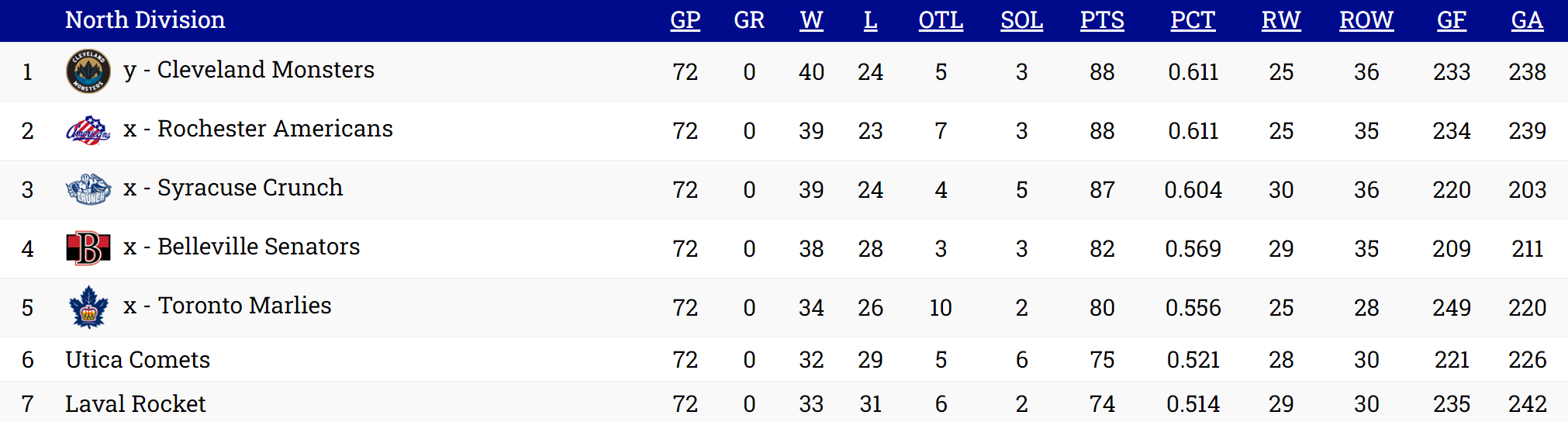
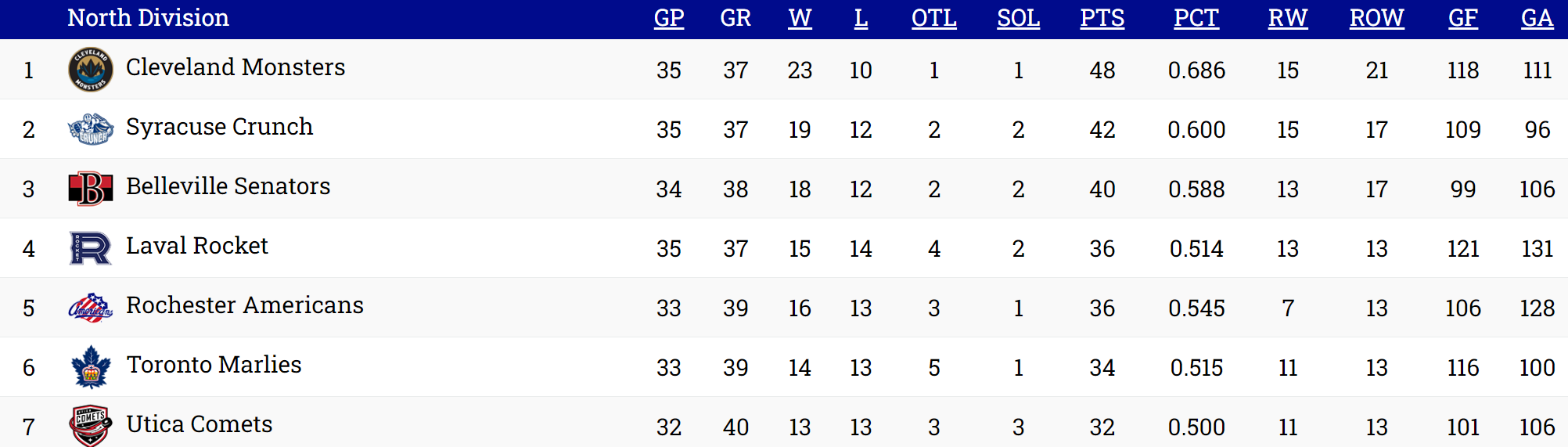
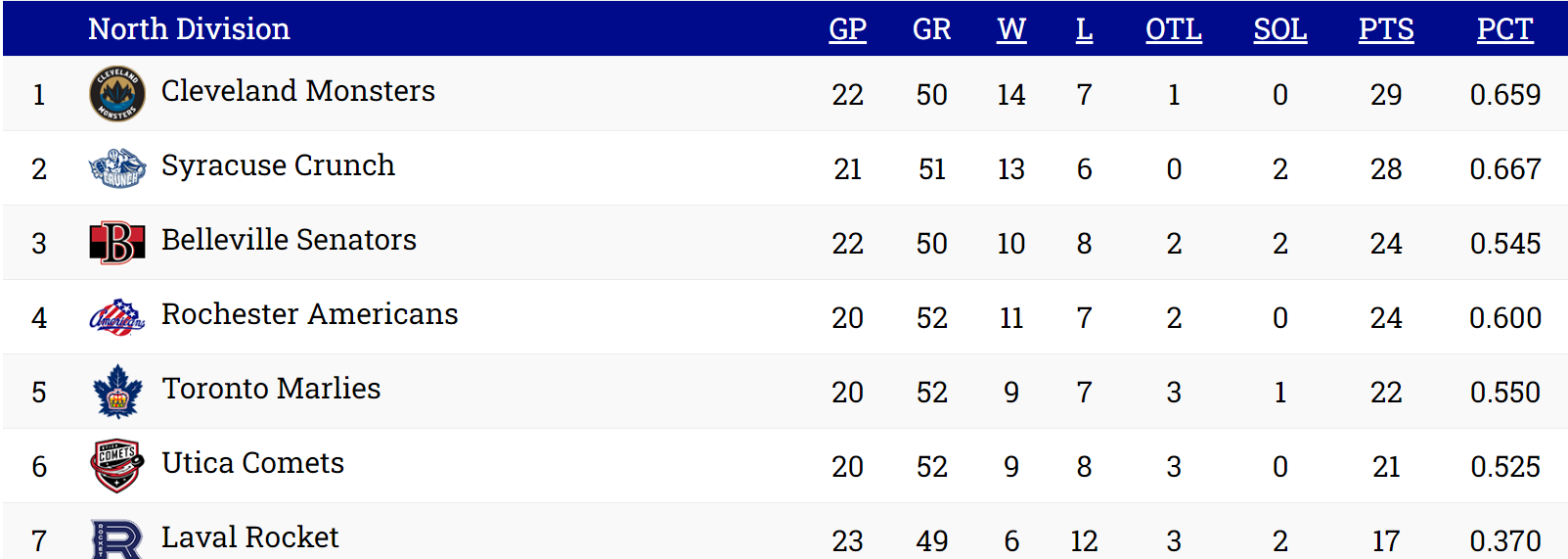
The BSens finished the season 34-27-11, which is slightly better than last (31-31-10; a modest 3 extra wins and 7 points). The team struggled to score (206, which is 27 less than last season), although they did cut down goals against (35 from the prior season, keeping in mind scoring throughout the league dropped). Unlike last season, the BSens did not qualify for the playoffs.
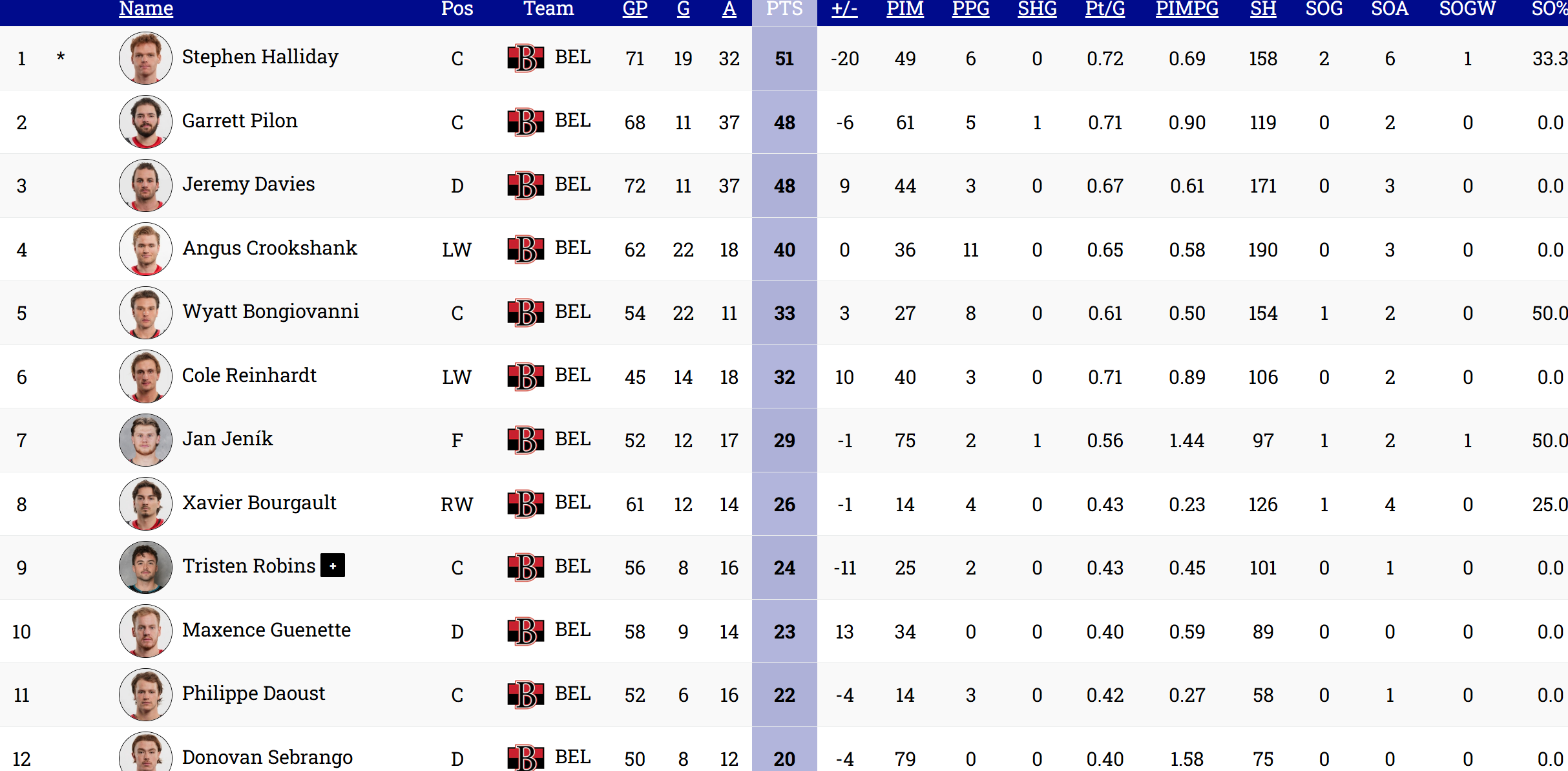
Halliday had an excellent rookie season, despite being hobbled by ECHL linemates to start the season (8-0-2-2; Rees/Boucher). His totals might not have been as halcyon as hoped, but are enough to confirm there is NHL potential, even if his defensive play needs work. He should dominate next season.
For Crookshank, this is the season where I’ve finally given up on his NHL potential. His footspeed is a huge impediment to his style of play (a bottom-six agitator/energy guy), and he’s not quite productive enough to overcome that. He’s excellent at this level, but not suited to the top line.
Reinhardt had a Jack Rodewald-style spike in production, which is not indicative of where his true potential is (ending the season 11-1-3-4). If (if) he has NHL-potential, it’s as a defensively sound depth player with good speed (a bit like a Peter Schaefer). That’s fantastic, but very much remains an if at this stage.
This was a down year for Guenette, which suggests there’s no NHL-potential and he’s simply a useful AHL defender (much like Max Lajoie, who left the org five years ago). Daoust, who was finally healthy, had a decent rookie season, but did nothing to show what the Sens expected when he was drafted (more time is needed, if he’s retained; he had an awful month-long stretch in Jan-Feb, 10-0-0-0).
Sebrango got hot early, but then went back to his typical play for the rest of the season (ending 14-2-2-4). I don’t see NHL-potential in him, although he has shown he can be a solid player at the AHL-level (something that was in doubt when acquired as part of the DeBrincat trade).
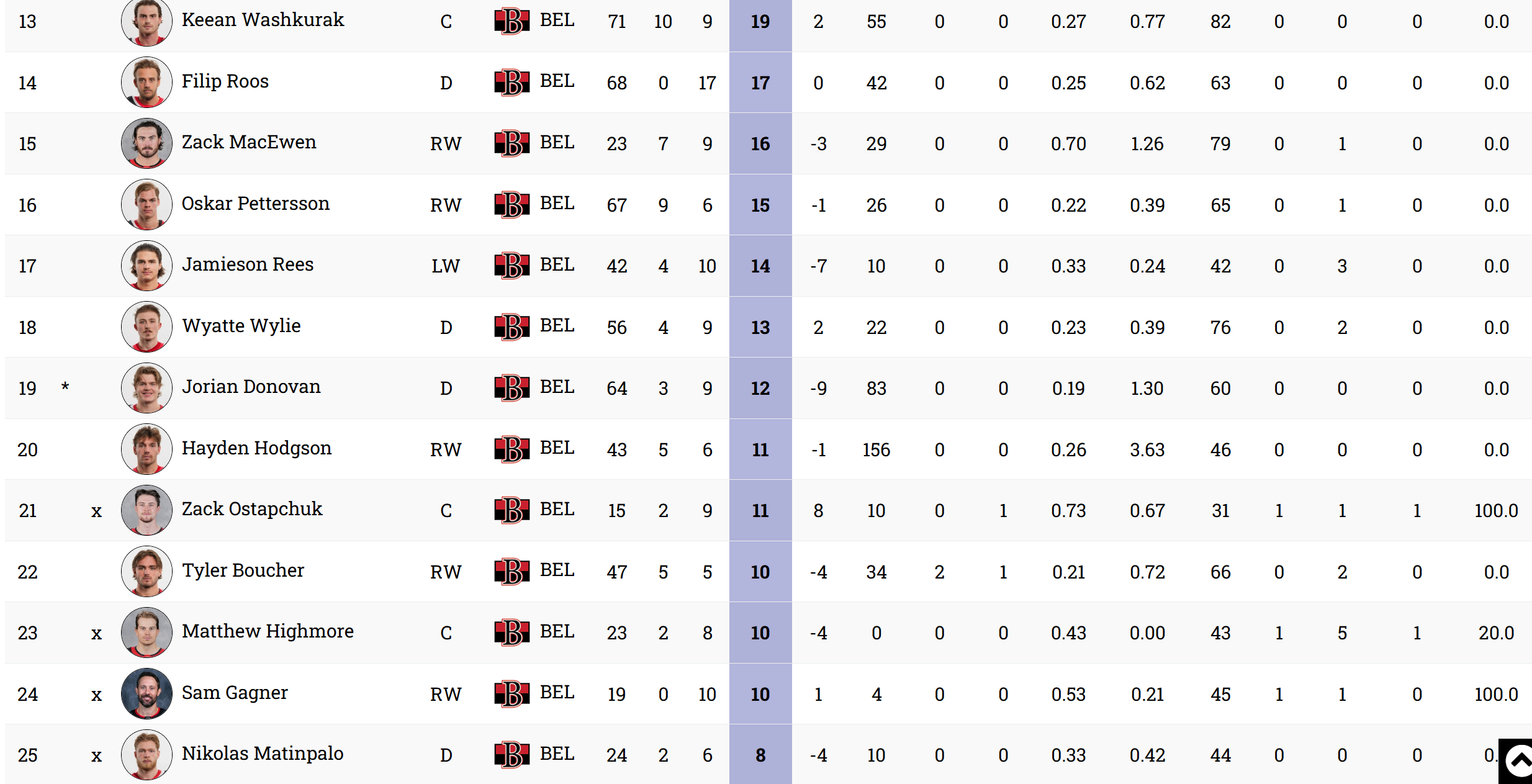

Both Rees and Boucher confirmed that they are marginal players (the former seems more like an ECHLer and the latter may be as well). Donovan had a very rough introduction to the league (20-0-0-0), but did improve as it went on. Toure‘s time in the ECHL helped and his transition was smoother because of it, but it’s not clear either defender has NHL-potential.
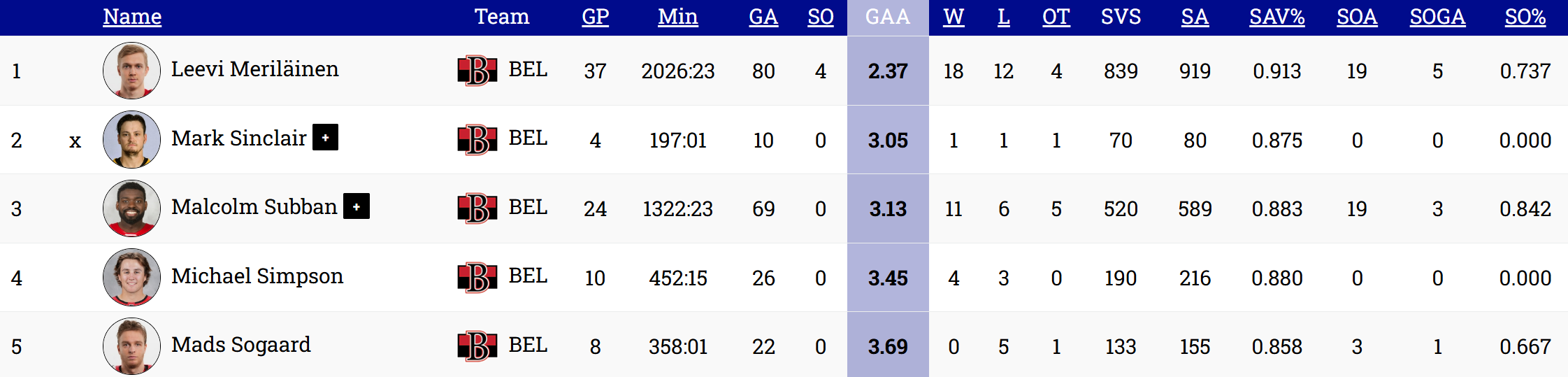
What a disaster this season was for Sogaard, who was hurt (again!) and awful in both the NHL and AHL (career worst numbers). Merilainen was the bright spot, but with no quality goaltender behind him he was overplayed. The Subban story is nice, but he can’t carry the load at this level anymore. The Sens suffered by taking a risk on their third minor league ‘tender as Simpson was not ready (such that we saw the return of Sinclair, who had that role the prior two seasons, but he couldn’t provide relief either). I don’t think goaltending is the only reason the BSens didn’t make the playoffs, but it didn’t help.
Overall, looking at the roster the BSens entered the season with, only Reinhardt and Bongiovanni (along with the aforementioned Halliday) stood out. The addition of Jeremy Davies helped a lackluster d-corps, but the roster was littered with useless additions (Roos), failed reclamation projects (Rees), and prospects with little apparent talent (Boucher, Pettersson). There’s a lot of work needed for both the prospect pool and in Belleville generally.
NHL Playoffs
I was happy to see some playoff hockey in Ottawa and other than the first game it was an entertaining series. It had no echo of the old rivalry with Toronto, as the modern Leafs are an inoffensive team you can’t hate for their style of play. The broadcasting was tolerable, although Craig Simpson remains one of the worst play-by-play analysts I’ve ever heard (my kingdom for Ray Ferraro!). I wasn’t expecting the Sens to win, but they would have been a more entertaining challenge for Florida (they would have lost too, particularly if there was an ‘accidental’ injury to Ullmark).
Playoff viewership numbers for the NHL continue to go down (albeit the article linked simply invents reasons for it, rather than digging into the data). This is no surprise, as I’ve been covering this in hockey and sports in general for years (and years, and years, and most recently). No one cares about Florida (or any of the sunbelt teams) and that will never change–hockey is too expensive and requires too much real estate to saturate communities already invested in other sports. When anyone can play basketball or baseball or soccer at virtually no cost (and the bar of entry for football isn’t high), there’s no room for hockey outside regional areas (mostly in the north). The league dodged a bullet by Dallas losing, as no one would watch Florida-Dallas. The smart thing for Bettman to do is relent and allow a Canadian team to win (the logic against it has always been: Canadians watch anyway and their market is saturated, so encourage/support the American base by having those franchises win). Giving the league’s only superstar (McDavid) a Cup makes sense (a bit like Ovechkin’s in 2018) before we go back to seeing unwatchable, marginal teams win in meaningless markets.
This article was written by Peter Levi




 eyeonthesens