Analysis and Predictions for the 2014 NHL Entry Draft

The 2014 NHL draft is tomorrow and it’s time to put on my prediction hat and take a look at who will be selected.  Before we get to the list is a short preamble explaining my reasoning and methodology.

With the advent of the NHL salary cap after the 2004-05 lockout, it became paramount for all organisations to invest in their scouting operations and draft well. Teams could no longer simply buy their way out of trouble or plug holes with expensive free agent talent. That change has helped drive the cottage industry that is draft prediction, but the wide variety of sources are not created equal and few of those who provide their opinions will reflect on their subsequent accuracy. It is my purpose here to collate the best sources and provide insight into who will be selected in this year’s upcoming NHL entry draft.

This is my fifth year predicting the draft (beginning with the now defunct Hockey Herald back in 2010). That year I picked 72% of the entire class (well ahead of my sources), while in 2011 I picked 70% (again well ahead), 75% in 2012 (two points up on Red Line Report), and 69% in 2013 (tied with Hockey Prospect‘s).  What follows is a continuation of the same analysis.

My method is to take the sum of reliable sources and produce a number (player X is ranked 15, 24, and 32, by different sources, those numbers are then added and averaged). This gives me a number I can use to compare that player to others. I then engage in further comparative analysis—for instance, if player X has a higher aggregate score, but player Y has the higher median score, the latter is given the higher position (so 11, 30, 31, 38 vs 12, 13, 16, 69). Precise predictions (player X at pick #29) are much more difficult and rare outside the first round (25% is a very good ratio overall). It’s worth noting that there is a difference between assessing who the best player is versus who a team will draft. Some publications give weight to the latter, while other sources do not. My purpose here is to slot players where they will be picked rather than assessing who is the best.

Determining my Sources of Data

While a wide variety of media and bloggers produce draft predictions (especially for the first round), not all are created equal. My preference is the professional scouting community itself and those sources that they rely on. For that purpose, the International Scouting Service (ISS), Kyle Woodlief’s Red Line Report (RLR), and Central Scouting (CS) are included. Central Scouting is the NHL’s own scouting service, while ISS and RLR are independent scouting services used within the NHL.

Rounding out my sources this year are the only two magazines to predict the entire draft: Aaron Vickers’ Future Considerations (FC) and Mark Edwards’ Hockey Prospect‘s (HP). They provide extensive predictions and are put together by knowledgeable hockey people.  I have used other sources in the past (Corey Pronman, The Hockey Writers, The Hockey News, etc), but have found they generally just muddy the waters so I’m keeping things tight this year.

It must be noted that both ISS and CS have inherent comparative problems. Central Scouting does not create a master list—players are divided into North American and European regions, and further subdivided into skaters and goaltenders. ISS separates their goaltenders into a separate ranking. These drawbacks are part of the reason I load up with the additional data.

Notes

Acronyms: ISS (International Scouting Service), CS (Central Scouting), RLR (Red Line Report), HP (Hockey Prospect), and FC (Future Considerations). For convenience I’ve identified goaltenders and defenseman in the player comments.

Ranking depth: CS 394, RLR 320, ISS 220 (200 skaters and 20 goaltenders), HP 210+ (it’s not tallied beyond that), FC 210.

I compared the guides recently where I pointed out some of their difference (as well as what I thought made for the best buy).

This draft is considered a weak one without much depth, which makes rankings more tenuous than normal.  It also helps explain the larger than usual number of 25 and under Europeans signed as free agents beforehand (I’ve included a list of them at the end of the article).

A final comment: the most obvious struggle for accurate scouting assessment remains players in Europe, who are underrepresented in lists for the obvious reason that it’s more expensive to cover Europe.

First Round

My sources have 21 players in common for this round, with a total of 40 players selected for it; three different players are slotted at #1.

1. Sam Bennett (2.25) – despite not having the highest score, he’s the only player with multiple #1 selections (RLR and HP; also first with CS)
2. Aaron Ekblad (2.00) – defenseman has the identical score as Reinhart below, but CS’ score pushes him over the top
3. Sam Reinhart (2.00) – the last player who could go #1 (ISS)
4. Leon Draisaitl (5.25) – ties Dal Colle below, but gets the edge via CS
5. Michael Dal Colle (5.25) – the final player whom all sources list within the top-ten
6. William Nylander (7.00) – the first player out of Sweden; listed as high as #4 (FC)
7. Nikolaj Ehlers (7.25) – HP makes him their #4 pick in the draft
8. Nick Ritchie (7.5) – HP with the high of #5
9. Jake Virtanen (10.5) – two picks at #7, he drops largely because of HP’s #18
10. Hayden Fleury (11.0) – defenseman has a very narrow range (#9-#13)
11. Robby Fabbri (14.0) – score hurt by HP’s #24 (CS isn’t high on him either), he has two top-ten selections from ISS and RLR
12. Dylan Larkin (13.5)
13. Kevin Fiala (14.5) – ISS has him all the way down at #20
14. Brendan Perlini (15.0) – very split opinions; he’s the last player with a top-ten selection (#9 ISS)
15. Sonny Milano (15.5) – HP with the high (#12)
16. Alex Tuch (15.75) – gets the edge over Barbashev due to the Russian factor and CS love
17. Ivan Barbashev (15.75)
18. David Pastrnak (20.5) – score thrown off by ISS’ second round placement (#33), which is a heavy outlier compared to all other sources
19. Josh Ho-sang (30.25) – score tilted by HP’s third round placement (#61)
20. Jared McCann (18.75) – widely different placements (#12-#25)
21. Kasperi Kapanen (21.75) – widely divergent rankings for the first player playing in Finland (#13-#29)
22. Nikita Scherbak (21.75) – the second player carrying a second-round selection (FC)
23. Nikolay Goldobin (24.5) – RLR has him at #18
24. Conner Bleackley (25.25) – a second-rounder for RLR
25. Jakub Vrana (26.0) – the final player that all sources slot in the first round
26. Adrian Kempe (27.0) – second-rounder for RLR
27. Roland McKeown (40.25) – defenseman’s score thrown by HP’s third-round ranking (#83; against three first round selections)
28. Travis Sanheim (31.0) – HP loves the blueliner (#16)
29. Jack Dougherty (31.5) – defenseman’s number drops due to ISS (#42)
30. Nick Schmaltz (35.25) – edges out Kamenev (one of the other remaining player with two first-round selections) due to the Russian factor, while beating Lemieux head-to-head

Here are the other 10 players who received first-round selections: Lemieux (2), Kamenev (2), Honka, DeAngelo, Demko, Pettersson, Glover, MacInnis, Quenneville, and Cornel.  The list above has 28 players in common with Bob McKenzie‘s list (with Honka and Demko not making mine; Dougherty and Goldobin not making his).

Second Round

Of the players not listed above, there are only 3 players who only received 2nd round picks (McDonald, Point, and Nedelijkovic).

31. Brendan Lemieux (31.75)
32. Valdislav Kamenev (32.75) – the final player with two first-round selections (ISS, RLR), the Russian factor could push him further down
33. Julius Honka (31.50) – HP slots the defender in the first round (#23)
34. Thatcher Demko (32.0) – the top goalie for ISS and CS, FC has him in the first round (#22)
35. Anthony DeAngelo (32.25) – blueliner is a first-rounder for FC (#29)
36. Markus Pettersson (35.25) – defenseman is slightly behind McDonald in numbers, but his higher first-round placement (#25 from RLR) and the fact that goaltenders tend to slide slots him here
37. Mason McDonald (34.33) – the second goalie on the list (for both ISS and CS)
38. Ryan MacInnis (46.75) – suffers from RLR’s ranking (#87); ISS has him in the first round (#25)
39. Brayden Point (42.5) – while he has no first-round selections, he’s one of the only players consistently slotted in the second
40. Alex Nedelijkovic (46.33) – the next goaltender on the list
41. Jack Glover (46.5) – boosted by RLR (#23), he’s a third-rounder for HP (#66)
42. John Quenneville (47.5) – another RLR favourite (#24) that HP doesn’t agree with (#81)
43. Eric Cornel (51.5) – much as above, except FC likes him (#30) while HP doesn’t (#89)
44. Anton Karlsson (47.0) – Swede suffers from HP’s ranking (#67)
45. Brett Pollock (48.25) – only FC puts him in the third round (#68)
46. Justin Kirkland (49.25) – once again HP slots him in the third (#68)
47. Dominik Masin (68.5) – suffers from FC’s fifth-round slot (#130) which is a clear outlier from his second-round placement elsewhere
48. Josh Jacobs (54.75) – blueliner suffers from HP’s ranking (#69)
49. Adam Mattsson (86.0) – Swedish defender is punished by his FC ranking (#195), which is an outlier compared to his otherwise second-round slots
50. Andreas Englund (54.0) – split opinions on the Swedish defenseman, with RLR and HP having him in the second and FC and ISS in the third
51. Gustav Forsling (56.33) – Swedish defender is strangely not ranked by RLR
52. Vaclav Karabacek (60.5) – suffers from HP’s ranking (#79)
53. Ryan Collins (61.75) – defender hurt by HP’s ranking (#84)
54. Hunter Smith (62.25) – marks the beginnings of divisive opinions; two second-round picks, with a third (RLR) and fourth (FC)
55. Ryan Donato (62.5) – as above, with RLR putting him in the third and ISS in the fourth
56. Emil Johansson (63.33) – Swedish defenseman is put well out of the draft by RLR, but he’s a second-rounder for HP and ISS
57. Chase De Leo (64.0) – slightly less radical rankings, with two seconds and two thirds
58. Nicolas Aube-Kubel (67.5) – suffers from a fourth-round hit from RLR (#106)
59. Jayce Hawryluk (64.75) – two second-round picks with a third (FC) and fourth (ISS)
60. Dylan Sadowy (69.75) – yet another split opinion with two seconds (ISS, HP) and two fourths (RLR, FC)

There are eight players remaining with two second-round selections: MacLeod, Tkachev, Lammikko, Bunting, Eiserman, Hickey, Watson, and Lindblom.  Bob McKenzie and I have the differences mentioned in the first round, along with Martin (3rd), Foegele (4th), Thomas (3rd), Peters (3rd), MacLeod (3rd), Kase (3rd), Iverson (4th), and Walman (3rd); he excludes Sadowy, De Leo, Johansson, Collins (gets an “honourable mention”), Forsling, Mattsson, Jacobs, and Kirkland.

Third Round

61. Juho Lammikko (71.25) – hurt by FC’s ranking (#120)
62. Vladimir Tkachev (70.75) – a toss-up between he and MacLeod, but his scores are slightly better in comparison; oddly not ranked by CS
63. Jonathan MacLeod (70.5) – benefits from HP’s ranking (#50)
64. Jake Walman (64.0) – consistent third-round picks for the defenseman, but his number is boosted by HP (#55)
65. Sebastian Aho (62.0) – Finnish blueliner is oddly not ranked by RLR; he’s a second-rounder for HP (#40)
66. Michael Bunting (72.25) – a second-rounder for both ISS and HP
67. Spencer Watson (84.25) – ranking is thrown off by HP (#131)
68. Shane Eiserman (74.25) – either a second-round player (FC, ISS) or a fourth (RLR, HP)
69. Brandon Hickey (80.75) – defenseman is another two second, two fourth prospect (ISS, HP; RLR, FC)
70. Oskar Lindblom (108.0) – Swede’s number takes a pummelling from RLR (#203), but he’s a second-rounder for ISS and HP
71. Blake Siebenaler (70.25) – defender gets a second-round nod from FC (#49)
72. Brycen Martin (76.75) – blueliner is highly touted by FC (#39), he’s a fifth-round pick for HP (#132)
73. Alexis Vanier (82.5) – defenseman has a similar issue–#51 for FC, he’s #143 for ISS (gets an “honourable mention” from McKenzie)
74. Connor Chatham (83.25) – RLR puts him in the fourth round (#119), gets a second-round nod from ISS (#54)
75. Aaron Irving (87.0) – blueliner is a second round pick for RLR (#40), but a sixth-rounder for HP (#151)
76. Alex Peters (85.0) – defender is a second-round pick for ISS (#47), the fifth for FC (#131)
77. Maxim Letunov (87.25) – second-round for HP (#51), he’s in the fifth for FC (#139)
78. Dysin Mayo (90.75) – defender is in the second round for RLR (#46), he’s in the fifth for ISS (#149)
79. Noah Rod (92.5) – Swede gets a second round nod from HP (#39), but is a sixth-rounder for FC (#165)
80. Aaron Haydon (94.25) – blueliner gets a similar split; #48 for FC, #158 for HP
81. Igor Shestyorkin (90.66) – goaltender goes unranked by ISS and CS; a second-round pick for RLR (#41)
82. Luc Snuggerud (102.75) – defenders ranking is hurt by HP (#179); a second-rounder for ISS (#56)
83. Ben Thomas (82.75) – defenseman gets three third-round votes with a fourth from FC (#94)
84. Jacob Middleton (81.33) – blueliner is not ranked by HP or CS, but gets a pair of third-round nods (FC, RLR)
85. Nick Magyar (84.75) – punished by RLR (#134), he’s otherwise solidly a third-rounder
86. Daniel Audette (90.25) – split between third and fourth picks (FC, RLR; ISS, HP)
87. Nelson Nogier (102.0) – blueliner is hurt by RLR’s ranking (#168)
88. Summers (87.0) – outside the draft for RLR, but a pair of early thirds from FC and ISS
89. Miles Gendron (111.75) – defenseman’s ranking is hurt by FC (#176)
90. Ondrej Kase (103.25) – ISS makes him a fifth-rounder (#150)

Five other players receive two third-round selections: Franklin (RLR, HP), Duke (HP, FC), Bishop (FC, ISS), Kulda (HP, ISS), and Gardiner (RLR, FC).

Fourth Round

91. Reid Gardiner (98.75) – very narrow range between the third and fourth round (#84-#118)
92. Clark Bishop (104.5) – gets an “honourable mention” from McKenzie
93. Reid Duke (106.25)
94. C. J. Franklin (79.5) – another run through the draft; not listed by FC or ISS, he’s the last player with two-third round selections
95. Edgars Kulda (117.0) – overager not selected by FC, but two third-round picks slots him here
96. Matt Berkovitz (91.0) – defenseman not selected by ISS
97. Alex Schoenborn (98.0) – not picked by FC
98. Darby Llewellyn (100.0) – ISS with the high (#78) and no picks outside the fourth round
99. Ville Husso (108.0) – CS’ top goalie out of Europe, ISS ranks him highly but he’s a fourth or fifth-round pick otherwise; not picked last year
100. Logan Halladay (102.0) – goaltender’s rankings all over the place, with a second-round slot from HP (#59) down to the sixth-round for FC (#166)
101. Matthew Mistele (110.0) – a third and two fourth-round picks give him more consistency than those with a better score who follow
102. Austin Poganski (112.75) – three fourth-round picks (ISS is the outlier)
103. Alexandre Goulet (113.5) – his ranking is thrown off by RLR (#157)
104. Julien Nantel (108.5) – HP is a fan (#63)
105. Tyson Baillie (109.25) – RLR likes him (#71)
106. William Lagesson (112.66) – defenseman inexplicably not ranked by RLR; #71 for ISS
107. Rourke Chartier (111.75) – FC gives him the highest rank (#78)
108. Keagan Iverson (113.25) – ISS is a fan (#85)
109. Mike Amadio (111.5) – ISS puts him in the third round (#87)
110. Brett Lernout (116.25) – ISS has the blueliner in the third round (#83)
111. Nikita Tryamkin (100.5) – not ranked by either RLR or HP, ISS has the Russian defenseman in the third round (#66)
112. Dakota Joshua (98.0) – not ranked by FC or ISS
113. Edwin Minney (98.5) – RLR is a fan of the goaltender (#70)
114. Richard Nejezchleb (110.0) – ISS has him highest (#84); RLR does not list him
115. Francis Perron (110.0) – HP does not list him; RLR has him at #78
116. Max Willman (113.0) – FC and ISS do not list him
117. Warren Foegele (115.5) – ISS and HP do not list him
118. Hayden Lavigne (120.0) – ISS and RLR do not list the goaltender
119. Christian Jaros (134.33) – Swedish blueliner is not ranked by HP, but is listed high in the fourth round by RLR and ISS
120. Kaapo Kahkonen (130.66) – Finnish goaltender is hurt by HP’s ranking (#189); gets an “honourable mention” from McKenzie

Twelve players remaining have two fourth-round (or better) selections: Wolff, Mangiapane, Iacopelli, Starrett, Pelletier, Jenkins, Moran, Holmstrom, Dvorak, Valiev, Fazleev, and Sharov.

Fifth Round

121. Nick Wolff (128.0) – defenseman’s number takes a hit from HP (#181)
122. Julien Pelletier (128.0) – has a third round pick (FC) to go along with a pair of fourths
123. Beau Starrett (127.75) – HP is not a fan (#174)
124. Brent Moran (133.66) – goaltender suffers from RLR’s ranking (#193)
125. Axel Holmstrom (140.33) – put out of the draft by RLR and not listed by ISS, his fourth-round scores by FC and HP are excellent
126. Kyle Jenkins (131.0) – defenseman is not listed by FC, but gets fourth-round picks from ISS and HP
127. Andrew Mangiapane (120.33) – not listed by ISS
128. Matt Iacopelli (123.33) – not listed by ISS
129. Alexander Sharov (176.0) – Russian put well out of the draft by RLR and not listed by ISS
130. Shane Gersich (120.5) – gets a second-round nod from RLR (#52)
131. Brandon Montour (125.25) – overage defenseman is a second-round pick for HP (#57)
132. Christian Dvorak (128.0) – a second-rounder for RLR (#38); “honourable mention” from McKenzie
133. Rinat Valiev (131.66) – defenseman suffers from RLR’s rating (#209), which is ironic because they were very high on him last year
134. Radel Fazleev (134.75) – bolstered by RLR’s ranking (#75)
135. Olivier Leblanc (133.75) – defenseman is among the last ranked in the draft by all sources
136. J. J. Piccinich (137.25) – hurt by HP’s ranking (#207)
137. Karson Kuhlman (143.5) – a third-round pick for RLR (#74)
138. Blake Hillman (120.5) – defenseman is not listed by FC and ISS
139. Colby Cave (121.0) – not listed by FC and HP; he was passed over last year as well
140. Dylan Gambrell (124.0) – not picked by FC and ISS
141. Pavel Kraskovsky (128.0) – FC leaves the Russian off their list
142. Miro Keskitalo (126.0) – Finnish blueliner not selected by FC and RLR
143. Matthew Highmore (126.5) – not ranked by ISS and HP
144. Stefan Leblanc (131.5) – unlisted by ISS and HP
145. Duncan MacIntyre (132.0) – blueliner left out by FC and HP
146. Lucas Wallmark (137.0) – plodding Swede was the highest ranked player not taken in the last draft; left off the ISS list
147. Joni Tuulola (147.0) – Finnish defenseman gets a high of #93 from ISS
148. Pierre Engvall (139.66) – Swede not listed by RLR
149. Luke Philp (137.25) – picked by all sources to be selected in the draft
150. Vladislav Gavrikov (146.66) – blueliner a third-rounder for FC (#80), he’s not listed by FC and not in the draft by RLR

Fifteen players have two fifth-round (or better) selections: Belpedio, Bayreuther, Donaghey, Bird, Pyrochta, Rosdahl, Baltisberger, Descheneau, Hitchcock, Muzito-Bagenda, Phelps, Pepin, Bergman, Jenys, and Halverson.

Sixth Round

151. Ryan Mantha (143.66) – a second-rounder for ISS (#59); he’s not listed by HP
152. Louis Belpedio (143.25) – defenseman gets a high of #111 from FC
153. Julius Bergman (173.0) – Swedish defenseman takes a hit from RLR which puts him out of the draft; not ranked by HP
154. Pavel Jenys (175.66) – RLR puts him out of the draft; HP does not rank him
155. Tyler Bird (146.0) – not ranked by ISS
156. Alexis Pepin (145.75) – FC with the high (#117) and RLR the low (#202)
157. Ryan Hitchcock (155.25) – all sources place him in the draft
158. Jaedon Descheneau (154.5) – as above; undersized forward went undrafted last year
159. Phil Baltisberger (152.33) – defenseman is not picked by HP
160. Daniel Muzito-Bagenda (157.0) – Swede goes unlisted by HP
161. Chase Phelps (163.66) – ISS leaves him off their list
162. Cody Donaghey (139.5) – defenseman is a fifth-rounder for HP and FC while being left off the other lists
163. Gavin Bayreuther (139.0) – as above
164. Brandon Halverson (186.0) – goaltender is listed outside the draft by RLR, but otherwise is a solid fifth-round pick
165. Kim Rosdahl (148.5) – the last player with two selections in the fifth (or higher); he goes unlisted by FC and ISS
166. Yegor Korshkov (137.5) – unlisted by FC and RLR
167. Dominic Turgeon (142.33) – HP has him in the fourth (#113), FC leaves him off their list
168. Filip Pyrochta (140.0) – defender a third from FC (#87), ISS puts him in the seventh and HP and RLR don’t list him
169. Blake Clarke (139.0) – doesn’t make the cut for FC and HP
170. Austin Lotz (146.0) – goaltender was passed over in the draft last year and ISS leaves him out this year
171. Brandon Prophet (150.5) – defender gets a fourth-round slot from FC (#113)
172. Anders Bjork (152.75) – a fourth-round nod from ISS (#104)
173. Rihards Bukarts (155.5) – a third-rounder for RLR (#86)
174. Riley Stadel (150.0) – defenseman has solid scores across the board, although FC has him out of the draft
175. Waltteri Hopponen (150.33) – buoyed by FC’s ranking (#73), he’s unranked by HP
176. Ryan Verbeek (155.0) – among the last players ranked in the draft by all sources; he’s a fourth-round pick from HP (#116)
177. Yannick Rathgeb (155.33) – defenseman’s rankings all over the place, with a fourth from FC (#109) and out of the draft for HP
178. Henrik Tornqvist (158.33) – Swede gets solid fifth-sixth round ranks except from RLR who doesn’t include him
179. Vitek Vanecek (160.5) – goaltender is given a pass by HP, but gets consistent numbers otherwise
180. Chase Perry (173.33) – goaltender is put out of the draft by RLR, while HP has him in the third round (#86)

There are three players with three selections in the fifth or sixth rounds: Kalapudas, Spinner, and Evans; no player remains that all sources pick to be drafted.

Seventh Round

181. Ryan Foss (177.25) – takes a pummeling from RLR putting him out of the draft; three sixth-round picks otherwise
182. Jake Evans (188.0) – RLR puts him well out of the draft
183. Steven Spinner (183.5) – hurt by RLR putting him out of the draft
184. Antti Kalapudas (174.0) – Finn is not ranked by RLR
185. Dallas Valentine (159.33) – defenseman is a fourth-rounder for ISS (#104), but out of the draft for FC
186. Aleksander Mikulovich (183.25) – blueliner is the last player with three sources putting him in the draft; RLR has him on the outside looking in
187. Seamus Malone (162.0) – a third-rounder for FC (#62)
188. Arkhip Nekolenko (171.0) – Russian is a third-rounder for ISS (#76)
189. Michael Prapavessis (177.33) – defenseman is a third-rounder for HP (#82)
190. Nikita Lyamkin (159.33) – Russian blueliner is a third-rounder for HP (#86)
191. Daniel Walcott (168.0) – another defenseman who is a fourth-round pick for HP (#91)
192. Jaden Lindo (163.66) – ranking is hurt by RLR putting him out of the draft
193. Kevin Elgestal (153.0) – a fourth-rounder for ISS (#101)
194. Josh Wesley (173.33) – defenseman’s ranking is hurt by RLR putting him out of the draft
195. Mark Friedman (159.0) – blueliner is a fourth-rounder for HP (#109)
196. Chandler Yakimowicz (157.5) – yet another fourth-rounder for HP (#118); he’s the last player picked twice for the draft with a rank this high
197. Ryan Rehill (146.5) – defenseman is outside the draft for FC and ISS
198. Liam Pecararo (148.5) – outside the draft for ISS and HP
199. Dryden Hunt (150.5) – ranked by ISS and RLR
200. Maxim Lazarev (155.0) – ranked by RLR and HP
201. J. D. Dudek (173.0) – outside the draft for ISS and RLR
202. Zach Yon (156.0) – not ranked by FC and RLR
203. Hunter Garlent (156.5) – FC and ISS include him; pint-sized forward was passed over last year
204. Julio Billia (197.0) – goaltender’s rank is thrown by RLR putting him well out of the draft
205. Tanner MacMaster (162.5) – ranked by FC and ISS
206. Tomas Havlin (178.0) – defender picked by FC and ISS
207.  Mitch Slattery (183.0) – outside the draft for RLR and ISS
208. Ty Edmonds (168.0) – goaltender goes unranked from ISS and HP
209. Sam Ruopp (172.0) – blueliner is listed by RLR and HP
210. Dylan Malmqvist (211.66) – defenseman suffers from RLR; ISS has him in the fourth round (#109)

Just missing the cut: Joe Hicketts (the defenseman is picked by three sources, but all place him in the seventh round); there are 15 other players with at least two selections in the draft (none ranked higher than the fifth-round).  Of note, there are five players picked in the top-100 by just one source: Dexter Dancs (RLR #59), Tyler Sheehy (FC #76), Ilya Sorokin (RLR #90), Dmitri Sergeev (ISS #92), and Hayden Hodgson (HP #93); there are eleven more players uniquely selected to go in the fourth round.  As per usual there are a number of highly ranked Europeans from CS who did not make the list: Lawrence Pilut (#16), Nikita Cherepanov (#22), Leon Bristedt (#24), Andrei Kuzmenko (#26), Artur Boltanov (#29), Andreas Soderberg (#30), Eetu Sopanen (#31), Semyon Koshelev (#35), and David Kampf (#36); along with goaltenders Jonas Johansson (#2), Linus Soderstrom (#3), and Sorokin (#5; see RLR above). There’s no real comparable among their NA rankings among skaters (the highest not appearing is Daniel Moynihan at #77), but one goaltender is in the same boat (Kevin Reich #5).

Given the weakness of this year’s draft there’s been a slew of free agent signings out of Europe: David Wolf (Cal), Roman Will (Col), Borna Rendulic (Col), Dennis Everberg (Col), Johan Alm (Nsh), Melker Karlsson (SJ), Simon Hjalmarsson (Clb), Michael Keranen (Min), Dennis Rasmussen (Chi), Petr Zamorsky (NYR), Tomas Nosek (Det), and Iiro Pakarinen (Edm) [subsequently Jiri Sekac (Mtl)]; this is in addition to older players like Joakim Lindstrom (Stl), Jori Lehtera (Stl), and Pierre-Edouard Bellemare (Phi).

This article is written by Peter Levi (@eyeonthesens)
Assessing NHL Draft Guides

With all the major hockey draft guides out it’s time to compare what they offer versus their cost.  Each guide has two common elements: players listed numerically along with player profiles (sometimes comprehensive, sometimes selective).  The guides may have mock drafts, organisational comments, and/or a look at eligible overage players and European free agents.  Other elements often included are a look at top players for future drafts, but personally I don’t see the value in that information for these products.

The four publications that cover the entire draft have 121 players in common–that’s close to two-thirds (57%) of the entire class.  Red Line Report remains the most radical of the guides and taking it out leaves 136 players shared (64%).  In terms of unique selections, HP has the fewest (16), followed by FC (20), ISS (35), and RLR (40).  Most of these players are late round picks (5th to 7th rounds), with only 11 listed in the 4th round, 2 in the 3rd, and 1 in the 2nd–there is a high proportion of Europeans amongst the unique’s (the region scouts struggle with the most), with 36 of 111 being from across the pond (32%; it’s 52/226 otherwise, or 23%).

There are a few odd choices (or non-choices) from the publications and these are the most interesting:

Gustav Forsling: the Swedish defenseman is slated as a late 2nd or early 3rd round pick, but Red Line Report doesn’t include him at all–not in over 300 selections.  There’s no reasoning provided for that, he simply does not appear.  RLR is known for its strong opinions, but I can’t recall another time (since I started reading the publication back in 2010) where they’ve completely delisted a player that highly touted elsewhere

Sebastian Aho: the Finnish forward is a second or third round pick except (again) from RLR, who just like Forsling above do not have him listed

Emil Johansson: the Swedish blueliner is another 2nd-3rd round pick that RLR lists well outside of the draft (267)

Igor Sheshyrokin is a 2nd to 5th round pick most places, but ISS (and Central Scouting) do not list the Russian goaltender

Dexter Dancs: the winger is a second round pick in RLR’s eyes, but listed by no one else (not even CS)

Other picks with at least two third or fourth round selections that are excluded by a single publication (included in brackets): Matthew Berkovitz (ISS), Alex Schoenborn (FC), Francis Perron (HP), William Lagesson (RLR), Edgars Kulda (FC), Andrew Mangiapane (ISS), Matheson Iacopelli (ISS), Kelly Summers (RLR), Kyle Jenkins (FC), Rinat Valiev (HP), Christian Jaros (HP), and Axel Holmstrom (ISS).  Finally, there are two players slotted in the third round that appear in no other publication: Tyler Sheehy (FC) and Ilya Sorokin (RLR).

When looking for commonalities above we can see that RLR is usually involved and that most of the players are European.  The latter isn’t much of a surprise given the limited capacity these publications have to scout in Europe.

Finally, it’s time to assess the publications by their broad categories–I’ve arranged them by their cost (changes in price from last year are noted):

ISS $99.99 (+$40)
Players listed: 220 (divided between skaters and goaltenders)
Player profiles: all
Organisational assessment: yes, but only as a grade
Mock draft: yes
Overage eligible/European free agents: no

RLR $50.00
Players listed: 315
Player profiles: top-115
Organisational assessment: yes
Mock draft: yes (two of them)
Overage eligible/European free agents: yes

Hockey Prospects $39.99
Players listed: 210
Player profiles: all (including additional players who do not make their top-210)
Organisational assessment: no
Mock draft: no
Overage eligible/European free agents: no
Other: includes game reports on players

Future Considerations $19.99
Players listed: 210
Player profiles: all
Organisational assessment: no
Mock draft: yes (including the second round)
Overage eligible/European free agents: no

RLR lists the most players, but offers the fewest scouting reports, while HP has the most scouting reports (above and beyond their list), but lacks any of the extras of the other guides.  Mock drafts aren’t a selling point for me and organisational assessments only matter if there’s reasoning behind them.  As such, of the extras only RLR’s are meaningful, but at their price point is not worth it for casual fans.  For my money Future Considerations remains the pick of the litter.

This article is written by Peter Levi (@eyeonthesens)

Reviewing Hockey Prospect’s 2014 NHL Draft Guide

Hockey Prospect‘s draft guide is out and here are my thoughts on it (for the last two year’s go here and here).  In terms of accuracy, this is how they’ve performed the last three years (compared to Red Line Report, ISS, and Hockey Prospects, all of whom also predict the entire draft): 2013 69% (1st), 2012 72% (3rd), and 2011 47% (3rd).  [Note: A few readers are confused about the nature of “accuracy” when referring to any hockey guide’s success in predicting the draft when their lists are (often) intended to simply list the best players in their opinion.  The “accuracy” I’m referring to is for fans in judging which list comes closest to how the draft plays out (so how accurately their list reflects what will actually happen at the draft)–it has nothing to do with the quality of any particular guide’s scouting (which would be an entirely different question). If you’re interested in draft selection versus quality of player I suggest you check out my NHL Draft Success article from April to get a sense of it, but I don’t data old enough from the guides to relate their predictions to draft success yet.] Here’s their top-30 list:

1          Bennett

2          Reinhart

3          Ekblad

4          Ehlers

5          Ritchie

6          Draisaitl

7          Dal Colle

8          Nylander

9          Larkin

10        Fleury

11        Tuch

12        Milano

13        Barbashev

14        Scherbak

15        Fiala

16        Sanheim

17        Pastrnak

18        Virtanen

19        Kapanen

20        Perlini

21        Kempe

22        Bleackley

23        Honka

24        Fabbri

25        McCann

26        Lemieux

27        Dougherty

28        Schmaltz

29        Goldobin

30        Vrana

The guide has 16 unique players listed (compared to the other big guides), all of whom are peppered throughout the sixth and seventh rounds; they have much more in common with the ISS and FC player lists than the more radical Red Line Report.  Despite the girth of the guide (nearly 700 pages) it does not include any specific organisational material or a mock draft.  The contents, beyond the list, consists of scouting profiles and lengthy game reports–the latter are the one unique element in the product, but I’m dubious of its value and would rather see that cut for other content.

In general I’m not fond of HP’s guide, as they offer less than FC at almost twice the price.  If they can repeat their accuracy from last season, however, it remains a useful resource.

This article is written by Peter Levi (@eyeonthesens)

Reviewing the ISS 2014 NHL Draft Guide

Clocking in at a ridiculous $99 price (far more than any other guide, even for those who pre-ordered and received a 40% discount), what has ISS added to its previous guide to justify the huge increase?  A slight expansion of their scouting reports (instead of just a consensus description, they include a few lines from specific scouts), expanded their organisational analysis in a very cheap way–simply added a draft list to their meaningless grade and “best picks” in recent history; and that is that.  Are the additions enough for the price?  Not even close.  Other lists do the same (or more) for less.  There is no reason to pay for the guide.

Putting price aside, here’s a look at their top-30 rankings and my thoughts about the publication (for the last two year’s go here and here).  In terms of accuracy here are their last three years (compared to Future Considerations, Red Line Report, and Hockey Prospects, all of whom also predict the entire draft): 2013 65% (last), 2012 70% (last), and 2011 60% (2nd).  Last year I considered their guide the second worst deal next to McKeen’s.

1 REINHART, Sam C 11/6/1995 R 6.00.75* 185 Kootenay WHL

2 EKBLAD, Aaron RD 2/7/1996 R 6.03.5* 216 Barrie OHL

3 DAL COLLE, Michael C 6/20/1996 L 6.01.5* 182 Oshawa OHL

4 BENNETT, Sam C 6/20/1996 L 6.00.25* 178 Kingston OHL

5 NYLANDER, William RW 5/1/1996 R 5.11 176 Modo SweE

6 DRAISAITL, Leon C 10/27/1995 L 6.01.5* 204 Prince Albert WHL

7 VIRTANEN, Jake RW 8/17/1996 R 6.00.75* 208 Calgary WHL

8 FABBRI, Robby C 1/22/1996 L 5.10.25* 170 Guelph OHL

9 PERLINI, Brendan LW 4/27/1996 L 6.02.75* 205 Niagara OHL

10 RITCHIE, Nicholas LW 12/5/1995 L 6.02.25* 226 Peterborough OHL

11 EHLERS, Nikolaj LW 2/14/1996 L 5.11* 162 Halifax QMJHL

12 FLEURY, Haydn LD 7/8/1996 L 6.02.5* 203 Red Deer WHL

13 KAPANEN, Kasperi RW 7/23/1996 R 6.00 181 Kuopio FinE

14 TUCH, Alex RW 5/10/1996 R 6.03.5* 213 USA Under-18 NTDP

15 LARKIN, Dylan C 7/30/1996 L 6.00.75* 190 USA Under-18 NTDP

16 MILANO, Sonny LW 5/12/1996 L 5.11.5* 183 USA Under-18 NTDP

17 MCCANN, Jared C 5/31/1996 L 6.00.25* 179 S.S. Marie OHL

18 HO-SANG, Joshua RW 1/22/1996 R 5.11* 175 Windsor OHL

19 BARBASHEV, Ivan C 12/14/1995 L 6.00* 180 Moncton QMJHL

20 FIALA, Kevin LW 7/22/1996 L 5.10 180 HV71 SweJE

21 VRANA, Jakub RW 2/28/1996 L 6.00 187 Linkoping SweE

22 KEMPE, Adrian LW 9/13/1996 L 6.01.5 187 Modo SweE

23 MCKEOWN, Roland RD 1/20/1996 R 6.00.75* 195 Kingston OHL

24 SCHMALTZ, Nick RW 2/23/1996 R 5.11.5* 172 Green Bay USHL

25 MACINNIS, Ryan C 2/14/1996 L 6.03.25* 183 Kitchener OHL

26 BLEACKLEY, Conner C 2/7/1996 R 6.00.25* 192 Red Deer WHL

27 SCHERBAK, Nikita RW 12/30/1995 L 6.01* 175 Saskatoon WHL

28 GOLDOBIN, Nikolay RW 10/7/1995 L 5.11.75* 178 Sarnia OHL

29 KAMENEV, Vladislav C 8/12/1996 L 6.02 185 Magnitogorsk Rus Jr

30 SANHEIM, Travis LD 3/29/1996 L 6.03* 181 Calgary WHL

ISS’ mock draft doesn’t extend beyond the first round, so they have nothing to say about Ottawa (although, without any reasons given, they rate the Sens organisation as a B+).  Unlike Future Considerations (which I discussed last week), there’s no effort to address the draft class as a whole (although many comments have been made about how weak it is, particularly after the top-ten).  Speaking of FC, there are 58 players in ISS’ list of 220 (10 more than the former) that they list which don’t appear in FC–these difference begin late in the third round.

The guide includes profiles of 220 players, although they continue their irritating separation of goaltenders from skaters (something no other guide does, although it echoes Central Scouting’s practice).  These profiles are expanded from previous seasons, but that small difference is simply not worth the cost.

This article is written by Peter Levi (@eyeonthesens)

Future Considerations 2014 NHL Draft Guide

Future Considerations 2014 NHL draft guide is out and here’s a look at their top-30 rankings and my thoughts about the publication (for the last two year’s go here and here).  In terms of accuracy here are their last three years (compared to ISS, Red Line Report, and Hockey Prospects, all of whom also predict the entire draft): 2013 68% (2nd out of 4), 2012 71% (3rd), and 2011 44% (4th).  Last year I considered their guide the best deal available for fans and we’ll see how this one holds up.

1). D Aaron Ekblad, Barrie (OHL), 6 ‘4, 215

2). C Sam Reinhart, Kootenay (WHL), 6 ‘1, 185

3). C Sam Bennett, Kingston (OHL), 6 ‘0, 180

4). RW William Nylander, MODO (SHL), 5 ‘11, 170

5). C Leon Draisaitl, Prince Albert (WHL), 6 ‘2, 210

6). C Michael Dal Colle, Oshawa (OHL), 6 ‘2, 180

7). LW Nick Ritchie, Peterborough (OHL), 6 ‘2, 230

8). LW Nikolaj Ehlers, Halifax (QMJHL), 5 ‘11, 165

9). D Haydn Fleury, Red Deer (WHL), 6 ‘3, 200

10). C Jake Virtanen, Calgary (WHL), 6 ‘1, 210

11). LW Brendan Perlini, Niagara (OHL), 6 ‘2, 205

12). C Jared McCann, Sault Ste. Marie (OHL), 6 ‘0, 180

13). LW Kevin Fiala, HV 71 (SHL), 5 ‘10, 180

14). C Dylan Larkin, USNTDP U18 (USHL), 6 ‘1, 190

15). C Robby Fabbri, Guelph (OHL), 5 ‘10, 165

16). LW Ivan Barbashev, Moncton (QMJHL), 6 ‘1, 185

17). LW Sonny Milano, USNTDP U18 (USHL), 5 ‘11, 185

18). RW David Pastrnak, Sodertalje (Allsvenskan), 5 ‘11, 170

19). RW Alex Tuch, USNTDP U18 (USHL), 6 ‘3, 215

20). RW Josh Ho ‘Sang, Windsor (OHL), 5 ‘11, 165

21). RW Conner Bleackley, Red Deer (WHL), 6 ‘1, 195

22). G Thatcher Demko, Boston College (NCAA), 6 ‘4, 180

23). RW Nikolay Goldobin, Sarnia (OHL), 6 ‘0, 175

24). D Jack Dougherty, USNTDP U18 (USHL), 6 ‘1, 185

25). C Jakub Vrana, Linkoping J20 (SuperElit), 5 ‘11, 185

26). RW Kasperi Kapanen, KalPa (SM JLiiga), 5 ‘11, 170

27). C Adrian Kempe, Modo J20 (SuperElit), 6 ‘2, 190

28). D Roland McKeown, Kingston (OHL), 6 ‘1, 200

29). D Anthony DeAngelo, Sarnia (OHL), 5 ‘11, 175

30). C Eric Cornel, Peterborough (OHL), 6 ‘2, 175

In FC‘s mock draft they have Ottawa selecting Marcus Pettersson in the second round, saying:

They need skilled defenders and a couple [of] high-end talents at the forward positions.

Last year they expected Ottawa to take Samuel Morin, but he was not available when Ottawa made their selection (Philadelphia picked him at 11th overall).

There’s no assessment of the various NHL organisations (or their scouting staffs), but they do offer a comment about the quality of this year’s draft:

The truth of the matter is, while there are no sure-fire ‘Next Great NHL Superstar’ types of talents available, there are a few kids who project to have very strong NHL futures ahead of them. Sure [many of] these prospects all have the potential to bust, but that potential is realized more than a handful of times in every draft class. The forward prospects are the real strength of this draft class with big power forwards, smaller skilled pivots and goal-scoring wingers deep into the third or fourth rounds. Also, add the odd agitating winger or two-way specialist into the mix and the forward position should be well represented in Philly. Plenty of strong goaltending prospects are also available this year. The list includes a couple calm and poised technical tenders, the bigger bodies with raw but potentially impressive upsides, as well as the more acrobatic types who are less blocker and more old school reflex stoppers. Defense is a weak area of this draft as there are very few guys who look like they can be developed into impact NHLers, but instead there appears to be a few blue-chippers and a bunch of guys who could be bottom-pairing contributors or career minor leaguers.

The guide contains profiles of varying extent for all 210 prospects listed and once again it’s very reasonably priced ($20.99).  I haven’t seen the other guides yet, but they are all more expensive than FC so it’s likely it will be the best bet for fans again this year.

This article is written by Peter Levi (@eyeonthesens)

Judging Player Production in Europe

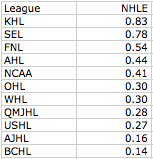
In my last post I made fun of efforts at translating production from other leagues to the NHL–it’s not that I don’t laud the effort, but I have yet to see a formula that can be applied to basic stats that makes sense.  To illustrate the point, I decided to highlight top North American performers in European leagues using this season to provide some insight (I’ve given their stats from this past season and then their best NA results and career totals; their current age is also in brackets).

KHL
Brandon Bochenski (32) 54-28-30-58 (NHL 41-13-11-24 06-07; NHL 156-28-10-68)
Nigel Dawes (29) 54-26-23-49 (NHL 66-14-18-32 09-10; NHL 212-39-45-84)
Kyle Wilson (29) 49-17-27-44 (NHL 32-4-7-11 10-11; AHL 427-149-170-319)
Dustin Boyd (27) 49-18-20-38 (NHL 71-11-11-22 08-09; NHL 220-32-31-63)

None of the players here truly established themselves as NHL regulars (although Dawes and Boyd did get to 200 games); that marginal existence (or in Wilson’s case, strong AHL career) has carried over to being excellent KHL players.  Does Bochenski’s domination of the KHL mean other players who dominate the league are Bochenski’s?  He out produced Ilya Kovalchuk, who was nearly a point-per-game in his last NHL season (12-13), but clearly isn’t anywhere near as talented as the Russian, so how much do their numbers matter?

NLA
Brett McLean (35) 50-18-26-44 (NHL 82-9-31-40 05-06; NHL 385-56-106-162)
Robbie Earl (28) 46-20-18-38 (NHL 32-6-0-6 09-10; AHL 313-66-103-169)
Alexandre Giroux (32) 46-20-18-38 (AHL 69-50-53-103 09-10; AHL 771-368-336-704)
Ahren Spylo (30) 47-16-22-38 (AHL 50-25-11-36 04-05; AHL 137-43-25-68)

These players have a less distinctive background in North America, being primarily AHL stars.  Joe Thornton was slightly better than a point-per-game player in the NLA (04-05), but this doesn’t mean Brett McLean is just a notch below him.  Not to beat my point to death, but clearly raw numbers from the league aren’t particularly useful in translating their production at the highest level

SHL
Chad Kolarik (28) 53-30-18-48 (AHL 76-31-37-68 12-13; AHL 277-98-111-209)
Ryan Gunderson (28) 54-8-33-41 (AHL 74-5-20-25 09-10; ECHL 156-9-98-107)
Rhett Rakshani (26) 55-13-25-38 (AHL 66-24-38-62 10-11; AHL 120-44-69-113)
Ryan Lasch (27) 54-20-16-36 (AHL 30-6-4-10 12-13; NCAA 161-79-104-183)

These players are quite similar to those above and I won’t bother making the point I’ve already made twice above.

Liiga
Ben Maxwell (26) 49-16-26-42 (AHL 73-22-36-58 08-09; AHL 296-68-140-208)
Corey Elkins (29) 54-15-25-40 (AHL 76-18-26-44 10-11; AHL 173-43-48-91)
Dan Sexton (27) 39-16-21-37 (NHL 41-9-10-19 09-10; AHL 144-36-64-100)
Aaron Gagnon (28) 48-17-19-36 (AHL 78-27-31-58; AHL 328-74-98-172)

The caliber here is quite Similar to the SHL.

DEL
Adam Courchaine (30) 51-29-45-74 (ECHL 42-21-28-49 05-06; ECHL 45-21-30-51)
Kevin Clark (26) 60-32-40-72 (AHL 72-12-19-31 11-12; AHL 160-26-60-56)
Blaine Down (31) 48-26-25-51 (AHL 54-8-13-21 02-03; AHL 134-18-28-46)
Derek Hahn (36) 52-12-34-46 (CHL 64-35-79-114 05-06; CHL 238-124-201-325)

This is a significant fall-off compared to the leagues above, as middling AHL and top ECHL players can make a big impact in the league.

The point of this isn’t to suggest we should give up the effort of understanding how a player’s performance in Europe translates at the next level, but as it stands all we can say with certainty is that big numbers in the top leagues (KHL, NLA, SHL, and Liiga) do translate at the AHL level (as they do in reverse).  Whatever limitations various players from either side of the Atlantic have, it seems like success in those leagues (or the AHL) easily moves back and forth, but that production does not have an obvious ratio at the next level.  I’m not sure what the solution to the conundrum is, but the problem shouldn’t come as a big surprise: massive point totals from junior players rarely translate to the NHL, but sometimes they do–the only certainty is that an absence of production at a lower level guarantees it will continue at the next.

This article is written by Peter Levi (@eyeonthesens)

Behind the Numbers of Binghamton’s 2013-14 Season

I wrote about Binghamton’s season back in April and then graded the prospects a week ago, but I return to the topic because Manny has gifted us with analytics via Josh Weissbock for the AHL.  Weissbock’s methodology is not included in the blog (just a link to his Twitter), but by the power of Internet I went and found an article he wrote for nhlnumbers which gives us somewhere to start:

To create a proxy for possession in the AHL, I looked at all games that have been played so far this year, added up each teams Shots For and Shots Against and calculated their Shots For %. This means there are some obvious limitations. These numbers also include special teams (not just even strength) and don’t take account score effects. So this a very rough proxy for the possession numbers we usually use for the NHL.

There’s clearly more to it now, but it sheds some light on where Weissbock’s numbers come from (he did Tweet how he calculated TOI).  I’m not going to break down each player comparing my thoughts to Manny’s because the differences aren’t extreme enough for that.  Instead I’ll highlight differences and reinforcements that I consider significant.

Goaltenders

I thought Andrew Hammond was solid in net and the numbers agree, although Manny believes more is needed from him next season; conversely I thought Nathan Lawson was average that was far too kind to the UFA.

Blueliners

No surprises here at all; I didn’t think much of Mark Borowiecki‘s season, nor is it a surprise to know he faced the toughest opposition in the league–I still expected more from him.

Forwards

I didn’t think much of Darren Kramer, Wacey Hamilton, or Corey Cowick‘s seasons and their underlying numbers are awful.  The former two comes as no surprise to anyone, but I think the data here makes it clear that Cowick cannot effectively handle a checking role (he was also a drag for Derek Grant and David Dziurzynski).  Jean-Gabriel Pageau was a monster against the toughest opposition.  It’s worth listing Binghamton’s forwards by the level of competition they faced (the number in brackets is where they finished in points-per-game in scoring by forwards; I’ve bolded the top-scorers):
Jean-Gabriel Pageau (4)
David Dziurzynski (11)
Derek Grant (9)
Jim O’Brien (8)
Corey Cowick (12)
Mark Stone (2)
Cole Schneider (5)
Matt Puempel (7)
Darren Kramer (14)
Wacey Hamilton (13)
Stephane Da Costa (3)
Buddy Robinson (10)
Mike Hoffman (1)
Shane Prince (6)
It would have been nice to see where Andre Petersson fit here before he left, but while excluded from Manny’s list his name appears amongst the bubbles of QoT/QoC and he slots ahead of Schneider above.  It’s worth pointing out that I gave Puempel and Prince equal grades and it’s clear the former had a better season given his QoT; Grant warranted a bit more generosity as well.

The last thing I want to address is the NHL Equivalency number included in the final chart.  These numbers are derived from a now gone-from-the-web Gabe Desjardins article, but Manny got his formula via Justin Azevedo:

chart

I have no doubt Desjardins put a lot of work into this, but as a cautionary tale for taking this chart as gospel, it predicts that Brandon Bochenski (KHL) is a 72-point producer at the NHL level (hell, Nigel Dawes is a 61-point player); or, for an AHL-example, Martin St. Louis should have been a 42-point NHL player.  I don’t think there’s a useful way to take statistics from one league and apply them to another, although it’s still fun to try.

This article is written by Peter Levi (@eyeonthesens)

European Free Agents of Interest

I’ve cast my eye on Europe the previous two years (2012 and 2013), and with the recent signing of DEL star David Wolf (Calgary) I thought I’d look again across the Atlantic and see what free agents might be worth pursuing.  The focus here isn’t aging veterans or former NHL players–I’m looking at lesser known, undrafted players who might make the jump.

Jan Kovar (LW/C), 24, 5’11 KHL Metellurg 54-23-45-68 (signed KHL; a player I highlighted in 2012)
The Czech player was second in league scoring, playing on a line with Sergei Mozyakin and Denis Zarpiov; he makes a lot of money in Russia and may not want to take the pay cut to get his shot in the NHL, but at some point he’ll pull a Roman Cervenka and take a year off to try it out

Sakari Salminen (RW/LW), 25, 5’11 KHL Torpedo 54-18-29-47 (signed KHL; player I identified in 2012)
Like most players who dominate in their domestic leagues, Salminen has made the transition to the KHL and enjoyed a great deal of success; leading Torpedo in scoring by nearly ten points (ahead of former NHLer Wojtek Wolski); I think there’s a good chance he’ll give the NHL a shot at some point

Dennis Rasmussen (C/LW), 23, 6’3, SHL Vaxjo 52-16-24-40 (signed SHL)
Enjoyed a career year leading Vaxjo in scoring; has good size which always makes GM’s happy; may not have an opt-out clause, but unless he goes for the money in the KHL he should land a deal with someone across the Atlantic [June 10th: Chicago signed him]

Michael Keranen (C/RW), 24, 6’1, Liiga Ilves 52-17-35-52 (signed, Liiga)
Nearly doubled his previous career high as he finished tied for the scoring lead in the Liiga; was nearly 20 points ahead of his nearest teammate–like Rasmussen above he’ll have to make the choice between the KHL and NHL, but undoubtedly he’s received calls from both [June 5th: Minnesota signed him]

Tommi Huhtala (LW), 26, 6’0, Liiga Blues 60-23-20-43 (signed KHL)
Locked into a KHL deal for the upcoming season; he lead the Blues in scoring while enjoying a career year; if he has a good season with Jokerit he might make the jump to the NHL, although at his age he may be beyond the point of wanting to play in the AHL

Julius Junttila (LW/RW), 22, 5’10, Liiga Karpat 56-19-15-34 (signed Liiga; a player I identified in 2012)
Set career highs with Karpat, where he finished fifth in team scoring; his numbers aren’t overwhelming, but he’s trending upwards and still very young

Borna Rendulic (RW), 22, 6’1, Liiga HPK 57-11-21-32 (FA)
Croatian national worked his way up through the Finnish junior system to establish himself as a Liiga-regular; he lead HPK in scoring

Ville Kolppanen (G), 21, 6’1, Liiga Ilves 2.18 .927
I believe he’s still eligible for the draft as an overage European, but I’ll include him here anyway; put up good numbers as Ilves’ starting goaltender

Players Signed from Previous Lists

Just a quick look back on those mentioned that appeared in previous versions of this list.  It’s worth noting the majority of players identified have not been signed.  There are far fewer European players who come over as compared to college, even though the dividends can be much higher (as you can see here).

Damien Brunner (RW) – signed with Detroit two years ago and after a strong rookie campaign struggled with New Jersey
Simon Moser (LW/RW) – signed an ELC with Nashville last season and spent most of the year in the AHL (48-8-18-26); he’s an RFA (I highlighted him in 2012)
Ronalds Kenins (LW) – signed by Vancouver last season to an ELC (I identified him in 2012), but was loaned back to Switzerland and enjoyed a career year (39-8-17-25); he should be in the AHL next season
Joel Vermin (C/W) – signed an ELC with Tampa last season (I highlighted him in 2013), but was loaned back to Switzerland where he struggled (49-6-12-18); his fate the following season is up in the air
David Wolf (LW) – signed by Calgary this week to an ELC (I identified him in 2012); DEL players tend not to translate well at the next level, although Marcel Muller was a decent AHL player

This article is written by Peter Levi (@eyeonthesens)

Thoughts on Senators Prospects (Part Two)

The second installment of my look at the Sens prospects (you can find Part One here).  After covering prospects in junior, college, and the ECHL, I’m taking a look at AHLers.  I have left out players who I don’t believe will return (like Wacey Hamilton), while players who are through their ELC’s who have established what they are (like Mark Borowiecki) are treated a bit further below (as is Cody Ceci, who spent most of his season in the NHL).  As always, for players without significant time in the NHL it’s worthwhile viewing the scouting reports when drafted (many of which can be found via the link above).

Cole Schneider (FA NCAA 2012; 69-20-34-54; previous season 60-17-18-35; splits 10-4-1-5/10-2-6-8/10-6-8-14/10-3-3-6/10-1-4-5/10-3-5-8/9-1-5-6)
An excellent sophomore campaign with only a few periods of inconsistency; so far Schneider has been an excellent free agent signing and all that remains to be tested is his capabilities at the next level–he can clearly dominate in the AHL.  Does he need to be a top-six player to pan out at the next level?  I think that remains to be seen–if he’s a possession guy then the goals aren’t the only way for him to step up.

Chris Wideman (4-100/09; 73-9-42-51; previous season 60-2-16-18; splits 10-1-7-8/10-1-3-4/10-1-7-8/10-2-10-12/10-1-4-5/10-0-3-3/13-2-8-10)
A fantastic sophomore season, slowing a little in the second half (32 points in the first 40, 19 in the next 33); undersized NCAA grad will always have to do more to get his shot, but another dominant AHL-season is going to force Ottawa’s hand.  It’s very rare for a small blueliner to play a depth role, so he has to push for at least a 4-5, second unit powerplay spot to have a realistic shot.

Matt Puempel (1-24/11; 74-30-18-48; splits 10-3-2-5/10-3-2-5/10-3-1-4/10-5-2-7/10-5-2-7/10-5-3-8/14-6-5-11)
First-rounder’s rookie season improved over the course of the season (went from 0.46 points-per-game in the first 30 to 0.77 the rest of the way); sniper projects as a top-six player who can eat up powerplay minutes, but whether he’ll achieve that potential is still up in the air (his ability at the AHL-level is not in question).

Shane Prince (2-61/11; 69-21-27-48; previous season 65-18-17-35; splits 10-2-2-4/10-3-5-8/10-2-5-7/10-6-4-10/10-3-2-5/10-3-3-6/9-2-5-7)
Improved over last season; his primary issue is inconsistency, but his tracking the right direction; I don’t know if Prince has the chops for the next level, but that possibility remains (perhaps as a pesky top-nine player).

Jean-Gabriel Pageau (4-96/11; 46-20-24-44; NHL 28-2-0-2; previous season 69-7-22-29; splits 10-5-9-14/10-2-4-6/10-2-8-10/16-11-3-14)
While his time in the NHL was a disappointment, he dominated in the AHL and his future remains bright; he’s not a lock for the NHL roster next season, but that league is in his future (even if he never produces enough to escape a bottom six role).

Mark Stone (6-178/10, 37-15-26-41; NHL 19-4-4-8; previous season 54-15-23-38; splits 10-4-4-8/10-6-6-12/10-3-9-12/7-2-7-9)
Injury-prone, but there’s no questioning Stone‘s hands or instincts; it remains to be seen if his feet are fast enough to be an NHL-regular, but he’ll get an opportunity to show that sooner than later.

Buddy Robinson (FA NCAA 2013, 69-15-16-31; splits 10-2-1-3/10-4-3-7/10-1-1-2/10-1-2-3/10-2-3-5/10-1-3-4/9-4-2-6)
The big winger gradually became more consistent over the course of his rookie season, which echoed Cole Schneider‘s last year; NHL-potential hasn’t been tested yet, but at the least he’s going to be a good AHLer.

Fredrik Claesson (5-126/11, 75-3-26-29; previous season 70-3-8-11; splits 10-0-0-0/10-0-5-5/10-1-6-7/10-1-8-9/10-0-1-1/10-1-1-2/15-0-5-5)
Steady Freddy enjoyed a fantastic sophomore season; defensively dependable, there’s no question he could at least fill-in at the NHL-level, so the question now is whether he can be a regular or not.

Corey Cowick (6-160/09, 72-12-13-25; previous season 72-16-19-35; splits 10-1-1-2/10-3-1-4/10-0-2-2/10-4-4-8/10-2-1-3/10-1-1-2/12-0-3-3)
After a successful season riding shotgun with Jean-Gabriel Pageau, everything came crashing to earth for Cowick who, other than a short stretch in December, put up awful numbers (even for a checker).  He’s clearly someone who needs to be insulated to perform at his best and that doesn’t bode well for an NHL future, even if he’s now fully established as an AHLer.

Derek Grant (4-119/08, 46-12-10-22; NHL 20-0-2-2; previous season 63-19-9-28; splits 10-3-3-6/10-3-1-4/10-0-2-2/16-6-4-10)
His numbers marginally improved over last season and he spent a good chunk of the early season in the NHL; projects as a PK forward and the upcoming season is going to be make-or-break for him (I don’t think he’ll be on the Sens roster, but he should dominate in the AHL no matter where he’s played).

Michael Sdao (7-191/09, 61-5-6-11; splits: 10-1-0-1/10-1-2-3/10-0-2-2/10-2-1-3/10-1-0-1/11-1-0-1)
Drafted as the best fighter of the 2009 class, his rookie season saw him eventually push Ben Blood out of the lineup, but not do enough to dress in the playoffs; he projects as a 5-6 guy.  His numbers are actually quite decent and he can do more with the puck than someone who is just a goon–the question remains if he can translate that to the next level and at this point it’s too early to tell.

Darren Kramer (6-156/11, 45-2-2-4; previous season AHL 21-1-0-1/ECHL 19-3-7-10; splits 10-1-1-2/10-1-0-1/10-0-1-1/15-0-0-0)
The best fighter in his draft class, he was a full-time roster player in his sophomore season, but dressed for only just over half the games–despite appearing in the playoffs, it’s clear his skill level isn’t high enough for him to fill anything other than the role of a fighter, something I don’t see him translating to the NHL.

Older/NHL Players

Cody Ceci (1-15/12; NHL 49-3-6-9; AHL 27-2-17-19)
First-rounder was locked into Ottawa’s lineup for the same kind of WTF reasoning that keeps Chris Phillips in the lineup; like most young defenseman there’s a lot growth yet to come and a full season in the AHL would likely help; an offense-first blueliner, the future should be bright for Ceci–the only question is when he’ll be ready for full-time NHL duty.

Mike Hoffman (5-130/09; AHL 51-30-37-67; NHL 25-3-3-6; previous season AHL 41-13-15-28)
He has nothing left to prove at the AHL level, so the question remains whether or not he can be a regular NHL player; I think he can–he has the speed and hands to be useful even if he can’t translate his scoring–the only question is whether he does this in Ottawa or not, and whether he’s someone who plays for parts of a few seasons and then disappears.

Stephane Da Costa (FA NCAA 2011; AHL 56-18-40-48; NHL 12-3-1-4; previous season AHL 57-13-25-38)
This was the first season where Da Costa looked like a (potentially) useful NHL player; I’m still not sure how well his skills translate, since I don’t think he’s particularly useful in a depth role and his production might not warrant anything else, but given that after last year I thought his peak was the AHL, he’s become a more interesting asset.

Mark Borowiecki (5-139/08; AHL 50-2-6-8; NHL 13-1-0-1; previous season 53-4-10-14)
Heart and soul player had a poor season–too many penalties, too many fights, sub par production, etc.  There’s no questioning his worth ethic, but the more I see of Borowiecki the more I’m convinced his peak is a 6-7 blueliner who is as good as he’s going to get right now.

David Dziurzynski (FA BCHL 2010; AHL 68-13-12-25; previous season AHL 54-4-16-20; NHL 12-2-0-2)
There’s nothing left for Dizzy to prove in the AHL–he’s a well-established checking forward whose numbers have been almost ruthlessly consistent (points-per-game per season: 0.26, 0.38, 0.37, and 0.36); is he good enough to perform the same role in the NHL?  I thought he looked out of place with Ottawa two season’s ago, but that’s not to say he couldn’t fit on a line in the right situation–although I’m dubious he’ll get that chance with the Sens.

This article is written by Peter Levi (@eyeonthesens)

Thoughts on Senators Prospects (Part One)

The signing of prospect Mikael Wikstrand on Thursday got me thinking about what we can expect from Ottawa’s many prospects.  Given the great multitude this will be done in two parts.  I’m leaving out players like RFA Ben Blood (he won’t be retained), Francois Brassard (the organisation has made it known they have no intention of signing him), or the injured Jarrod Maidens.  Acronym of note for players in pro: ppg = points-per-game.  Players who will be playing pro next season have been coloured green.

CHL Prospects

It’s worth noting here that production (unless it’s bad) doesn’t mean much at this level; Tyler Donati was an OHL star and couldn’t manage to become an AHL-regular, so keep that in mind.  Scouting reports are much better guides to these players and you can find most of them by draft year: 20102011, 2012, and 2013.

Curtis Lazar (1-17/13; WHL 58-41-35-76; previous season 72-38-23-61)
The scouting consensus was that the first-rounder was a solid, well-rounded second-line player and nothing from this season would suggest otherwise.  His numbers were up from his draft year and he performed very well at the WJC.  The organisation has talked about him making the jump to the NHL next season, but there’s no reason (beyond budget) to rush him into the lineup.

Vincent Dunn (5-138/13; QMJHL 50-31-20-51; AHL 1-0-0-0; previous season 53-25-27-52)
Super pest dropped a long way in the draft; his numbers were essentially unchanged from the previous season and all the scouting reports project him as a pesky bottom six forward–nothing from this year has changed that estimation.

Ben Harpur (4-108/13; OHL 67-3-13-16; previous season 67-3-12-15)
Drafted primarily because he was big; a stay-at-home blueliner,  his limitations with the puck are going to make the transition to pro very difficult (his numbers did not improve over his draft year); I don’t believe the organisation will sign him when they have to make that choice next year.

Chris Driedger (3-76/12; WHL 28-14-7 2.64 .918; ECHL 1-2 3.92 .893; AHL no result; previous season 36-14-4, 2.51 .915)
Won the goaltending sweepstakes within the organisation by beating out sixth-rounder Brassard; scouting reports are all over the place and contradictory, largely because Driedger was not the full-time ‘tender in his draft year; his numbers have improved in each of the two season since he was drafted and he’s slotted in to play backup in the AHL (a backup at the NHL-level is where he projects out).

NCAA/USPHL

College scoring is more predictive at the minor pro level than that of the CHL, but it’s still not the best guide.  The various US junior systems are as potentially misleading as those in CHL.

Tim Boyle (4-106/12; USPHL 37-5-16-21; previous season NCAA 15-0-2-2)
The Sens surprise pick of the 2012 draft, Boyle left the NCAA after a year at Union College to go back into the US junior system; his numbers were good, but not dominant (ala former Sens prospect Bryce Aneloski who did the same thing); there’s a lot of time left for him to develop so it’s too early to judge him, but there’s a lot for him to prove.

Ryan Dzingel (7-204/11; NCAA 37-22-24-46; AHL 9-2-5-7; previous season 40-16-22-38)
Left college early (after three seasons) to turn pro; another skilled player who fell in the draft (his second) because of his size and lack of physicality; after dominating at Ohio State he did not look out of place in his short debut with Binghamton; is he another Ryan Shannon, or is he something more than that?  It’s difficult to judge at this point.  The challenge for all top scorers when they turn pro is can they do anything else if their scoring doesn’t translate.

Max McCormick (6-171/11; NCAA 37-11-24-35; previous season 40-15-16-31)
Teammate of Dzingel and drafted in the same year; he has been very good at Ohio, albeit not quite as electric as the above; he”ll finish up his college career before turning pro; he’s a hard-working player who projects as a depth, energy player.

Garrett Thompson (FA 2013; NCAA 43-16-16-32; AHL 7-1-2-3; previous season NCAA 37-11-15-26)
Free agent signee from Ferris State I don’t know enough about to project–he was not on the radar when he was draft eligible and has been described as a meat and potatoes type of player, so projects as a depth forward.

Robert Baillargeon (5-136/12; NCAA 35-10-17-27; previous season USHL 55-18-23-41)
Lead Boston U in scoring in his rookie season, benefitting from a more settled season than his last in the USHL; his stock fell at the draft due to a lack of “toughness”, but all the things that actually matter (speed, skill with the puck) are present and were demonstrated this season.  I think to his the highest level he’ll have to become an Erik Condra; a depth player with good possession numbers.

Quentin Shore (6-168/13; NCAA 33-7-18-25; previous season 39-10-9-19)
A solid season at U Denver; drafted as a two-way player and something of a gamble, we’re still a few years away from judging him.

Chris Leblanc (6-161/13; NCAA 23-6-6-12; previous season EJHL 44-13-20-33)
A surprise draft pick enjoyed a solid rookie season with Merrimack; there were no scouting reports on him beyond the organisation describing him as a “big two-way player”; he’s a long way away, but projects as a depth player.

Europe

Much like the CHL above, production does not mean much except in absence here.

Mikael Wikstrand (7-196/12; SHL 19-4-7-11; Alls 27-4-16-20; previous season Alls 45-11-14-25)
Benefitted the previous season from playing with lockout players like Anze Kopitar, but this year he not only maintained but improved his production in the absence of NHL superstars.  Scouting reports when drafted all indicated he was a good, two-way player (his 3 points in his draft year seem the primary reason he nearly fell out of the draft), but his performance as a powerplay quarterback eluded everyone (including the Sens organisation).  He should do well in Binghamton this upcoming season, although the usual switch to smaller ice might lead to a slow start.  He was projected as a bottom-pairing NHL player, but if his offense translates he might also be a second unit PP guy.  Time will tell.

Tobias Lindberg (4-102/13; SuperElit 38-7-15-22; Alls 3-0-0-0; previous season SuperElit 43-9-13-22)
An off-the-wall pick last year, Lindberg‘s numbers improved only slightly from his draft year (ppg went from 0.51 to 0.57) and I think his future is heavily tied into how he does next season.  I have a suspicion he’ll wind up being Marcus Sorensen (4-106/10)–an energy player whose skills don’t quite translate outside of Europe.

Marcus Hogberg (3-78/13; Alls 5-8-0 2.93 .892; SHL 4-0-0 1.08 .960; previous season SuperElit 2.77 .906)
Scouts struggle to figure goaltenders out (have some fun and scan goaltending picks from any draft), so what little was said about Hogberg at the draft was all over the place; his numbers weren’t great this season for Mora in the Allsvenskan, but he was fantastic in the SHL and one wonders how much of his stats are dependent on the defense in front of him.  He’ll spend another year in Sweden, but I’d expect him to come to Binghamton in 15-16.

ECHL Prospects

Elmira just finished a disastrous season (24-40-8, third worst in the league), which is their last season in affiliation with Ottawa (no official replacement has been named for the Sens).  The Jackals produced the second fewest goals in the league and allowed the second most–it was an unmitigated disaster and that’s worth keeping in mind for the players below.

Troy Rutkowski (FA WHL 2013, ECHL 41-0-9-9 PPG 0.21; AHL 12-1-0-1; ECHL splits 10-0-3-3/10-0-2-2/10-0-1-1/11-0-3-3)
The disaster that is Troy Rutkowski makes it clear why Colorado walked away from him (5-137/10) last year.  Now, it’s possible that he could turn into a decent AHL player (and certainly he might have a future bouncing around Europe), but NHL-calibre players don’t struggle in the ECHL.  With plenty of opportunity in Elmira, the offense-minded blueliner was unable to translate his CHL success.  Yes, the Jackals had a terrible season and a bad team, but that didn’t prevent other prospects from performing adequately.  There was no sign of evolution of his play over the season (his production did not increase).  Ottawa is stuck with Rutkowski‘s contract for two more seasons and given the thinness of their blueline in Binghamton he’ll probably get one more try before they attempt to move him.

Jakub Culek (3-76/10; ECHL 49-8-22-30 PPG 0.61; AHL 7-0-0-0; ECHL splits 10-3-6-9/10-1-5-6/10-4-5-9/10-0-4-4/9-0-2-2)
Enjoyed a moderately successful rookie season in Elmira, although he faded badly down the stretch (18-0-4-4).  I don’t think there’s any NHL potential in him (when drafted he projected as a depth, checking forward), but he could become a solid bottom-six forward in the AHL.

Ludwig Karlsson (FA NCAA 2013; ECHL 39-11-13-24 PPG 0.61; AHL 8-0-0-0; ECHL splits 10-2-2-4/10-2-5-7/10-2-4-6/9-5-2-7)
Did not perform as expected (you don’t sign a college free agent to play in the ECHL), but at least in Elmira he was decent (other than the games immediately after his injury).  His season was derailed early and he got stuck behind a huge logjam at forward–next season will be make-or-break for the Swede.

This article is written by Peter Levi (@eyeonthesens)