Brampton Beast

brampton

There have been a lot of changes since I initially went over the team’s roster just a few weeks ago. Let’s walk through the team as it stands now just one day before their season opens (highlighting changes I haven’t covered previously; the new ECHL website layout is a nightmare at the moment, incidentally):

Goaltenders
Jake Paterson (AHL-deal)
Anthony Dumont-Bouchard (undrafted, with most of his time spent in the Q other than his final year in the O with Kitchener)

Leonid Lazarev was released

Defense
Macoy Erkamps (ELC)
Chris Martenet (Dallas ELC; not someone the Stars want even on their ECHL affiliate in Idaho)
Mathieu Gagnon
Reggie Traccitto
Jordan Henry
Mike Folkes
Matt Petgrave
Austin McEneny
Jonathan Racine
Chase Golightly

Hugo Enock was released

Forwards
Aaron Luchuk (ELC)
Daniel Ciampini (AHL-deal)
Francois Beauchemin (AHL-deal)
Anthony DeLuca (claimed off waivers; played in Denmark last year, but was on the BSens Wichita affiliate back in 15-16 for half a season)
David Vallorani
Artur Tyanulin
David Pacan
Chris Leveille
Anthony Beauregard
Erik Bradford
Brandon MacLean
Nathan Todd
Jackson Leef
Alexandre Mentink (I believe this is a PTO because he was playing in a senior league last year after three seasons away from hockey completely)

Lucas Venuto and Kris Newbury were released; Jake Wood was claimed off waivers

Filip Gustavsson, Ryan Scarfo, and Boston Leier were all assigned to Brampton earlier, but all have been recalled due to injuries and NHL-recalls. Leier played in the BSens first game and Gustavsson is likely to play in Manitoba. This flood of roster moves pushed the BSens into signing Daniel Ciampini to an AHL-deal and I’d expect him to play ahead of Scarfo.

Aaron Luchuk remains in Brampton and I think that’s largely to ensure he gets lot’s of ice time. If, over time, others are recalled ahead of him than that’s an indictment of his performance.

This article is written by Peter Levi (@eyeonthesens)

The Milkman Returns

Image result for milkman

Jeremy Milks, one of the original Sens bloggers, came out of the woodwork after three years of dormancy. What brought the milkman back to the blogosphere? Was it ownership? The Karlsson trade? Excitement over the youth movement? Nope, it was Cody Ceci.

For those of you unfamiliar with Jeremy, he’s an old school fan–likes ’em gritty–good in the corners–and he’s not comfortable with all those fancy stats (math and sports don’t mix). I haven’t blogged as far back as Jeremy has, but we were both blogging at the same time for years. Despite that I rarely had reason to comment about him because his opinions were echoed by the Ottawa media. However, given today’s post by him, I did want to reference the last time (in 2014) I discussed him because it’s relevant to what he posted today:

For some reason I’ve gotten that reputation [of liking tough guys over skilled guys] in the Sens small but fiercely opinionated online community and maybe that’s my own fault. … Even if I’m wrong sometimes, I take satisfaction in defending a player that gets almost unanimous scorn. … I don’t want to turn this into another stats argument and point to a bunch of numbers. We all know they’re good.

So how has Jeremy evolved in the four years since he wrote the above? What’s changed–what brought the inestimable Sens blogger back to the keyboard to share his views? Well, as we’ll see, nothing. The milkman has returned to fight the same battles.

I want to boil Jeremy’s piece down to his main points (you can read the entirety of his article via the link above)–I want to look at his argument, which he sets out as a comparison between Ceci and Thomas Chabot:

Ceci had one of those mediocre games that would go largely unnoticed in most NHL cities

Jeremy likes using strawmen in his discussions and this is a classic–if he’s being honest with us, is there a Canadian market that doesn’t pay attention to this sort of thing? There were more angry articles written about Kenny Jonsson in his rookie season with Toronto more than 20 years ago than we saw angry blog pieces about Ceci over the same time period, so let’s not pretend he’s playing in an especially hostile environment, particularly given the incredibly tame media here.

Not many teams can stop the Bruins first line … but the sight of Bergeron’s hat-trick goal bouncing in off of Ceci’s skate launched a thousand and one “I told you so” tweets. Never mind that Ceci was (awkwardly) doing the right thing…. All of that doesn’t matter. At least not to Ottawa fans and Mr. Ceci. For many, Ceci will never measure up, even though nobody really knows what that measure is supposed to be.

This is a pretty bizarre statement–the org has told us incessantly what he is and what the expectations for him are. That aside, Jeremy says Ceci was bad against the line because everyone is bad against them (no need to back this up–we need to trust that Jeremy knows that’s true–all defensemen are equally bad against this so criticism of his performance isn’t fair). What’s interesting is the “I told you so”–so fans knew better than the coach how this would turn out? And Ceci can’t live up to fan expectations? I wonder, Jeremy, who set those expectations? And how do fans know better than a professional organization and coach? But we’ll come back to that.

Analytics-minded fans say they know the measure, and it’s possession time among other stats. And they may very well be right

Let’s note they may be right–not that they are right. Jeremy is gracious by not offering an explanation of what that means.

Ceci, miscast as a shutdown defender on a thin Senators blueline, has to face Bergeron

How does Jeremy know he’s miscast, exactly (eyeball test? tarot cards? how?)? It fits the “poor me” defence, but let’s see what reasons he has for this.

he’s skating backwards more often than handling the puck, and when he does get it on his tape, it’s probably going high off the glass and through the neutral zone so his team can make a line change. Doesn’t make for a very compelling set of numbers. For many, he also fails the eyeball test

The description makes it sound like he fails the Jeremy eyeball test–the generalization about what Ceci does has to come from somewhere, after all.

We watch with our eyes but we also watch with our prejudices. We want to see what we already know, which is why analytics has cut through some of the traditional views and made everybody mad on both sides of the divide. It challenges everything we think we know and therefore it’s a threat. On the other hand analytics dismisses intangibles too easily and the eyeball test probably takes too much of it into account.

This is fascinating to me–what two sides? Analytics only makes people upset who reject it and the number who do shrinks annually. He’s absolutely correct that those who focus purely on the eyeballs make too much of it (something demonstrably proven over and over again in sport–you can start with Moneyball and work your way forward).

We see a minor miscue [by Ceci] and it brings to mind hundreds from the past and suddenly that bad bounce turns into the blooper that should see him traded for a draft pick

Jeremy remembers hundreds of miscues from Ceci–that seems problematic.

We don’t see the routine plays that a veteran makes to be in position to halt a breakout or that vital routine pass to break out of the zone. Not the home run pass to create a breakaway, but the simple chalkboard play to get out of your zone. Ceci, and most vets, make these unremarkable plays more often than not

We’re safely back in strawman territory as Jeremy knows anyone criticizing Ceci is incapable of recognizing what he does well. Thank god Jeremy is here to inform us!

It’s a bit reminiscent of Jason Spezza, who was well-liked by more fans than Ceci, but still took so much heat that he wanted out of town shortly after being named captain

Last I checked fans don’t make trades. Jeremy leaves it unsaid that the Sens were eager to get out from under Spezza‘s contract (particularly given Melnyk’s financial woes)–the fact that Bryan Murray made a terrible deal isn’t the fans fault (something people in analytics knew was a disaster from the start). If fan pressure truly resulted in trades, Ceci would have been jettisoned years ago.

That [more offensive] role has been offloaded to even younger players

We’re stumbling into Jeremy’s logic a bit here–the coaches that understand how important those simple plays are (that fans are too dumb to recognize) apparently don’t think Ceci can take that next step and fill-in for Erik Karlsson. So who understands his value? Not the coaches, from what’s said here, but not the fans either? Is it just Jeremy?

Meanwhile, Chabot is the fan’s new golden kid.

Wow, that sounds undeserved right? Probably anointed by his GM as an amazing player–one of the best he’s seen in 20 years–and despite all his numerous mistakes and cries from the analytics community, he still plays a ton. Or wait, my mistake, I just described Ceci. Moving on!

There’s long been a sentiment that Ottawa management favoured local prospects for marketing reasons over more skilled options, but in the case of Ceci, he was one of the most highly rated defensemen in his 2012 draft class.

We can forgive Jeremy for not following the draft very closely (none of them have veteran savvy so how good could they be?), but I can fill in some details for him. The 2012 draft was a weak one, but he’s correct that Ceci was ranked highly. Not many people read those draft reports, however, they just look at the ranking, but if you do read them you’ll see all the warning signs scouts had for him at that stage–you’ll note most had him topping out as a top-four blueliner–not a guy for the top-pairing. Those are opinions from days of yore, but let’s be careful with this narrative that he was anointed at the draft which somehow leaves the org no choice about what to do with him.

Ceci’s only crime is having a “standard” hockey personality

How his personality is reflected in his play is a mystery only Jeremy can resolve.

He’s well liked in the locker room

This is Sens org PR 101–he’s good in the room goddamn it!

In a fair world, Ceci would probably be seen as a “fair” player

I don’t think even Jeremy knows what ‘fair’ means removed from the abstract. What’s fair? Does it mean average? Above average? Which other players are ‘fair’? I don’t know and I don’t think Jeremy does either–I’m assuming he means he’s not bad, but that’s simply an assumption.

For Cody Ceci, the intense scrutiny will continue until something breaks, either for management or the player. He probably deserves better

This makes me curious–why does he deserve better? Why does he deserve anything? This isn’t a league with participation trophies–it’s competitive where you need to be better than other players or you lose your job. I assume he wants the player treated better, but other than the fanbase he couldn’t get better treatment and for Ceci what’s more important? Love from your bosses, or from random fans online? The answer is pretty clear.

These attacks have real ramifications. Just ask Jared Cowen, or other high draft picks before him who didn’t measure up to expectations

Sport is entertainment and entertainers have to put up with a lot of shit–that comes from being a public figure and for athletes this usually begins as teenagers. Despite that, how is it relevant to Ceci in a way that impacts his play? Does he bauble the puck due to comments in The Silver Seven (if he does, where’s that mental toughness the ‘good-in-the-room’ guys are supposed to have?). And is Cowen the hill Jeremy wants to die on in relation to Ceci? The problem with this idea is that players run out of organizations are almost always skilled guys–ones who weren’t good in the room, or weren’t tough enough, or didn’t work hard enough. Those are the players who receive unfair criticism (typically from management) and then blossom elsewhere. The guys like Ceci, the ‘good in the corners’ guys, they are afforded every opportunity and given every excuse (as, indeed, Ceci demonstrates).

Let’s try to sum up Jeremy’s argument. As it turns out, despite his opening, it’s not a comparison between players, but rather a defense of Ceci from public criticism. Jeremy doesn’t reflect at all on the walls put around the guy by the organization, the coach, most of the media, and his teammates. Cody Ceci needs even more protection apparently–fans need to stop being so mean–stop pointing out his flaws and trying to make their favourite team better. There’s no real structure to this argument, but you can sum it up in just two points:

1. Ceci’s performance isn’t very good, but he’s being utilized poorly

No one would argue this point.

2. Fans are being overly negative because they’ve already made up their minds that he’s not very good.

The problem here is that Jeremy doesn’t think he’s very good either–he’s a ‘fair player’–a term that I think means average. How does Jeremy know this? I have no idea–he doesn’t tell us–but because he’s a fair player we shouldn’t criticize him because he’s being used inappropriately.

This is convoluted and nonsensical. Jeremy is not a bad guy, but he clutters up what is an emotional statement with an attempt at an argument. Do fans have a right to criticize Cody Ceci? Absolutely. As long as they aren’t crossing the line of actual harassment, it’s justified–especially given the org’s refusal to accept any of the foibles even Jeremy himself admits. If Ceci was a rookie or sophomore you could argue that fans need to be patient (although demotion to the AHL or returned to junior is a legitimate discussion), but that’s simply not the case here. I think the reason why Jeremy put up this post is because he’s frustrated with arguments he’s having with other fans. If Jeremy can’t argue facts, he can try to shut down criticism entirely by saying people are being too mean (something we aren’t hearing from Ceci, certainly). Jeremy isn’t intentionally being disingenuous–I’m sure he believes everything above (even the contradictory parts), but as an argument it’s simply ridiculous.

Welcome back Jeremy. You’ve generally been a Don Brennan clone over your blogging career, but you are entertaining and I hope you keep posting.

This article is written by Peter Levi (@eyeonthesens)

Belleville 1, Utica 3

I’m a little late with my impressions of the game, but better late than never. I prefer seeing games live and cramming this one in late at night definitely took away from the experience–with that said, it was not an entertaining game. Just a note about AHL Live: the quality of the stream was good, so we can hope that’s a trend for this season. Let’s start with the basics.

Utica 3, Belleville 1
Shots: 29/32
PP: 1-1/0-3
Goaltender: Mike McKenna (26-28)
Goal: LaBate (Leier, Percy)

Context
The Comets were playing their second of back-to-back nights after getting thrashed by Toronto 7-3 the night before. The team features former Sen pick Jonathan Dahlen (discarded in the Alex Burrows trade). The only change made to the lineup was swapping 19-year old Lind for 21-year old Palmu–goaltender Richard Bachman played both games.

Lines
I’ve mentioned previously that Mann’s decisions when it comes to TOI are going to dictate what kind of success he’s going to have and I was curious what lines he would utilize–keeping in mind that both Jim O’Brien and Ben Sexton are hurt (with Paul Carey and Max Lajoie in Ottawa), circumstances that threw off my line-predictions:
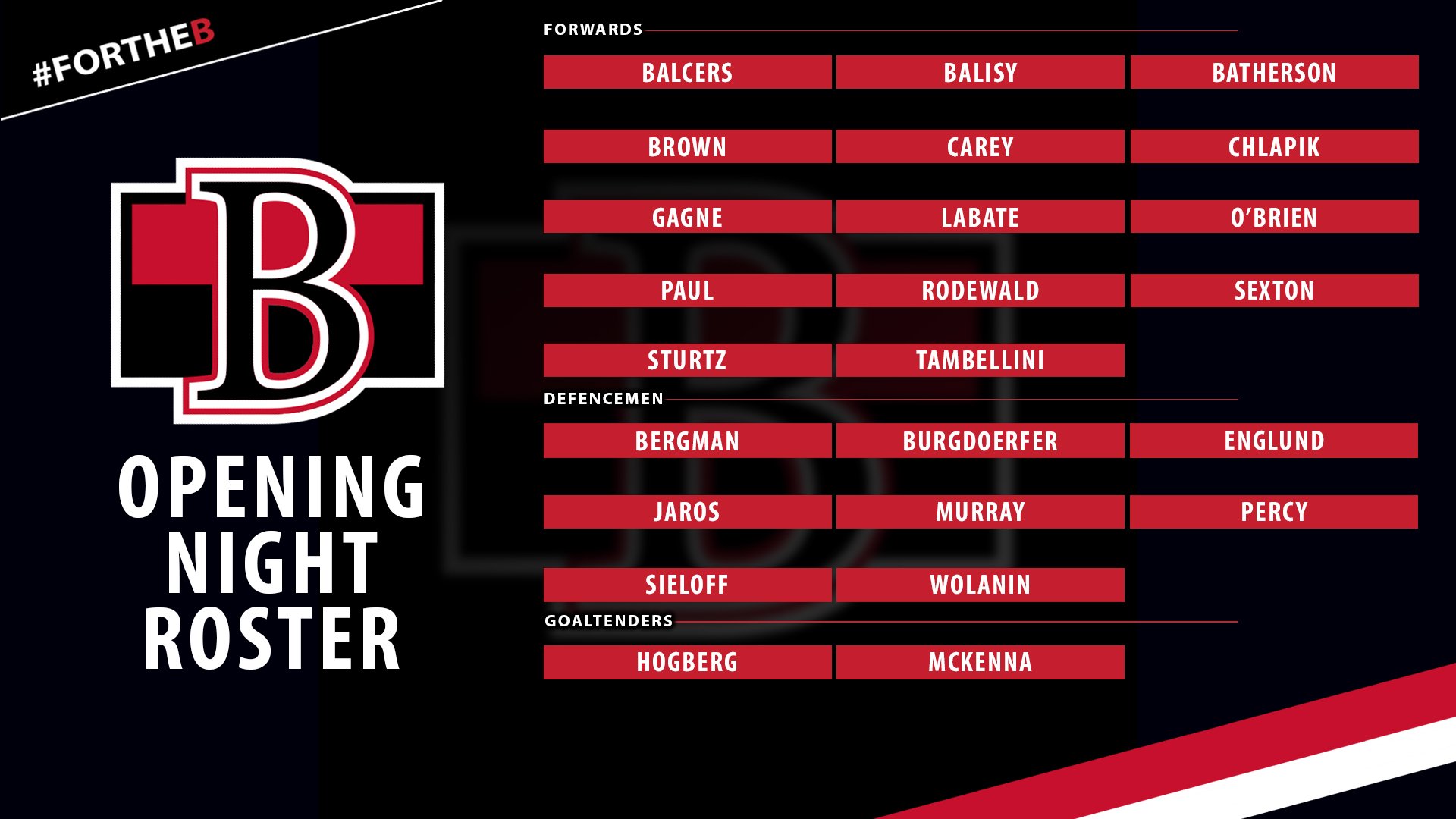
Balcers-Chlapik-Rodewald
Paul-Brown-Batherson
Tambellini-Balisy-Gagne
Leier-LaBate-Sturtz
Wolanin-Burgdoerfer
Percy-Jaros
Sieloff-Bergman

How off were my predictions? Removing the roster situation, not that far (I had Chlapik centering the first line, Brown and Batherson on the second, Tambellini and Gagne on the third, and LaBate and Sturtz on the fourth). On defence I had all the pairings correctly predicted, but I had the first and second swapped. It’s very clear Mann wanted ‘veteran savvy’ on each defense pairing, although in practice with the exception of Percy it was the prospects who had to make up for their veteran partners.

What about special teams? Who did Mann use? Well the team enjoyed a long powerplay due to Brendan Woods losing his mind and punching Chlapik repeatedly for no reason (the AHL, in its wisdom, thought that was just fine).
Tambellini-Chlapik-Gagne/Percy-Balisy
Paul-Brown-Batherson/Wolanin-Balcers

Because of the length of the one of the PP’s we did see a little variation, but these were the set combinations and they make my head explode. Why the hell is Tambellini on the first unit? Why is Balisy? The second unit looks like it should be the first, but it wasn’t. Neither unit generated many opportunities as they both looked disjointed.

As for the penalty kill, we only saw it for a few seconds as Utica scored off the opening faceoff. The unit was: Paul-Balisy/Percy-Jaros. It’s worth noting that last season Jaros was not very good on the PK–doesn’t mean that won’t change, but it’s something to keep in mind.

There were a few eye-catching coaching decisions which elicit groans of disappointment:
Rodewald on the first line: This is a horrendously inconsistent player who drags down whoever he plays with (as, indeed, he demonstrated on the night). Any of the other RW’s would have been a better choice and Mann made no adjustment to this unit throughout
Burgdoerfer on the first pairing: something I guessed we’d see after his selection as captain, but illustrative of Mann’s inability to recognise his flaws (all related to his instincts); Wolanin helped him out, but he’s a drag on whoever he plays with
-No Jaros or Bergman on the powerplay: the latter has historically been good with the extra man and the former has the biggest shot on the team–they only appeared once (as a duo of all things) during seven minutes of wasted powerplay time

On Twitter a fan is tracking Corsi along with zone starts, entries, and exits (part of my delay in posting this was a desire to see that info). Analysts have been moving away from Corsi, but it does have its uses (as a reminder: that’s measuring shot attempt differential while at even strength). What we can take away from that information:
-the Paul-Brown-Batherson line dominated (in relative terms), although they were never given a defensive zone start (most of which were split between the 1st and 4th line)
-the fourth line did well, the third line was roughly even, and Rodewald dragged down his partners on the first line (this isn’t obvious from the Corsi data by itself, incidentally)
Wolanin and Jaros (unsurprisingly) had the strongest games; Sieloff was awful, although that doesn’t jump out at you as much via Corsi
-You get a sense of just how magical Burgdoerfer is by looking at his zone exit numbers (12 attempted, just 7 completed)

The numbers are very kind to Sieloff, who was guilty of some horrendous giveaways in his own zone–three in particular stood out, including passing to the wrong team in front of his own net late in the first. This is not typical of his play (which isn’t to say he’s a great player, just that these kinds of unforced errors were not typical of him last season), so I’m not sure what the issue was.

Chlapik‘s numbers aren’t overwhelming, but he continues to do things not many other players can do at this level (there was a fantastic pass in the second period that stands out to me); he and Balcers are clearly still figuring each other out, but having a useless player (Rodewald) on the other wing dragged both down.

We’ll hope for better things in game two, which will also give us insight into Mann. Is the coach someone who adjusts or is he, like Kleinendorst, very slow to figure things out? Time will tell.

This article is written by Peter Levi (@eyeonthesens)

Belleville Senators: Predictions

Image result for nostradamus

The BSens play tonight (a game I’ll have to catch after the fact), so this is my last chance to make predictions in a timely fashion. I did so last year and on the whole I did pretty well. While we aren’t yet sure of the lines/combinations, we can bemoan Burgdoerfer‘s selection as captain–it’s not that I think the selection matters for individual or team performance, but it does show who the coach has faith in and putting that mantel on the turnover-machine (stay safe kids and don’t play the drinking game) means he will get significant ice time.

Putting that aside, let’s dig in, shall we? I’ve gone over most of the players previously sans predictions and I’ve linked those breakdowns below.

Division/Schedule

As covered previously the BSens have an easier road to success this year with a softer division to play in (I highlighted the teams they play the most–blue at the top, pink second, and green third):

Schedule (76) 29-42-5
North Division (54, 71%)
Toronto (Tor) 12 54-18-4
Syracuse (TB) 6 46-22-8
Rochester (Buf) 4 37-22-17
Utica (Van) 6 38-26-12
Binghamton (NJ) 6 25-38-13
Cleveland (Clb) 8 25-41-10 (Central Division)
Laval (Mtl) 12 24-42-10
Atlantic Division (14, 18%)
Lehigh (Phi) 2 47-19-10
Charlotte (Car) 4 46-26-4
Providence (Bos) 2 45-26-5
Bridgeport (NYI) 2 36-32-8
Hartford (NYR) 2 34-33-9
Hershey (Wsh) 2 30-37-9
Central Division (8, 10%)
Grand Rapids (Det) 4 42-25-9
Manitoba (Wpg) 4 42-26-83

The BSens have four less games against Rochester, two less against both Binghamton and Syracuse, and no games against Wilkes-Barre or Springfield; they’ve added eight games against Cleveland (vs none last year) and four games against Grand Rapids (also none last year). On paper this is a better schedule, removing a net 8 games against better teams and replacing them with 8 against a worse team. Deserved or not the team should see a bump in performance (which, in turn, should help bump their individual production).

Coaching

I previously look at Troy Mann in Hershey, but it’s buried in a larger article so it’s worth going over again:

  • 2014-15 46-22-8 .658 pugilist Dane Byers remained the captain
  • 2015-16 43-21-12 .645 pugilist Garrett Mitchell was the captain
  • 2016-17 43-22-11 .638 same captain
  • 2017-18 30-37-9 .454 same captain

Mann had Jim O’BrienBurgdoerfer, and Carey previously. He relied heavily on vets for scoring, although it’s difficult to separate what was made available to him vs who he played. His rewarding of non-players as captain is, however, right up the org’s alley (and echoed this year).

The Roster

Let’s look at the changes from the disastrous 17-18 to now to get a better sense of just how much better the roster really is (listed in order of performance).

Deleted

  • Forwards: Colin White (NHL), Max McCormick (NHL), Ethan Werek (unsigned), Mike Blunden (EBEL), Max Reinhart (unsigned), Francis Perron (T-AHL), Daniel Ciampini (ECHL), Nick Moutrey (ECHL), Kyle Flanagan (retired), Eric Selleck (AHL PTO), Tyler Randell (AHL)
  • Defense: Ben Harpur (NHL), Ville Pokka (KHL), Cody Donaghey (T-ECHL)
  • Goaltenders: Danny Taylor (KHL), Chris Driedger (ECHL)

This is not a who’s-who of minor league greats. So how about the influx of talent (I’ve largely excised the AHL-contracts from this list, although I detail them below)?

Added

  • Forwards: Carey (NHL), Balcers (AHL), Tambellini (AHL), Balisy (AHL), LaBate (AHL), Brown (OHL), Luchuk (OHL), Batherson (QMJHL), Sturtz (NCAA)
  • Defense: Percy (AHL), Bergman (T-AHL), Wolanin (NCAA)
  • Goaltenders: Mike McKenna (AHL), Filip Gustavsson (SHL)

It’s a lovely list, but what does it mean? Let’s look at what’s tangibly been lost and added.
Forward Goals Lost/Gained: 65/76 (+11)*
Defense Goals Lost/Gained: 5/17 (+12)
Total Points Lost/Gained: 192/220 (+28)*
Goalie Wins Lost/Gained: 21/17 (-4)
*For Carey, since he played in the NHL last season, I took his average output over the three previous seasons (17); I did the same for his points (40)

Without factoring in production from new prospects we can already see it’s a more talented group offensively with the difference most starkly seen on the blueline (which could hardly have been worse last season).

Back to projections: what follows is explaining how I arrived at my numbers–for those who just want the list it’s at the bottom. I should note that I’ve aimed conservatively across the board–we could (even should) see better numbers from some of the players. The (AHL) in brackets means their career average in the league. Players are very roughly organized in how much I think they will play (as opposed to perform).

Defense

Stuart Percy DL 1993; 1-25/11 Tor 2017-18 67-7-27-34 0.51 (AHL 0.38)
Projection: 0.40
His totals are going to be heavily impacted on Lajoie or Wolanin being in the NHL and where he plays on the powerplay (first or second unit), but there’s no reason to doubt he’ll at least park himself around his average production (his number above is arrived at by removing his anomalous season in Wilkes-Barre).

Erik Burgdoerfer DR 1988; FA 17 66-5-12-17 0.25 (AHL 0.25)
Projection: 0.25
It’s clear Captain Turnover is going to play quite a bit, although if Mann has a brain it will be less than under Kleinendorst; he should hit his usual targets.

Christian Jaros DR 1996; 5-139/15 44-3-13-16 0.36
Projection: 0.50
Probably belongs in the NHL and may not stay in Belleville for long. If he’s given the right opportunities I expect his numbers to improve significantly (he was much-hindered by Kleinendorstian coaching). It was extremely difficult to find a comparable defender (physical D out of the SHL with some skill)–the best I could do was Carl Dahlstrom, but he struggled in his first AHL season which is unlike Jaros. In the end I gave him an increase that’s hinged on him playing on the top-PP.

Max Lajoie DL 1997; 5-133/16 AHL 56-1-14-15 0.27*
Projection: 0.38
*Currently in the NHL
Ironically last year I compared him to Dylan DeMelo (along with Reese Scarlett); because of his weird usage he wound up below targets, but when/if he returns to the BSens I expect him to be about that figure (since I don’t think he’ll get top-PP time)

Christian Wolanin DL 1995; 4-107/15 NCAA 40-12-23-35 0.87
Projection: 0.58
There’s a good chance he doesn’t spend much time in Belleville, but there’s a logjam of players in Ottawa at the moment and so long as Lajoie is doing well he’s not going anywhere. I used his former teammate Tucker Poolman as the comparable.

Julius Bergman DR 1995; 2-46/14 SJ 65-10-10-20 0.30 (AHL 0.32)
Projection: 0.30
I’m uncertain how he’ll be used; I expect he’ll see less TOI 5-on-5 (due to perceived defensive weakness), but will still see PP time; the question is whether Mann wants to use a forward on the point, because if he does and Jaros is here, he won’t get much special teams time. Given the uncertainty I’ve put him at the same levels as last season (so slightly below his career average).

Patrick Sieloff DL 1994; 2-42/12 Cal 58-1-9-10 0.17 (AHL 0.18)
Projection: 0.17
Assuming he stays healthy and plays there’s no reason at all why he won’t be in the usual range of his numbers, which he’s hovered around every season (even though I expect him to play less, which is why I matched last year’s total rather than his career average).

Jordan Murray DL 1992; FA 17 58-8-15-23 0.40
Projection: 0.19
Received a ton of special teams time and TOI because of how weak the blueline was last year; I expect a sharp reduction as he should be a part-time player at best (his number is via cutting out the powerplay points and then a further 25% reduction due to fewer opportunities).

Andreas Englund DL 1996; 2-40/14 69-1-9-10 0.14 (AHL 0.14)
Projection: 0.14
Absolute rubbish last season and I wouldn’t expect him to play in the regular rotation. His puck skills are awful so he could regress further from his usual abysmal numbers.

Macoy Erkamps DR 1995; FA 16 46-1-3-4 0.08 (AHL 0.11)*
Projection: ECHL
*Currently in the ECHL
He’ll need a number of circumstances to occur to get another sniff of the AHL-level; if so he’ll have miserable production numbers.

Forwards

Paul Carey CL 1988; FA 18 NHL 60-7-7-14 0.23 (AHL 0.63)*
Projection: 0.60
*Recalled to the NHL
I took his production from his three most characteristic seasons (excising his best-ever in 16-17 and a down year in 13-14).

Ben Sexton RW 1991; 7-206/09 Bos 30-11-10-21 0.70 (AHL 0.45)
Projection: 0.62
His last two seasons seem the most characteristic, so I excised his seasons in Providence. Keep in mind he’s very injury-prone, having played more than 40 games just once in four AHL-seasons (which could mean not just missed time but possible regression).

Rudolfs Balcers LW 1997; 5-142/15 SJ AHL 67-23-25-48 0.71
Projection: 0.71
Played on a team with the same offensive challenges as the BSens last year, so there’s no reason to expect him to be any worse, although he was also getting top TOI which isn’t guaranteed here (thus I kept him around the same numbers).

Filip Chlapik CL 1997; 2-48/15 AHL 52-11-21-32 0.62
Projection: 0.71
Last year I used a combination of players as comparables and was almost picture-perfect in my prediction. I’ve cut it down to two of those four, putting him between Ondrej Palat and Marek Zagrapan. I very much doubt, incidentally, he’ll spend the entire season in Belleville.

Drake Batherson RW 1998; 4-121/17 QMJHL 51-29-48-77 1.51
Projection: 0.55
As I’ve mentioned before that I think there are similarities between Batherson and Tanner Pearson–both were passed over in the draft, both known for offense–so I’ve used the latter’s numbers as the starting point, but scaling it back in reference to where they were drafted as a measure of some separation of talent (1st vs 4th round, so I chopped the number by 25%). I’m being very conservative with him and I take this as the low end of what I expect.

Logan Brown CL 1998; 1-11/16 OHL 32-22-26-48 1.50
Projection: 0.75
Finding a direct comparable for Brown proved impossible–no other big center out of the CHL was picked mid-first round and sent to the AHL in the recent past–the closest parallel I could find was Anthony Mantha (Joe Colborne is another big, mid-first round center, but he went to the NCAA first). Mantha was a bit buried on a talented Grand Rapids team in his rookie season (14-15), so I’m taking his sophomore numbers as the better comparable. If he performs very well I’d expect him to be brought up to Ottawa.

Nick Paul CL 1995; 4-101/13 Dal AHL 54-14-13-27 0.50 (AHL 0.47)
Projection: 0.47
On the one hand we can throw out Paul’s rookie year in the AHL as an aberration in terms of numbers, but on the other hand we have to question if he’ll get the favourable TOI he received from Kleinendorst. To split the difference I’ve settled on his AHL-average (assuming he’ll slip to the second PP unit while seeing some time in the top-six).

Gabriel Gagne RW 1996; 2-36/15 68-20-5-25 0.36 (AHL 0.28)
Projection: 0.50
After last season it’s neigh on impossible to find a similar player (Hunter Smith was what I used last year, but that’s a guy who flamed out into the ECHL); Gagne had a chaotic season, split between opportunity and afterthought and he was wildly inconsistent. There’s plenty of opportunity for him to continue to grow however, but how much prime time will he get? I’m expecting growth, but not at the same pace as from rookie to sophomore–I’ve gone with a reasonable improvement.

Adam Tambellini C/LW 1994; 3-65/13 NYR 69-16-16-32 0.46 (AHL 0.47)
Projection: 0.43
He’s unlikely to spend much time in the top-six and isn’t guaranteed PP time either, which would push down his numbers considerably. I’ve settled him at his rookie season ratio to figure in whatever vagaries of usage we’ll see.

Andrew Sturtz RW 1994; FA 18 NCAA 37-14-26-40 1.08
Projection: 0.48
He doesn’t seem targeted for a lot of ice time or PP-time, so if that remains the case it hurts his potential output. Comparisons weren’t easy–undrafted, smaller forwards with similar numbers–Trevor Moore is the closest to that pattern and I’ve taken his slightly lower, sophomore numbers as the baseline (keeping in mind that if he’s not given opportunities they could be much lower).

Chase Balisy C/RW 1992; 6-170/11 Nsh 67-14-21-35 0.52 (AHL 0.53)
Projection: 0.49
Much like Tambellini he’s likely to receive less ice time and limited PP time, depressing his production–I’ve given him roughly the same kind of reduction.

Jack Rodewald RW 1994; T-16 AHL 62-14-11-25 0.40 (AHL 0.38)
Projection: 0.32
After two seasons of favourable usage from Kleinendorst he’s been reduced to a bit part; I expect his numbers to plummet with part-time usage (I gave him Ciampini’s levels from last season).

Joseph LaBate LW 1993; 4-101/11 Van AHL 39-6-8-11 0.28 (AHL 0.32)
Projection: 0.25
Consistently falling production won’t improve here and I’m expecting career lows.

Jim O’Brien C/RW 1989;  1-29/07 AHL 60-13-16-29 0.48 (AHL 0.54)*
Projection: 0.45
*Injured and expected to miss the bulk of the season
Received top TOI last season along with limited PP usage and, if healthy, I think the former would be reduced, cutting down his numbers. I’ve given him his 16-17 production.

Boston Leier LW 1993; FA 18 CIS 27-15-24-39 1.44
Projection: 0.28
Had a better camp than Luchuk which is why he was the first recalled from Brampton. There aren’t a lot of templates for Leier, who was a good (but not great) CHL player and a great (but not elite) University player. The two comparisons I’ve found are Philippe Maillet and Eric Faille–the former was a better CHL/CIS player, while the latter is about on par and therefore our basis for projection. While Faille now plays in Slovakia, I’ve used his AHL numbers, keeping in mind Leier is certainly going to receive limited minutes (and games), so the rookie season is my go-to.

Aaron Luchuk CL 1997; FA 18 OHL 68-50-65-115 1.69*
Projection: 0.33
*Currently in the ECHL
Given that he didn’t make the BSens and the clogged lineup that’s in front of him I have Tyler Donati’s rookie season as his AHL-baseline (I feel like when he does play he’ll get better minutes than Leier).

Ryan Scarfo CL 1994; FA 18 NCAA 38-20-16-36 0.95*
Projection: 0.22
*Currently in the ECHL
I wasn’t thrilled with this signing–Scarfo had mediocre numbers until his senior year (clearly boosted by teammates) and he was unimpressive in a lengthy showcase in Belleville. It was difficult to find a parallel, but Dominik Shine seems close enough (a slightly better career, but reasonably close otherwise). I’ve taken his rookie season and shaved 20% off because Shine was a regular and Scarfo will not be (ergo, less TOI and opportunities).

Francois Beauchemin RW 1996; FA 18 AHL 31-5-4-9 0.29*
Projection: ECHL
*Currently in the ECHL
He’s the least likely player to be recalled so if he see’s any playing time at all it will be extremely limited.

Goaltenders

Mike McKenna G 1983; FA 18 AHL .909 2.64
I didn’t indulge in predicting wins/losses for goaltenders last year and I won’t this year either–it’s a bit of a fools errand since coaching has a much more dramatic impact on goaltenders vs other players. McKenna is an older guy whose numbers the last two seasons have been mediocre–were it not for his playoff run it would be hard to explain signing him. We should expect him to continue his decline and he shouldn’t play more than a typical backup.

Marcus Hogberg G 1994; 3-78/13 .899 3.27
After an erratic rookie season where he was bounced around and stuck behind two veteran goaltenders for half the year, Hogberg will at least get a chance to prove himself. As impatient as the org is, goaltenders can take a long time to develop and it will be interesting to see if he’s given the opportunity to work on his game. It’s extremely difficult to find a parallel for Hogberg–a Swede with good numbers in the SHL who struggled in his first AHL season and spent time in the ECHL. Oscar Dansk is about as close as I can get, although he went via the OHL to a rough first pro year, back to the SHL (where his seasons were middling), before becoming a decent AHL-goaltender. Hogberg should be better this year, but the question is how much better–can he be more consistent?

Filip Gustavsson G 1998; 2-55/16 Pit SHL .918 2.07*
As mentioned above very few Swedish goaltenders, particularly ones with solid numbers in the SHL, ever go to the ECHL. He should do well there, although the quality of the team in front of him will make a difference. I don’t expect him to remain with the Beast for very long–certainly not the whole season–although assuming he performs well I have no idea what the BSens will do with yet another three-headed monster in net (McKenna should be pushed to the pressbox, but coaches like their veterans, so who knows?).

Jake Paterson G 1994; 3-80/12 Det ECHL .899 3.71*
Projection: ECHL
*Currently in the ECHL
Even in circumstances where he’s called up to the AHL he won’t start unless there is no other choice.

The List

Logan Brown 0.75
Rudolfs Balcers 0.71
Filip Chlapik 0.71
Ben Sexton 0.62
Paul Carey 0.60
Christian Wolanin 0.58
Drake Batherson 0.55
Gabriel Gagne 0.50
Christian Jaros 0.50
Chase Balisy 0.49
Andrew Sturtz 0.48
Nick Paul 0.47
Jim O’Brien 0.45
Adam Tambellini 0.43
Stuart Percy  0.40
Max Lajoie 0.38
Aaron Luchuk 0.33
Jack Rodewald 0.32
Julius Bergman 0.30
Boston Leier 0.28
Joseph LaBate 0.25
Erik Burgdoerfer 0.25
Ryan Scarfo 0.22
Jordan Murray 0.19
Patrick Sieloff 0.17
Andreas Englund 0.14
Francois Beauchemin ECHL
Macoy Erkamps ECHL

Keep in mind this list is by points-per-game; it could look radically different just based on total points due to games played. We should see some booms (and busts) with younger players, but those with a few years in the league should have relatively stable production.

This article is written by Peter Levi (@eyeonthesens)

Belleville Senators Lineup and Lines


I think Chris Stevenson accidentally let slip what was meant to be announced today–that Filip Gustavsson was sent to the ECHL–despite claiming it was a guess when asked about it. He’d also left out Ryan Scarfo who was also officially sent to Brampton today, so I think CJ was aware of the final BSens roster and accidentally put that out before it was official. That aside, I think we can explore what the BSens lines will look like now that Christian Jaros has been sent down (with Max Lajoie staying in the NHL for now). A couple of notes first:

  • Jim O’Brien, Kurt Kleinendorst’s #1 center from last year, was hurt in the pre-season and may miss the entire season (if not, certainly a significant part of it)
  • Excluding O’Brien, the BSens have 13 forwards, 8 defensemen, and 2 goaltenders available on their roster; I think it’s unlikely they will keep two extra defensemen in Belleville for long such that one of Jordan Murray (AHL-deal) or Andreas Englund (performance) will be sent down to Brampton

Lineup

The pre-season lines don’t, I think, mean much. Chris Stevenson has already offered his own ideas and I’m sure we’ll see more sooner than later. Acronyms below: green for rookies, blue for ELC’s who aren’t rookies, and bold for those with veteran status.

Forwards (13)

Centers (5): Carey (L), Chlapik (L), Brown (L), Paul (L), Balisy (L)
Rightwing (5): Sexton, Batherson, Gagne, Sturtz, Rodewald
Leftwing (3): Balcers, Tambellini, LaBate

Paul has spent most of his AHL-career as a center, but he was playing wing in pre-season and were it not for the injury to O’Brien I think that’s probably where he starts. Carey is also someone I believe will start on the left side. Gagne, who is a leftie, can play that side, but it’s not his preference. Here’s my guess for the lines when the season opens:

CareyChlapik-Sexton
BalcersBrownBatherson
Tambellini-Paul-Gagne
LaBate-BalisySturtz
Extras: Rodewald

While this would make for a very young second-line (something traditionally the BSens coaches have avoided), I think the talent is good enough to bypass the usual conservatism. Putting Sturtz on the fourth-line doesn’t make much sense, but it’s difficult to rationalize him anywhere else at the moment. These lines provide good offensive balance, if a bit soft on the fourth line. The pieces of the top two lines could be moved around, but I think that’s how the top-six starts (the names are identical to those in CJ’s lineup, but the arrangement is different). It also means none of the new signings are benched and the top-prospects are playing.

Defense (8)

Lefties: Englund, Percy, Sieloff, Wolanin, Murray (AHL-contract)
Righties: Jaros, Bergman, Burgdoerfer

Lefthand shots get pushed to the right side all the time, but at least for the moment there’s no need for that kind of adjustment. One of the reasons Lajoie is in the NHL is there’s no room for him in the AHL right now–the lineup is overcrowded.

PercyJaros
Wolanin-Burgdoerfer
Sieloff-Bergman
Extras: Englund, Murray

I don’t like Burgdoerfer playing that high in the lineup (or at all, really), but Mann has expressed a fondness for him and the org likes him (CJ’s lineup, which has him on the first pairing, is presumably related to discussions with the org and Mann, but I’m still hoping sense will prevail). I’d love to see a Jaros-Wolanin, but I suspect Mann would fear their defensive effectiveness and we’ll only see that on the powerplay.

Goaltenders (2)

Everything we’d heard leading up to this season was that Gustavsson would be given a chance to prove himself in Belleville, but with McKenna signed to play it was assumed that Hogberg would go down to Brampton to start. Instead, the org did the smart thing to let the rookie eat up starts in the ECHL initially (we can argue over whether an aging McKenna was really needed–I’d say no–but because he’s there he can’t be ignored).

Depth in Brampton

Forwards: Luchuk (ELC), Leier (AHL-deal), Scarfo (AHL-deal), Beauchemin (AHL-deal)
Defense: Erkamps (ELC)
Goaltender: Gustavsson (ELC), Paterson (AHL-deal)

Last season the team ran into manpower problems due to injuries and callups and they’ve overcompensated this time around with a pile of AHL-contracts. Luchuk, with a shiny ELC to his name, is not supposed to be in ECHL (conversely Erkamps, who is in the final year of his ELC, is someone the org just wants to be rid of). We’ll see Luchuk in Belleville eventually I believe, and I think Leier will be returned when the opportunity arises (the latter due to performance, the former due to his contract if nothing else). Gustavsson may not be in Brampton for long (depending both on his play and Hogberg‘s). The other players are just there in case of emergencies.

This article is written by Peter Levi (@eyeonthesens)

Senators News & Notes

Image result for over the top

I made the mistake of listening to TGOR Monday morning and the level of cringe over Brady Tkachuk was high (in spirit similar to what I was hearing from TSN 1200 in late August)–it boiled down to “wow, look at what he did in the pre-season!” Do we really need to dust off the Brandon Bochenski trophy? I know ticket sales are slow, but let’s temper down expectations for the rookie, shall we?

Image result for belleville senators logo

Since the end of last season I’ve been fearing just how much Jim O’Brien will be shoved down our throats–he was going to be one of the litmus tests for Troy Mann who’d shown some Kleinendorstian tendencies in Hershey. As it turns out, this test may never come, as O’Brien suffered a serious laceration to his right leg that might keep him out for most of the season. The injury also helps clear the logjam of bodies in Belleville.

Chris Stevenson (paywall) wrote about the BSens and it includes statements from Pierre Dorion that are just so very very him:

I think having a good culture, having a positive attitude is more important than winning, but at the same time, creating a winning environment is also very good for the development of prospects

It’s important to reflect on how just meaningless this sentence is. Is Pierre implying that in the previous horrendous seasons he didn’t have a good culture or positive attitude? No? Then if its not a contrast to those seasons, isn’t the only difference winning? And if winning is what’s important, why did we have those disastrous seasons? Logic and Dorion don’t mix.

I know that people don’t like to hear that, the fact that he [Mann] was experienced.

In 11 years of covering the org I’ve never heard anyone say they wanted an inexperienced AHL coach. It’s never happened. The common complaint is that the team keeps hiring inexperienced coaches who crash and burn. Mann added:

Your veterans have to be good and they have to lead the young kids, but the young players drive the engine of the team

That first part of what he said, veterans needing to be good, has been a major problem since Dorion took over the roster (as I go through here)–under Lee/Dorion the BSens were swamped with gritty vets with little to no skill and they dragged down whatever youthful talent they played with. We’ve seen less of that this season (not none, but less), so we can hope for greater emphasis on things that matter.

Stevenson, who I doubt saw Belleville play more than once or twice last season (if at all) gives us his imagined lineup:

Carey-Brown-Batherson
Balcers-Chlapik-Sexton
Tambellini-Balisy-Gagne
Paul-LaBate-Sturtz/Rodewald
Wolanin-Burgdoerfer
Percy-Jaros
Sieloff-Bergman
Englund, Murray

He lists McKenna/Hogberg as the goaltenders, having forgotten Gustavsson (which is pretty funny)–I’ve pointed this out to him on social media so I expect he’ll correct it shortly (he also forgot Scarfo as a forward, but he’s pretty forgettable). Regardless, is this a reasonable lineup? Yes it is–I can quibble with it (especially on defense–Burgdoerfer on the top pairing?), but it’s a reasonable assembly.

Close-up of a fortune teller looking into a crystal ball

I wanted to reflect on my roster speculation for the BSens roster in May, because what good is analysis if you don’t reflect upon it? At the time I assumed WolaninWhite, and Brown would wind up in Ottawa (two first-round picks and a hyped prospect for a weak blueline), but for the moment it’s only White with the team (the right decision I think–we’ll see how long it lasts). I thought Chlapik was 50-50 to make the team and that’s exactly where he is–one of the last cuts and various media people (eg Shawn Simpson) were scratching their heads over him being sent down. Because of how thin the team was on defense I assumed NCAA-grad Kelly Summers would be signed–he wasn’t, but was invited to BSens camp (where he was cut). I expected Filip Ahl and Markus Nurmi to stay in Europe (which they did); that Nick Paul and Patrick Sieloff would be re-signed (they were); and that the collection of veteran detritus from the last season would be allowed to walk (the useful Ville Pokka venturing off to Europe), which they did. I also predicted we’d see a ‘gritty’ signing for the forward group and a veteran goaltender signed–the org picked up Mike McKenna and Joseph LaBate. In general my look into the crystal ball was fairly accurate, but I’m happy to see a slight halt to the usual rush to shove top-prospects into the NHL lineup.

In terms of specific roster moves since that post:
Signed: McKenna (G), Percy (D), Tambellini, Balisy, LaBate, Carey, Beauchemin, Paterson (G)
Re-signed: Paul, Sieloff (D)
Acquired: Bergman (D), Balcers
Traded: Perron, Donaghey (D)

The latter two signings are largely for Brampton, but in general this is an upgrade (even LaBate, who I wouldn’t have signed at all, is a more productive player than his parallel last season, Tyler Randell).

Stats

Unrelated to Steveson’s piece I wanted to bring attention to this Twitter feed which is proposing:

to provide stats and analysis that currently aren’t available to public domain at the AHL level, specifically the Belleville Senators. That means I’m going to track team shot location data, individual Corsi/Fenwick data along with zone exit/entry.

If that happens it will be of great assistance for those interested in what’s happening in Belleville.

I strongly suspect, with the price reduction for AHL-streaming, that we’ll get a few weeks of many fans watching the BSens, which will then fall off leaving just a few hardcore folks (as The Silver Seven‘s Spencer can tell you, it’s not easy keeping up with the AHL team all season).

brampton

The Beast added another player (or, rather, re-signed one):
Matt Petgrave DL DOB 1992 ECHL 44-8-15-23 (0.52)
He’s a former OHLer who went the University route before turning pro.

[Subsequently Josh Soares and Leonid Lazarev were released, while Daniel Ciampini was picked-up a tryout contract. Erik Bradford was also signed: CL DOB 1994 ECHL 65-16-36-52 0.80]

Free Agents

A couple of more free agent signings to add to the list:

Europe: Michael Cajkovsky (Car)
CHL: Michael Prapavesis (Clb)

This brings the European signings up to 36 and the CHL signings up to 11 (NCAA remains at 18).

This article is written by Peter Levi (@eyeonthesens)

BSens Update

Image result for belleville senators logo

There’s a variety of BSens news to catch up on, so let’s get to it.

The team has played two exhibition games, both wins over Laval (5-0 and 4-2). This is a great start, although let’s temper excitement noting two things: 1) it’s the pre-season, and 2) it’s against Laval, a team that was actually worse than Belleville last season. I’ll discuss the lineups below (the games weren’t streamed so I was unable to watch them).

On the negative side, we have coach Troy Mann praising Erik Burgdoerfer. Mann had him in Hershey years ago, but let’s hope he doesn’t give the turnover machine the prominent minutes that Kurt Kleinendorst did.

Roster Moves

My predictions for where rookies would wind up have been a mixed bag thus far, although a lot can change in a month or two. Both Logan Brown and Christian Wolanin, who I thought would start in Ottawa, have been sent down. I correctly predicted Colin White would remain, just as I had Drake Batherson and Filip Chlapik sent down. I wasn’t expecting Max Lajoie to last in camp for so long, but either he or Christian Jaros (possibly both) will be coming down at some point just due to the numbers in Ottawa (the team doesn’t have the wherewithal to demote Ben Harpur).

As for those sent down to Brampton, Macoy ErkampsFrancois Beauchemin, and Jake Paterson were expected. Boston Leier isn’t a huge surprise either (although I would have preferred Ryan Scarfo go down instead of him), but Aaron Luchuk does surprise me–I wonder if it’s a matter of playing time or performance that’s behind that decision.

The team outright released Daniel CiampiniChase Stewart (thank god), Jonathan Racine (thank god), Jordan Stallard, and former draft-pick Kelly Summers. Some or all of them might get looks in Brampton (Ciampini can certainly perform at that level, if nothing else). 24-players remain on the AHL-side with more expected to arrive from Ottawa.

I don’t think the lineups from the pre-season games mean much (since a lot of players are being given test-drives by Mann), but let’s look at them (Hogberg got the shutout for game one, Gustavsson the win in game two):
Forward Combinations Game One
Paul-Brown-Batherson
Leier-Luchuk-Gagne
LaBate-O’Brien-Sturtz
Stallard-Beauchemin-Ciampini
Forwards Combinations Game Two
Paul-Brown-Batherson
Balisy-Luchuk-Gagne
Balcers-O’Brien-Sturtz
Stallard-Beauchemin-Leier

Defense Combinations Game One
Percy-Erkamps
Murray-Summers
Racine-Stewart/Sieloff
Defense Combinations Game Two
Percy-Erkamps
Murray- Wolanin
Racine-Stewart/Englund

The fourth-lines can be thrown away–they are clearly experimental–as are the Luchuk lines now that he’s been demoted. The Paul-Brown-Batherson combination seems locked in (probably as the second line), while Sturtz being paired with O’Brien seems set on the third-line. As for the defense nothing at all seems set other than how far Englund has finally fallen.

Schedule

I wanted to comment on the BSens schedule this year. Cleveland has joined their division, migrating from the Central (where they were the worst team last season). This move was necessitated by the addition of the Colorado Eagles to the league (bringing the AHL up to 31-teams).

Schedule (76) 29-42-5
North Division (54, 71%)
Toronto (Tor) 12 54-18-4
Syracuse (TB) 6 46-22-8
Rochester (Buf) 4 37-22-17
Utica (Van) 6 38-26-12
Binghamton (NJ) 6 25-38-13
Cleveland (Clb) 8 25-41-10 (Central Division)
Laval (Mtl) 12 24-42-10
Atlantic Division (14, 18%)
Lehigh (Phi) 2 47-19-10
Charlotte (Car) 4 46-26-4
Providence (Bos) 2 45-26-5
Bridgeport (NYI) 2 36-32-8
Hartford (NYR) 2 34-33-9
Hershey (Wsh) 2 30-37-9
Central Division (8, 10%)
Grand Rapids 4 42-25-9
Manitoba (wpg) 4 42-26-83

How does this compare to last year? They have four less games against Rochester, two less against both Binghamton and Syracuse, and no games against Wilkes-Barre or Springfield; they’ve added eight games against Cleveland (vs none last year) and four games against Grand Rapids (also none last year). On paper this is a better schedule, as it removes a net 8 games against better teams and adds 8 against a worse team. Deserved or not the team should see a bump in performance.

brampton

The Beast have signed yet another pugilist:

Josh Soares W DOB 1982 Nor 40-9-25-34 (0.85) [ECHL 73-47-56-130 1.41]
The undrafted 36-year old punched his way from the CCHL into a successful NCAA career that landed him an AHL-gig that he bombed out of and headed to Europe (with stops in Germany, Sweden, Austria, and finally Norway). He was an effective ECHL player ten years ago, but I can’t think the mileage has done him any favours.

This article is written by Peter Levi (@eyeonthesens)

BSens Sign Francois Beauchemin and Jake Paterson

I started writing about Zack Smith on waivers this afternoon–Dorion reaping what he sowed by signing him to a ridiculous contract last year and finding no one dumb enough to take him for picks–when the news of a couple of new AHL-contracts emerged. While the Sens need a goaltender for the ECHL (to play alongside rookie Leo Lazarev and, I presume, Marcus Hogberg), the last thing they need is another forward with around sixteen already slated for Belleville. Regardless, here are profiles for both.

Francois Beauchemin RW DOB 1996
2016-17 QMJHL 69-45-52-97 1.40
2017-18 AHL 31-5-4-9 0.29/ECHL 22-7-5-12 0.54

Never ranked for the draft (HP has one game report from 2016 where they liked his smarts and he threw a big hit); he’s a cautionary tale for players putting up big numbers in their final junior year–unlike FA Aaron Luchuk his production was unexpected (his previous season he scored only at a 0.60 pace). He signed an AHL-deal with Florida’s affiliate, but spent as much time with their ECHL team as with Springfield–his numbers weren’t remarkable in either case. I’m not at all sure why the Sens gave him an AHL-contract when there are already so many bodies in Belleville.

Jake Paterson GL DOB 1994 3-80/12 Det
2016-17 ECHL .918 2.28 34-13-2
2017-18 ECHL .899 3.71 11-10-2

The former Detroit-pick has quite a few scouting reports on him from when he was drafted in 2012:

McKeens: Not blessed with an abundance of speed or lateral quickness
ISS: needs to improve is his rebound control, seems to have trouble at times fighting pucks
HP: [has] trouble with shots midway into the zone and off the wall and has did let in some unorthodox goals over the course of our viewings. Paterson is a tough one to project

The Wings signed him, but he spent most of his ELC playing in ECHL Toledo. His monster final season with Toledo earned him an AHL-deal with Milwaukee, but he quickly bombed out with the team (along with former BSen Matt O’Connor) and bounced between three ECHL teams, putting up awful numbers. While he’s surely bound for Brampton, the Sens have to be hoping and praying last season was an anomaly. Without a trade or serious injury troubles he’ll never play for the BSens.

This article is written by Peter Levi (@eyeonthesens)

Brampton: Ottawa’s ECHL Affiliate

brampton

When the BSens were in Binghamton I covered their ECHL affiliate in Wichita, but that affiliation was dropped when the franchise moved to Belleville; the Sens shared an arrangement with Montreal in Brampton last year. The org no longer shares the team, which is a boon for Belleville as they can use the Beast as both a resource and a dumping ground. Last season Brampton did not provide relief when the BSens were short on players (two of the three ECHL players who served the most time, Dziurzynski and Vaive, were drawn from other teams), serving only as a place to dump underperformers (basically Vincent Dunn, who was sent to Pittsburgh in the Derick Brassard trade).

The Beast were 28-34-10 last year (by far the worst in their division) and coach Colin Chaulk and GM Cary Kaplan remain (the former since 15-16, the latter since 13-14). Here’s a look at the Beast’s roster thus far (arranged by productivity and position, with returning players in blue and rookies in green; I’ve included career points-per-game where appropriate):

Forwards
Artur Tyanulin DOB 97 ECHL 39-18-24-42 1.07
Former OHLer (and 67)
Brandon Marino DOB 86 ECHL 72-20-42-62 0.86 [ECHL 327-103-234-337 1.03]
NCAA grad has been a high performer at this level
Chris Leveille DOB 87 ECHL 64-18-33-51 0.79 [ECHL 132-31-65-96 0.73]
CCHL grad has good ECHL and lower league numbers
David Pacan DOB 91 6-177/09 Svk 52-12-25-37 0.71 [ECHL 320-99-182-281 0.88]
OHLer, prior to his year in Slovakia, he’s posted good ECHL numbers
David Vallorani DOB 89 ECHL 46-10-20-30 0.65 [ECHL 255-83-148-231 0.91]
NCAA grad has bounced around between various European leagues and the ECHL
Nathan Todd DOB 95 ECHL 34-8-7-15 0.44 [ECHL 46-8-11-19 0.41]
Another former OHLer/67 who was with Brampton last season
Jackson Leef DOB 92 ECHL 44-5-9-14 0.31
NCAA division III grad has been unremarkable in the SPHL and ECHL
Jake Wood DOB 93 ECHL 19-1-3-4 0.21
NCAA grad has underperformed at every level
Kris Newbury DOB 82 5-139/02 DEL 45-11-25-36 0.80 [AHL 826-199-383-582 0.70]
Once a high-end AHL performer his German numbers are only average; he’ll presumably be looking for an AHL-deal with someone
Lucas Venuto DOB 94 Swe Div I 41-16-28-44 1.07 [ECHL 36-2-5-7 0.19]
Former OHLer has spent most of his pro time in Sweden, but did have an unremarkable half-season with Brampton two years ago
Anthony Beauregard DOB 95 CIS 28-19-41-60 2.14 [ECHL 21-5-5-10 0.47]
Former QMJHLer who went to the ECHL, left early to the CIS, and left university hockey early to turn pro again

Defense
Jordan Henry DOB 86 ECHL 56-9-20-29 0.51 [ECHL 263-51-88-139 0.53]
WHLer has logged 300 AHL games, but hasn’t had a real sniff since the 12-13 season; this will be his fourth year with Brampton
Reggie Traccitto DOB 89 ECHL 66-13-19-32 0.48 [ECHL 193-26-49-75 0.39]
CIS grad has slowly carved out solid ECHL numbers–this will be his fourth season with Brampton
Chase Golightly DOB 92 ECHL 55-1-11-12 0.21 [111-3-24-27 0.24]
NCAA grad hasn’t done much at this level
Mathieu Gagnon DOB 92 EIHL 54-2-9-11 0.20 [ECHL 150-8-17-25 0.17]
QMJHL pugilist has continued to punch things wherever he’s gone (he was with Brampton two years ago)
Mike Folkes DOB 88 ECHL 46-0-7-7 0.15 [ECHL 186-3-20-23 0.12]
In five professional seasons he’s scored four times–gives you an idea of what he brings to the table
Hugo Enock
DOB 97 Allsvenskan 45-1-4-5 0.11
Unimpressive Swedish numbers and at 5’8 he’s an unusual signing
Austin McEneny DOB 97 OHL 61-6-24-30 0.49
Undrafted OHLer

Goaltenders
Leo Lazarev DOB 97 OHL .898 3.23 32-16-0
OHLer has a 67 connection

There are a few players in Belleville’s camp without contracts who might be fodder for the Beast:

Defense
Chase Stewart DR DOB 97 QMJHL (Rimouski) 53-5-35-29 (0.54)
After failing out of the OHL he wound up in the Q playing with Thomas Chabot; beyond a career year in his final stint in junior he also increased how much he fought (going from 4-5 fights a year up to 7). He was second on his team in scoring, well behind D’Astous (another development and rookie camp invite). The Beast already have tough guys so he’s going to have to show another dimension to earn a spot.
Kelly Summers DOB 1996 DR 7-189/14 NCAA (Clarkson) 40-6-24-30 (0.75)
I did a full breakdown of him this summer; while the Sens didn’t sign him I did think it was possible he’d be invited to camp. When looking at his comparables he seemed most similar to James de Haas, who spent half a season with Lehigh Valley last year (33-1-10-11, or 0.33)
Jonathan Racine DL DOB 1993 ECHL (Manchester) 20-1-3-4 (0.20)
While he’s played a ton of AHL games (259) it was only for one reason: fighting (27 at that level over his career). However, averaging a pathetic 0.11 points-per-game has finally shuttled him down to the ECHL, where he’s not been much better. As mentioned above the Beast have plenty of fighters so it’s hard to see room for him.

Forwards
Jordan Stallard CL DOB 1997 5-127/16 Win WHL (Prince Albert) 72-44-47-91 (1.26)
Parker Kelly’s teammate did what an overager is supposed to do in his final year: dominate, but it wasn’t enough to impress the Jets (he was fairly highly regarded when drafted–only ISS didn’t care for him). Stallard was the top scorer for his team, but numbers like this aren’t always good indicators for overagers. In his case they didn’t come out of the blue for him–he averaged 0.86 points-per-game in his previous two seasons. I’m a fan of talent, so I like that they invited a player whose core ability is producing.
Daniel Ciampini CL DOB 1990 AHL 49-7-9-16 (0.32)
You can read a full breakdown of his season in Belleville via the link, but in essence: he’s been an excellent ECHL-player, but a lack of speed and consistency is what keeps him from being an AHL-regular.

This article is written by Peter Levi (@eyeonthesens)

Senators News & Notes

There hasn’t been this much to write about the Sens in pre-season since the 2011 rebuild (comparisons I’ve made previously). Almost daily news of interest is coming out and I don’t expect that to truly die down until the season starts. In the last few days I’ve posted comprehensive looks at the Sens two new prospects, looked at Pierre Dorion’s track record, and even looked at what toxic fandom might mean for Sens fans.

Pierre Dorion

Two things stood out from Dorion’s comments to various bloggers:

sometimes when you get [into] the fifth, sixth, seventh rounds sometimes you try to hit a home run with a skill guy. We’re going to do less and less of that now. Just because at the end of the day most of them don’t ever pan out

This confirms what I’ve said the last two drafts (about the team drafting ‘safe’); it’s also a terrible idea that’s refuted from the team’s own history. One Mike Hoffman is worth hundreds of Max McCormick‘s–the team puts far too much weight on ‘character’ players who can easily be obtained (if required) via free agency at low cost (ask the San Jose Sharks). To briefly go over the relative failure since Dorion has been involved (excluding the 2007 draft since that was put together by John Muckler’s team):

Skill Fails (10)
Andre Petersson (08)
Emil Sandin (08)
Brad Peltz (09)
Jakub Culek (10)
Bryce Aneloski (10)
Matt Puempel (11)
Shane Prince (11)
Robbie Baillargeon (12)
Tobias Lindberg (13)
Kelly Summers (14)

Character Fails (14)
Jared Cowen (09)
Jeff Costello (09)
Corey Cowick (09)
Mike Sdao (09)
Darren Kramer (11)
Jordan Fransoo (11)
Tim Boyle (12)
Curtis Lazar (13)
Ben Harpur (13)
Vincent Dunn (13)
Chris Leblanc (13)
Quentin Shore (13)
Andreas Englund (14)
Shane Eiserman (14)

While the proportions are similar what value, really, are you getting from grinding third and fourth-liners, or bottom-feeding defensemen? It’s a puzzling approach that doesn’t wind the wheel of adding talent.

The next comment:

You can have as many big names as you want but sometimes it doesn’t bring Cup after Cup after Cup

No Cup has ever been won by a team without ‘big names’–the closest you can come to that is the 1995 New Jersey Devils, but even that team had Martin Brodeur, Scott Stevens, and Scott Niedermayer. I’m not sure if the comment is delusion on Dorion’s part or if he’s making a virtue of necessity.

The Rebuild

I have some additional thoughts to my previous article on the rebuild (which got some love from scout Craig Smith, which is always gratifying) via Nichols:
-Even after all this time Dorion is unaware that using ‘character’ to promote players isn’t effective outside a very narrow part of the fanbase who are already onboard
-Dorion: “it’s unfortunate that Josh Norris is not at his peak because then maybe fans would be more excited … whether he’s a second or third line guy or whether he’s a seventh forward or a fourth forward, we feel comfortable he’ll be a good player for us.
I entirely agree with Nichols’ response to this: “There’s nothing wrong with drafting or developing good third line players, but for the Senators’ rebuild to ultimately be successful and take a lot of the pressure off of management, the Senators will need to procure some elite prospects to build around.
I didn’t mention in my Norris profile that one of the problems with him being a combine warrior is that it leaves him no place to go–every single player taken in that draft has room to improve, but Norris is at his physical peak already, so how much better can he be?
-Nichols: “Ceci may be a great guy and a fantastic teammate, but as frequent observer, I don’t believe he has the hockey IQ to ever thrive in the roles that the Senators have used him in.
I want to say this is inarguably the case, but the org would argue it. The org loves secondary characteristics–playing through pain, a good team guy, great tan, etc–it takes a long, long time for them to embrace the wider reality (think of how late the org was trying to lock-up Jared Cowen).
-Nichols: “What I struggle with is that if the Senators decided to rebuild in February and were permitted to talk contract with Karlsson leading up to July 1st before they could their formal offer, why play up the fact that they would make an offer on July 1st? Surely, they would have had some kind of understanding of Karlsson’s intentions for wanting to stay or negotiate terms before then? And if Karlsson was that unwilling to talk terms, why wouldn’t the organization set its own drop date for negotiations before the trade deadline so that it could maximize the return by giving teams two prospective playoff runs and an extended window of negotiation to talk contract? To me, at its base level, everything just sounds like spin and this rebuild seems designed to lower expectations, explain the decision to cut payroll and put an uncertain timeline on when fans can expect this group to be competitive again.
I agree wholeheartedly with him. As I went over in my theory about when the decision to rebuild I think what we’ve heard about it now is simply spin. It boggles the mind that the team didn’t speak to EK since November–not a word to your team captain. It does lend credence to them wanting to move him, but I don’t think the intent was a rebuild until much later.

Rudderless Ship?

Mike Kelly laid down the thunder on the org going over basic analytics:

In 2016-17, at even-strength, the Senators ranked last in offensive zone puck possession, 2nd last in offensive zone turnover rate, which measures how often a team turns the puck over per puck possession, and 3rd last creating shots from the slot.

Defensively, Ottawa spent the second most amount of time defending in its own end, had the worst defensive zone turnover rate in the league and yet its goaltenders still posted the 8th best save percentage in the NHL. The Senators finished with the 2nd best team save percentage on shots from the slot and ranked 1st on shots from the inner slot.

And on and on it goes. None of this is new for those of us who keep an eye on this sort of thing, but having it spelled out so starkly in the midst of a rebuild is refreshing.

the Senators clearly don’t know what they don’t know. It bit them last season and it’s going to bite them again this season.

This is exactly the same sentiment I have and I made the same point in my rebuild article. A captain without a compass isn’t going to arrive at the desired destination.

I happened to catch Jeff O’Neill weighing in on TSN:

When the owner is a dope, like they have, it’s awful all the way down. … I think Eugene Melnyk is bad for the league–I think he’s the worst owner in pro sports.

Yikes.

Gus Kastaros (of McKeen’s) is yet another who didn’t think much of the EK trade (outside of the org I haven’t seen a positive opinion of it yet).

Image result for mark stone

Louis Jean got dog-piled on social media after reporting that Mark Stone won’t resign until the org gets its house in order. This isn’t a radical thought–I certainly don’t think he’s going to stay anymore than Matt Duchene is, but I feel for the guy with the reaction to it.

belleville sens

The org has hired an AGM to replace Randy Lee, but Peter McTavish is apparently going to be more of a numbers guy rather than running the BSens as Randy Lee did. There remains the dreaded possibility that failed Leaf AGM Claude Loiselle will be foisted on the team, but that’s still up in the air.

While Sens camp has largely gone as planned we do have one surprise thus far: Logan Brown was sent down to the BSens camp. This doesn’t mean he won’t be recalled or will spend much time in Belleville (I think a season in the AHL would be good for him), but in my roster speculation article back in August I thought he’d stay with the Sens for marketing reasons and because the Sens like to rush top-picks into the lineup (Curtis Lazar, Cody Ceci, Mika Zibanejad, Jared Cowen, etc). He may have been sent down purely due to the numbers game, or perhaps the team has decided he needs more minutes to develop–either way, I think it’s a good decision. Also a good decision: PTO Jack Skille was released. Jim O’Brien, incidentally, seems to be injured but has apparently already passed through waivers so once healthy can go down.

There’s nothing exciting about the BSens invites, especially as the roster is bloated: Brampton Beast players Anthony Beauregard and Austin EcEnemy (profiles forthcoming) are there along with pugilist Chase Stewart (from whom there seems no escape as the org seemingly loves him), rookie camper Jordan Stallard, former BSen Daniel Ciampini, former 2014-pick Kelly Summers, and yet another fighter in Jonathan Racine. All of these are likely heading to Brampton (or being released).

prospects

A couple of more free agents to add to the NHL-pile from the CHL: Yegor Zamula (Phi) and Joel Teasdale (Mtl).

This article is written by Peter Levi (@eyeonthesens)